Rainy Days by Kirsten Bruening
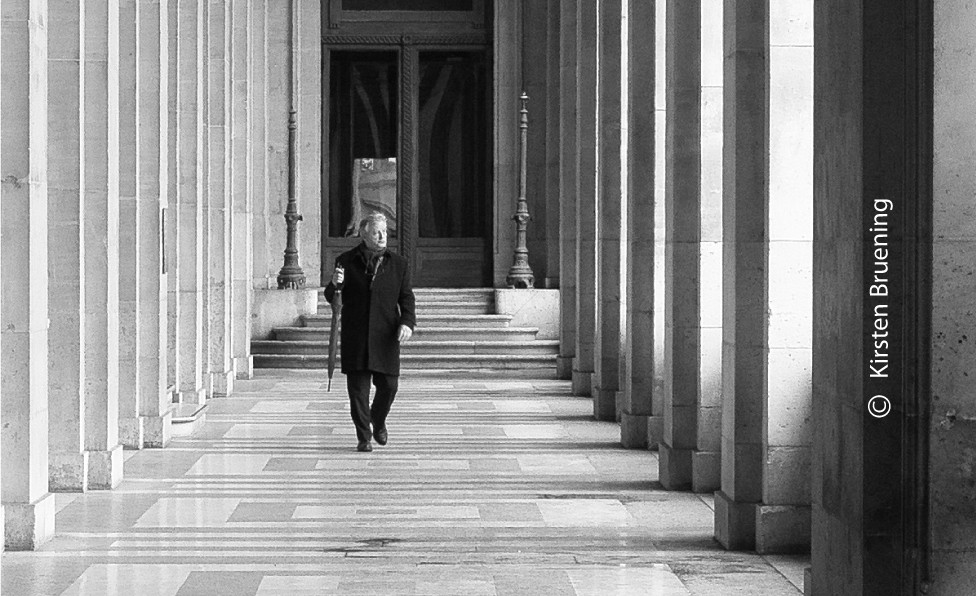
Captured amidst the atmospheric blend of rain and snow in Paris, this image transforms the historic architecture of the Louvre into a dramatic stage. The photographer masterfully utilized the reflection of car headlights against the museum's weathered walls to create deep, compelling shadows. The composition reached its zenith at a decisive moment when a man with an umbrella emerged from a side building, introducing a human element that anchors the scene. This photograph is award-worthy for its impeccable timing and the evocative interplay of light, texture, and urban solitude, turning a fleeting moment into a timeless narrative of city life.
Kirsten Bruening
Based near Cologne, Germany, Kirsten Bruening is a dedicated photographer whose creative journey began in childhood with a fascination for analogue techniques. After a fifteen-year hiatus, she returned to the craft with a renewed focus on black and white imagery, specializing in nature, portraiture, and wildlife. Her work is defined by a profound appreciation for the expressive power of light and shadow, and she is currently pursuing further academic studies to refine her technical expertise and artistic vision.
Resonance Score Breakdown
Transparency Note: The resonance score (8.8/20) is calculated based on social engagement metrics collected before the award announcement.
Expert Photography Reviews · 6
The Weight of Water
Rain does not fall; it arrives. It changes the frequency of the street, turning the hard edges of stone into something fluid and uncertain.
Read the reflection →The Weight of an Umbrella
Dear traveler, I have been thinking about the way we carry our own shelter. We walk through the world expecting the sky to stay clear, yet we are always prepared for the sudden shift, the cold dampness that turns a familiar street into a strange, shimmering maze.
Read the reflection →Reviews & Comments
Share your thoughts about this award-winning photograph. Your reviews contribute to the community engagement score.
Parisian rain has been a visual trope since Atget, yet Bruening avoids the trap of mere nostalgia. The way those headlights bleed across the Louvre’s masonry echoes the wet-plate luminosity of early street work, but with a modern, digital sharpness. I’m genuinely struck by how that umbrella silhouette cuts through the gloom; it’s a sharp, lonely punctuation mark. It’s rare to see such a tired subject handled with this much rhythmic, cinematic precision. It’s quite beautiful.
The frame opens on a wet, cinematic Paris. Headlights slash across the Louvre’s stone, painting shadows that feel like a noir set piece. Then, the man enters. It’s a perfect tracking shot frozen in time. I’ve watched this scene a dozen times today, and I still feel that sudden, sharp chill of the rain on my own neck. The shutter speed caught the rhythm of the city perfectly. It’s the frame the editor keeps.
Before the eye identifies the Louvre, a sudden chill settles in the chest. The wet pavement’s glare triggers a visceral, phantom shiver; I’ve felt that exact damp Parisian cold in my own marrow. When you return a year later, the man’s solitary umbrella feels less like a narrative anchor and more like a quiet defense against the encroaching shadows. It’s an activation of urban loneliness that lingers, following you into the dark long after you’ve looked away.
The man’s stride is caught mid-extension, but the umbrella’s arc is slightly behind his center of gravity. It’s a near miss. If he’d been two frames further, the tension between his gait and the rain’s trajectory would have snapped into focus. I’ve spent my life chasing that singular, weightless instant, and this just isn’t it. It’s close, but it lacks the kinetic punch I need. I wanted to feel the impact; I only see the walk.
The palette here evokes the bruised, slate-grey melancholy of a Morandi still life, where the wet pavement’s charcoal sheen bleeds into the ochre warmth of the Louvre’s stone. It’s the precise, shivering blue of a winter twilight that catches my breath, grounding the man’s silhouette in a solitude so profound it feels tactile. One finds the interplay of headlight amber and rain-slicked shadow isn’t merely atmospheric; it’s a symphony of chromatic longing that haunts the soul.
Rain doesn’t just fall here; it bruises the stone of the Louvre. Bruening understands that light isn’t an illumination, but a violent intrusion against the encroaching dark. When that umbrella emerges, it’s not a human element—it’s a punctuation mark in a sentence about isolation. I’ve stared at these headlights bleeding into the pavement, and honestly, it makes my chest ache. It’s a cold, honest reckoning with the fact that we are all just ghosts haunting our own architecture.