Running Wheel by Jabbar Jamil
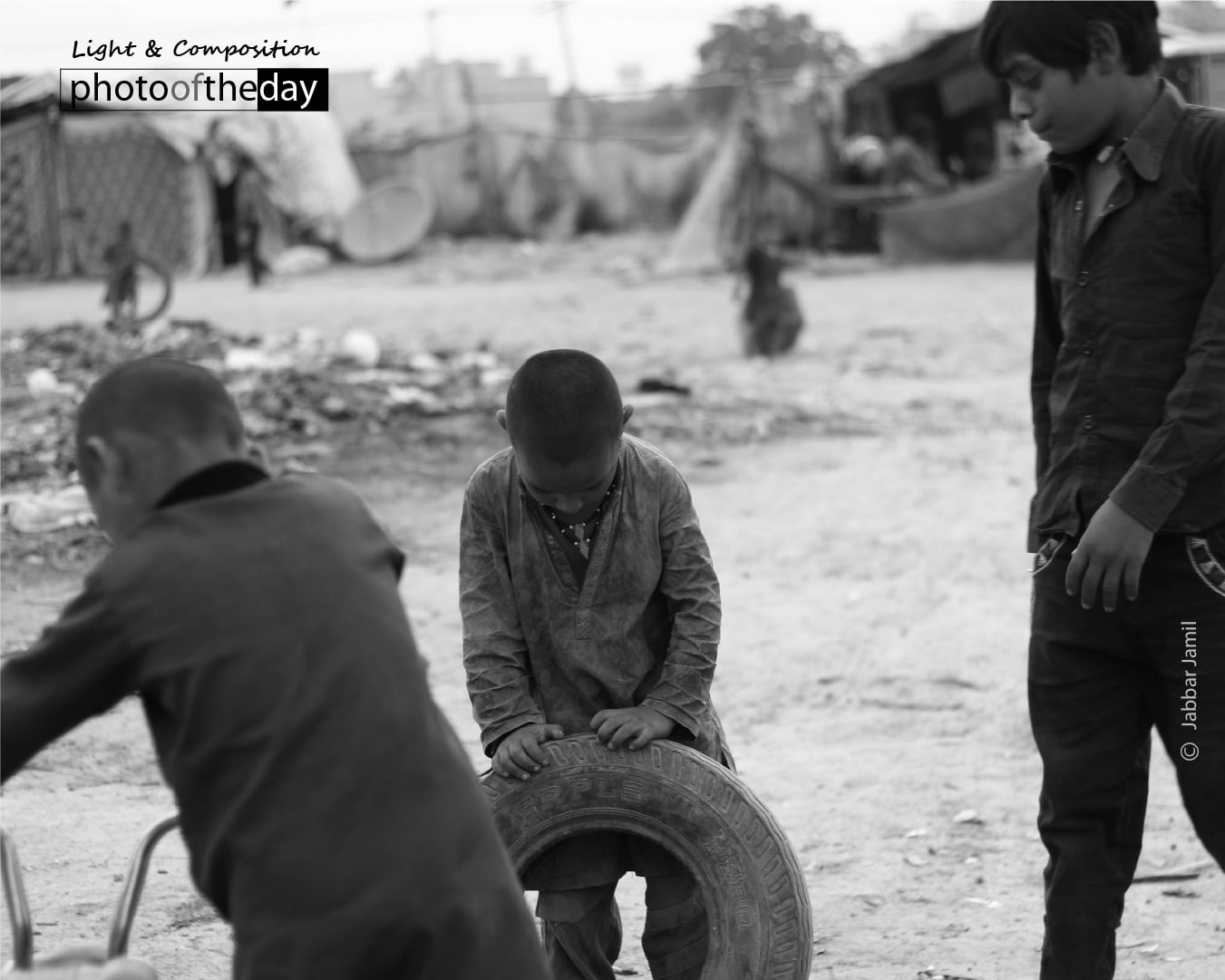
Captured on May 15, 2018, in the bustling slums of Sialkot, this photograph documents the timeless joy of children playing with a simple wooden wheel. The image freezes the moment a child runs alongside the rolling hoop, a ubiquitous game in the area that serves as a metaphor for resilience against life's hurdles. The photographer’s ability to find beauty and narrative depth within the challenging environment of the slums makes this piece award-worthy. It is a poignant observation of childhood innocence and play, elevated by the raw, authentic atmosphere of the setting.
Jabbar Jamil
Based in Sialkot, Pakistan, Jabbar Jamil is a dedicated street photographer who views his craft as a vital bridge to the world beyond his comfort zone. For Jamil, photography serves as both a creative outlet and a therapeutic escape, allowing him to document the unfiltered realities of his surroundings. His work focuses on the human experience, often finding profound stories in the everyday scenes that others might overlook, ultimately using his lens to foster connections within his community.
Resonance Score Breakdown
Transparency Note: The resonance score (11.7/20) is calculated based on social engagement metrics collected before the award announcement.
Expert Photography Reviews · 8
The Momentum of Play
A river stone, when caught in a turbulent eddy, will spin in a perfect, repeating circle, carving its own path into the bedrock over centuries.
Read the reflection →The Rhythm of Dust
The smell of dry earth after a long heatwave is a specific kind of hunger. It is the scent of iron and parched stone, rising up to meet your skin when the wind shifts.
Read the reflection →Reviews & Comments
Share your thoughts about this award-winning photograph. Your reviews contribute to the community engagement score.
It’s easy to snap a child running in the slums, but catching the precise geometry of that rolling wheel against the dust suggests Jamil didn’t just stumble upon the scene. He clearly spent hours in that heat, waiting for the light to catch the rim just so. I’ve spent enough days shivering in the Highlands to recognize the patience here. It’s a rare, earned moment. I’d have liked to stay there myself, just to watch.
Of the thousands of street shots I’ve reviewed, most rely on cheap sentiment. This succeeds because the motion blur of the wooden wheel isn’t just a technical choice; it’s the engine of the frame. It’s rare to see such kinetic energy captured without losing the child’s focus. I’ll admit, the grit of Sialkot actually made me ache for my own lost youth. It’s a keeper because it captures the universal, relentless momentum of growing up.
The slum’s narrow, unpaved datum creates a claustrophobic corridor, yet the child’s movement punctures that density. The fenestration of the surrounding brickwork is jagged, framing a void that feels heavy with history. I’m struck by how the light rakes across the uneven ground, emphasizing the grit beneath the wheel. It’s a brutal, honest space, but watching that boy navigate the threshold between ruin and play—it’s enough to make me catch my breath.
The light in Sialkot doesn’t just fall; it clings to the dust. Watching this child chase his wooden wheel, I’m struck by how the sun catches the grit of the alleyway. He’s running through a moment of pure, fleeting grace. I’ve spent enough hours waiting for the earth to speak to recognize that stillness in his movement. It’s a quiet, aching reminder that joy doesn’t need much to exist. My heart truly softened seeing it.
Sialkot’s dust doesn’t just settle; it consumes. Jamil’s wheel isn’t a toy, but a tether to a fleeting, kinetic existence. The shadows here aren’t mere absences; they are the heavy, encroaching silence of a life lived on the periphery. I’ve stared at that boy’s blurred stride until my own pulse quickened. It’s a brutal, honest geometry. He’s running against the dark, and for a terrifying second, I’m not sure he’s going to win.
Dust rises in Sialkot. The wheel rolls, a wooden circle against the grit. I’ve watched this child run, yet my eyes drift to the wall behind him. It’s textured, weathered, vast. The boy isn’t the only subject. The silence in the frame is heavy. It’s a weight I feel in my own chest. Nothing here is accidental. The empty corner is not empty. It holds the breath of the street. It’s enough.
The shutter speed is perfect. It’s a blur of kinetic energy, catching the wheel’s rotation just as the boy leans into the frame. I’ve spent years watching frames like this, and honestly, it makes me want to grab a camera and run alongside him. The composition holds the tension of the chase, a cinematic sequence condensed into a single, breathless beat. It’s the frame the editor keeps because the cut would have been a mistake.
You didn’t just capture a kid running with a wheel; you caught the exact second he forgot where he was. I’ve spent enough time in places like Sialkot to know that dust usually hides the struggle, but here, it’s just a backdrop for pure, unadulterated motion. And honestly? It made me miss being that young. You waited for the blur to align with his focus. That’s not luck. That’s you feeling the moment before it happened.