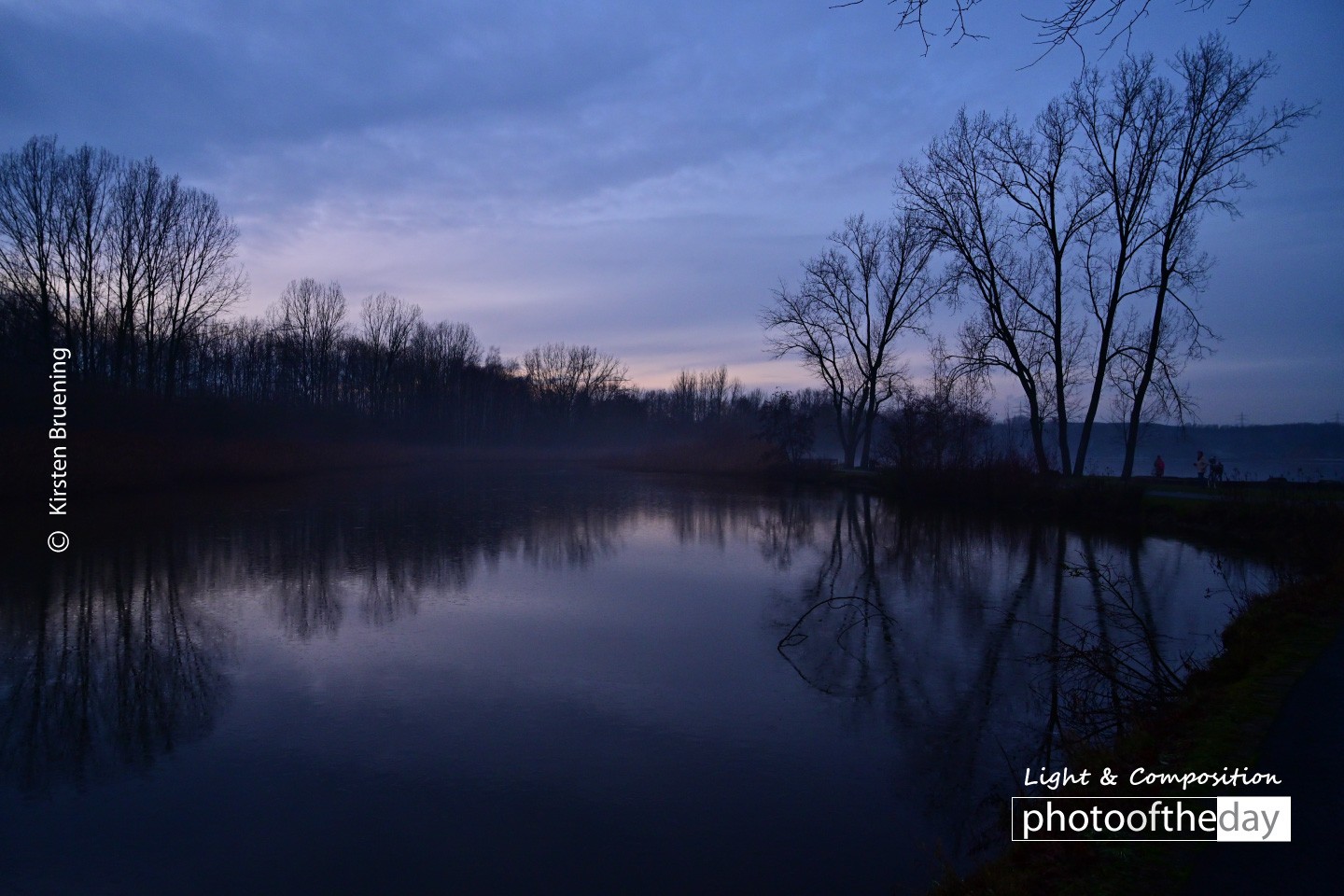
Blue Colors by Kirsten Bruening
Captured on a crisp November evening, this photograph masterfully documents the serene transition of light over a tranquil lake. The photographer utilized the cold, clear atmospheric conditions to emphasize the deep, monochromatic blue hues of the twilight sky. By framing the silhouetted trees in the foreground, the composition creates a striking contrast against the expansive horizon, while the mirror-like reflection on the water’s surface adds a sense of profound depth and symmetry. This image is award-worthy for its evocative use of natural light and its ability to transform a quiet, chilly landscape into a compelling study of color and stillness.
Kirsten Bruening
Based near Cologne, Germany, Kirsten Bruening is a dedicated photographer whose creative journey began in childhood with an exploration of analogue techniques. After a fifteen-year hiatus, she returned to the craft with a renewed focus on nature, portraiture, and wildlife, often favoring the timeless elegance of black and white imagery. Driven by a belief that light and shadow hold the key to emotional expression, she is currently pursuing formal studies to further refine her technical expertise and artistic vision.
Resonance Score Breakdown
Transparency Note: The resonance score (9.9/20) is calculated based on social engagement metrics collected before the award announcement.
Expert Photography Reviews · 5
The Architecture of Silence
In the deepest part of the evening, just before the world surrenders entirely to the dark, there is a brief, suspended interval.
Read the reflection →The Weight of Twilight
There is a specific kind of gratitude that arrives only when the day begins to surrender its edges. As the light thins and the world turns toward the cool, quiet blue of evening, the frantic pace of our thoughts often slows to match the cooling air.
Read the reflection →Reviews & Comments
Share your thoughts about this award-winning photograph. Your reviews contribute to the community engagement score.
Most landscape entries I’ve reviewed this year rely on garish saturation to force emotion. Kirsten’s work succeeds because it doesn’t try so hard. The way the silhouetted trees bite into that icy blue gradient creates a genuine stillness that’s rare in modern digital files. I felt a sudden, sharp chill looking at this, which is exactly why it’ll still matter in thirty years. It’s a quiet, honest study of light that doesn’t need to shout to be heard.
The lake doesn’t demand attention. It waits. The blue isn’t a color; it’s a breath held in the cold air. I’ve stood by water like this, feeling the world shrink to a single, quiet point. The trees are mere ink marks against the void. Nothing here is accidental. The empty corner is not empty. It’s the weight of the silence that hits me. It’s enough. I don’t need to see anything else.
It’s a quiet, chilly frame, but I can’t help but feel a bit cold looking at it. While the symmetry of those silhouetted trees is technically sound, it’s a landscape devoid of the pulse I look for. Where is the heron or the kingfisher that should be haunting these reeds? It’s a pretty scene, sure, but it’s just a backdrop. I’d trade all that blue for one sign of actual, breathing life.
The horizontal axis bisects the frame with surgical precision, creating a perfect 1:1 reflection ratio. Those silhouetted trees act as vertical vectors, breaking the horizon’s monotony and anchoring the composition’s center of gravity. It’s a beautifully solved spatial equation. I’m genuinely struck by how the negative space in the upper quadrant balances the density of the shoreline. It’s rare to see such rigorous geometry yield this much stillness. It’s a triumph of pure, calculated equilibrium.
Blue light swallows the Koln shoreline, but what does this silence actually hide? Bruening frames these trees as mere silhouettes, stripping them of their specific, living history. It’s a pretty aesthetic, sure, but I find the lack of human presence here unsettling. Why do we insist on sanitizing nature into a monochromatic void? When we erase the messy reality of the landscape, are we documenting the world or just our own desire for control?