Big Apple by Yohann Libot
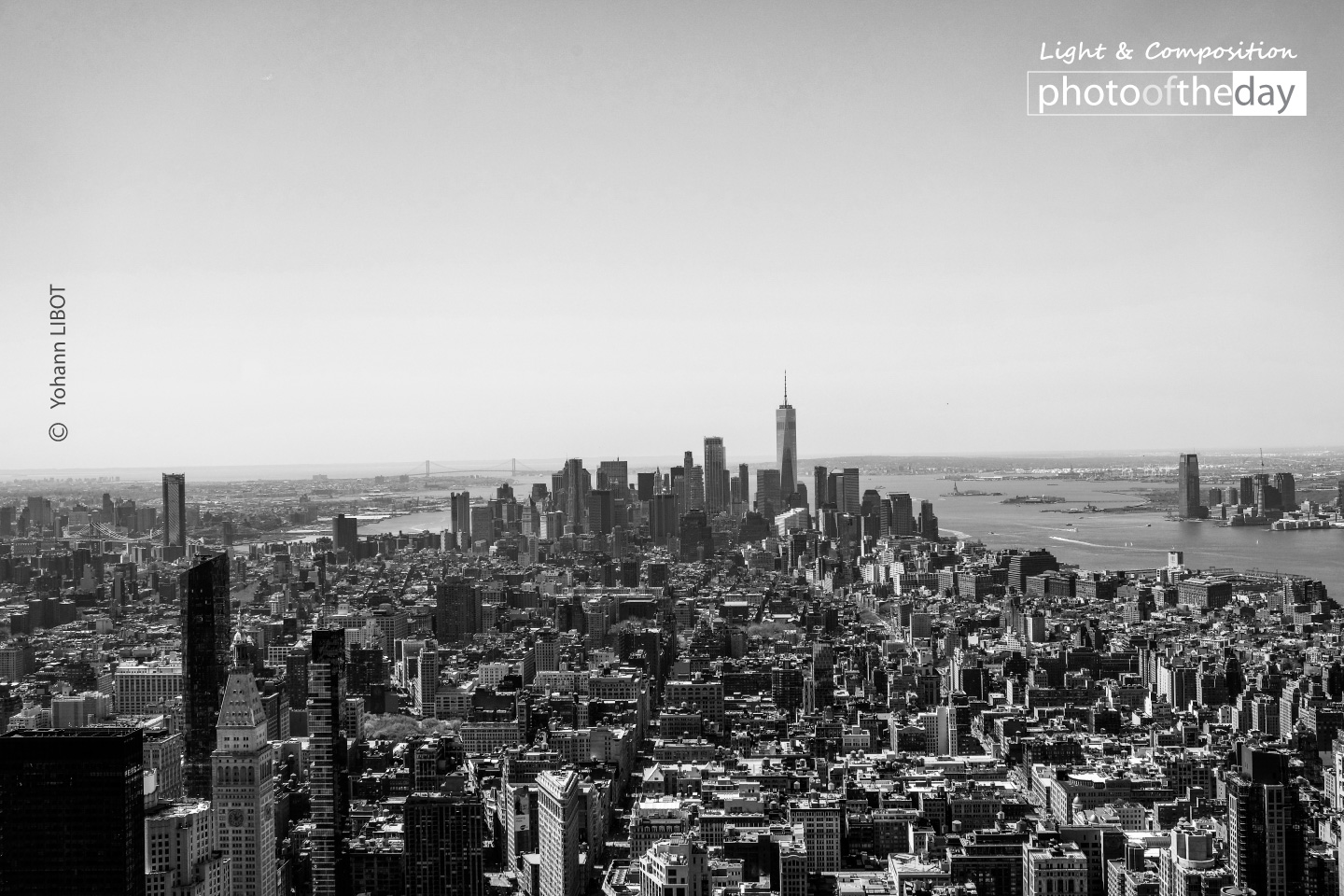
Captured from the iconic vantage point of the Empire State Building, this photograph offers a sweeping perspective of New York City’s architectural landscape. The photographer sought to translate a classic tourist experience into a compelling study of urban geometry, focusing on the rhythmic lines and towering structures that define the metropolis. By embracing the city's scale, the image transforms a familiar view into a deliberate exploration of urban form. Its award-worthy quality lies in the clean composition and the photographer's ability to find artistic order within the dense, bustling complexity of the Big Apple.
Yohann Libot
Born in France, Yohann Libot is an internationally published, self-taught photographer known for his nomadic approach to capturing global cultures and icons. After transitioning from a career in fashion marketing in 2010, he established himself as a professional, often referred to as the “Gypsy Photographer” for his free-spirited and distinctively dream-like visual style. His work has appeared in a wide array of commercial and editorial outlets, ranging from travel guidebooks to international advertising campaigns, reflecting his deep passion for documenting the unique lifestyle and spirit of the countries he visits.
Resonance Score Breakdown
Transparency Note: The resonance score (10.2/20) is calculated based on social engagement metrics collected before the award announcement.
Expert Photography Reviews · 5
The Weight of Stone
I keep a small, smooth pebble in my desk drawer, pulled from the foundation of a house that no longer stands. It is heavy for its size, a dense anchor of limestone that once held up a family’s quiet evenings and their loud, sudden griefs.
Read the reflection →The Geometry of Being
We often speak of cities as if they were living, breathing organisms, yet they are fundamentally exercises in geometry.
Read the reflection →Reviews & Comments
Share your thoughts about this award-winning photograph. Your reviews contribute to the community engagement score.
You’ve captured the geometry perfectly, but I’m looking for the pulse of the city. It’s all steel and shadow, very clean, yet I feel a strange coldness looking down from that height. Where are the people? I’ve spent enough time on those streets to know they aren’t just lines in a grid. You’ve got the technical skill, but next time, find the heartbeat. I want to feel the grit, not just the architecture.
The vertical axis dominates here, forcing a rigid hierarchy upon the grid. Libot’s frame relies on a 3:1 ratio of dense, shadowed architecture to the receding horizon, creating a compelling tension between mass and void. I’m genuinely struck by how the diagonal shadows slice through the rectangular blocks, effectively neutralizing the chaos of the streets below. It’s a perfectly solved spatial equation; he’s turned the city’s frantic sprawl into a precise, rhythmic exercise in structural equilibrium.
Looking down from the Empire State Building, I feel a strange, cold detachment. It’s a sterile geometry, devoid of the messy, breathing pulse I crave. Where is the life? In my world, you earn a frame by disappearing into the brush, not by paying for an elevator ride to a tourist deck. This is an extraction of order from a concrete grid. It’s technically sharp, sure, but it’s entirely hollow. It doesn’t move me at all.
At this altitude, the diffraction limit is your only enemy. Libot’s choice of aperture keeps the focal plane razor-sharp across the grid, avoiding the soft haze that usually plagues such vast depth. I’m genuinely moved by how the micro-contrast renders those distant steel canyons; it’s as if the lens is peeling back the city’s skin. It doesn’t just capture geometry; it resolves the very physics of urban density. It’s a cold, precise, and beautiful triumph.
It’s a static grid of steel and glass, lacking the kinetic pulse I look for. I’ve spent my life chasing the exact millisecond where tension peaks, but this view from the Empire State Building is just a long exhale. There’s no muscle, no exertion, no weightless instant to catch. It’s technically clean, sure, but it feels cold. I’m left searching for a heartbeat in the concrete that simply isn’t there. It’s too still for me.