No Camera Shy by Jabbar Jamil
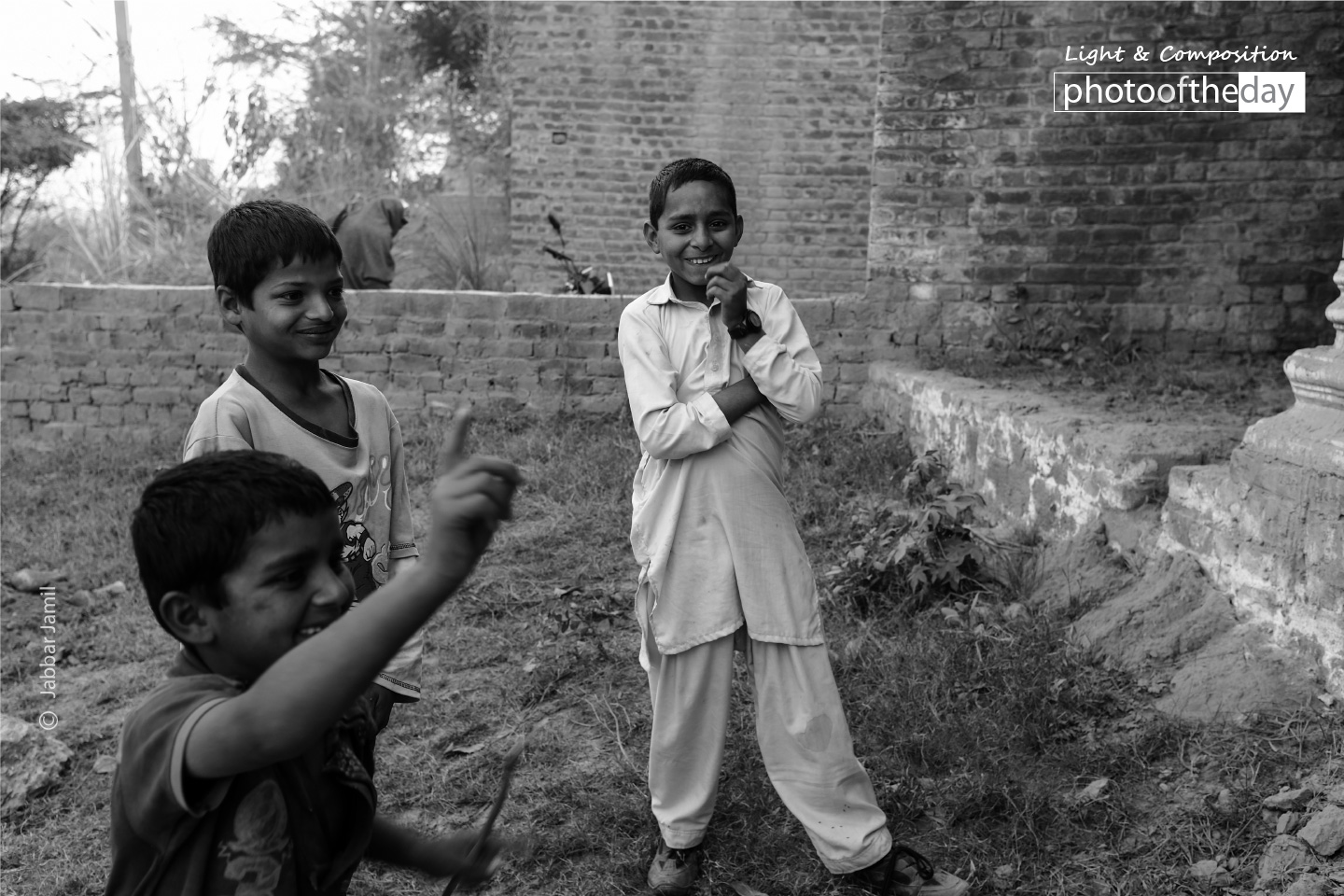
While caught in traffic during road construction in Sialkot, the photographer seized an unexpected opportunity when local children began dancing upon noticing his camera. Despite the challenge of a low shutter speed, which made capturing the fast-paced movement difficult, he managed to secure this candid moment. The resulting image stands out for its raw, spontaneous energy, capturing a genuine interaction between the photographer and his subjects. It is this ability to find beauty and connection in the mundane, unplanned moments of street life that makes this photograph a compelling award-winning piece.
Jabbar Jamil
Based in Sialkot, Pakistan, Jabbar Jamil is a dedicated street photographer who views his craft as a vital bridge to the world beyond his comfort zone. For Jamil, photography serves as both a creative outlet and a therapeutic escape, allowing him to document the unfiltered realities of life, whether beautiful or stark. Through his lens, he prioritizes the human connections formed during his sessions, often finding that the relationships built with his subjects are just as significant as the images themselves.
Resonance Score Breakdown
Transparency Note: The resonance score (11.8/20) is calculated based on social engagement metrics collected before the award announcement.
Expert Photography Reviews · 6
The Unscripted Joy
Epictetus reminded his students that we are all actors in a play written by another. We do not choose our roles, nor do we choose the stage upon which we stand; we are merely tasked with playing our part well, whatever the circumstances.
Read the reflection →The Sidewalk Stage
We often mistake the city for its infrastructure—the concrete, the asphalt, and the rigid zoning lines that dictate where we belong.
Read the reflection →Reviews & Comments
Share your thoughts about this award-winning photograph. Your reviews contribute to the community engagement score.
f/2.8 at 1/60s, 35mm. A gamble that barely paid off. The motion blur on the children’s limbs is a technical failure, yet it’s the only thing keeping this frame from feeling static. I’m annoyed by the lack of sharpness, but I can’t deny the energy. He didn’t freeze the action; he surrendered to it. It’s sloppy engineering, but it’s a functional argument for chaos. Sometimes, the math doesn’t need to be perfect to work.
Dust rises in Sialkot. The children move, a blur against the grit of the road. It’s chaotic, yet I’m drawn to the edges. The frame isn’t crowded. It’s held together by the stillness of the background. I feel a sudden, sharp ache for that quiet street. Nothing here is accidental. The empty corner is not empty. It’s a breath. A pause in the noise. Jabbar didn’t just capture a dance; he captured the silence between steps.
These kids aren’t just dancing for a lens; they’re performing for a witness. You can see the joy in their hands and the wild, unscripted energy in their eyes. It’s a gift when a stranger lets you into their orbit like this. I’ve spent years on the street, and I know that look—it’s pure, unguarded connection. This face has a whole life in it. It’s a beautiful, messy, honest moment of human contact.
The frame’s geometry is chaotic, yet the central figure’s verticality anchors the frame against the blur of Sialkot’s background. It’s a precarious balance. The motion blur doesn’t distract; it reinforces the spatial tension between the static architecture and the kinetic subjects. I’m genuinely unsettled by how the negative space collapses under the weight of the movement. It’s a rare instance where the lack of technical sharpness doesn’t compromise the structural integrity of the picture plane.
You didn’t just capture a scene; you caught a pulse. That low shutter speed blur isn’t a technical failure, it’s the rhythm of those kids dancing in the dust. I’ve spent years in traffic like that, and usually, I’m just looking for an exit. You looked for a connection instead. It’s messy, it’s real, and it makes me miss the chaos of the street. You waited, you saw them, and you felt it. That’s everything.
Sialkot’s urban fabric usually demands a rigid, structural reading, but here, the children’s kinetic energy disrupts the static datum of the street. The blurred motion against the harsh, high-contrast fenestration creates a visceral tension between solid and void. It’s a messy, honest slice of life that ignores architectural order. I’m genuinely moved by how the chaos of the road becomes a stage, proving that a space’s true character isn’t found in blueprints, but in its inhabitants.