Crystal Mill by Steve Hirsch
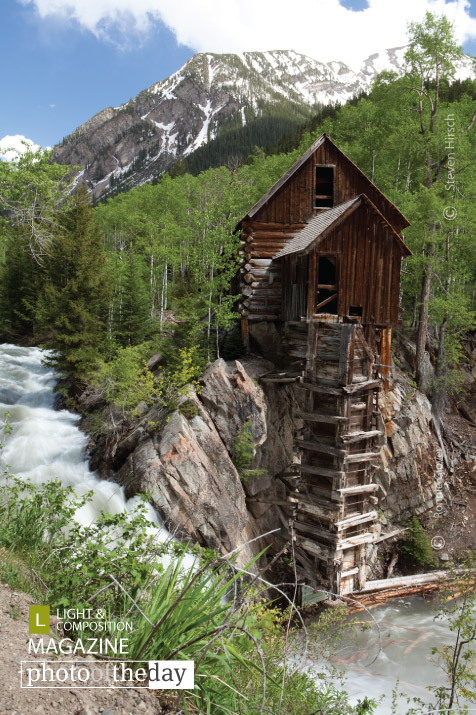
The Crystal Mill, a historic wooden powerhouse built in 1893 to support local silver mining, stands as a testament to Colorado's rugged past. Captured during a journey to this remote ghost town, the photograph highlights the mill's weathered architecture against the dramatic backdrop of the wilderness. By utilizing a tripod and a variable neutral density filter, the photographer achieved a long exposure that emphasizes the serene, timeless quality of the site. This image is award-worthy for its masterful composition and the evocative way it preserves the haunting beauty of a structure now listed on the US National Register of Historic Places.
Steve Hirsch
Based in Columbus, Ohio, Steve Hirsch is a dedicated photographer who rediscovered his lifelong passion for the craft after a successful career as an otolaryngologist. His work is defined by a deep commitment to travel, landscape, and wildlife photography, often taking him to diverse global locations to capture nature in varying seasons and light. Through his patient approach to planning and execution, Hirsch creates evocative imagery that serves as a personal artistic expression, with his photographs featured in private collections and professional spaces across the United States.
Resonance Score Breakdown
Transparency Note: The resonance score (13.2/20) is calculated based on social engagement metrics collected before the award announcement.
Expert Photography Reviews · 7
The Architecture of Silence
In the high country, time does not move in a straight line. It pools like water in the hollows of stone, gathering the debris of centuries until the past and the present become indistinguishable.
Read the reflection →The Architecture of Silence
We often mistake stillness for an absence, as if the world stops breathing when the noise of our own lives fades. But silence is not empty; it is a heavy, velvet fabric that drapes over the shoulders of the earth.
Read the reflection →Reviews & Comments
Share your thoughts about this award-winning photograph. Your reviews contribute to the community engagement score.

The Crystal Mill is a well-worn path, yet Hirsch has managed to avoid the usual tourist snap. I’ve spent enough mornings shivering in the Rockies to know that water doesn’t blur itself; he clearly hauled the tripod and waited for the light to settle. It’s a respectable effort. One wonders if he returned a second time to get it right. I’d have liked a bit more grit, but it’s a decent day’s work.
Of the thousands of landscape submissions I’ve reviewed, most rely on tired saturation. Hirsch avoids that trap. By dragging the shutter to a fifth of a second, he turns the Crystal River into a soft, milky anchor for the mill’s jagged timber. It’s a quiet, deliberate choice. I’ll admit, the f/22 diffraction bothers me, but the composition’s balance keeps it relevant. In thirty years, this won’t just be a postcard; it’ll be a haunting, frozen memory.
The water here doesn’t rush; it breathes. Steve waited for the light to soften against the timber, letting the long exposure turn the river into a ghost of itself. I’ve stood in places like this, where the silence feels heavy, almost sacred. It’s a quiet ache, really—watching the mill hold its ground against the encroaching forest. He didn’t just capture a structure; he listened to the mountain’s slow, steady pulse. It’s hauntingly still.
Shooting at f/22 pushes the Canon 5DII past its diffraction limit, softening the micro-contrast of the timber’s grain. It’s a risky trade-off for that silky water motion. While the optics struggle to resolve the finest wood fibers, the resulting atmospheric diffusion feels almost ethereal. I’m genuinely moved by how the light clings to the mill’s weathered edges. It’s not perfectly sharp, but the way the photons scatter across that historic structure is, physically speaking, quite beautiful.
The river blurs. It’s a soft, white ribbon beneath the timber. I’ve spent minutes watching the water dissolve against the rock. The mill doesn’t dominate; it anchors the silence. It’s a quiet weight in the center of the frame. Nothing here is accidental. The empty corner is not empty. It’s the breath between the stones. I feel a sudden, sharp ache for the stillness of that mountain air. It’s rare to find such peace.
The mill’s placement at the frame’s lower third creates a precarious spatial tension against the verticality of the canyon walls. It’s a rigid geometry. The long exposure softens the water, yet the timber structure remains anchored by its own sharp, unforgiving lines. I’ve grown weary of such romanticized ruins, but the sheer discipline of this framing forces an uneasy respect. The composition doesn’t just hold; it demands a total surrender to its architectural weight.
The ochre of the mill’s timber, weathered like a Morandi still life, bleeds into the glacial turquoise of the river, creating a chromatic tension that’s utterly intoxicating. It’s the way the light clings to the mossy rocks, a muted, bruised emerald, that makes one’s heart ache for the silence of that valley. I’ve rarely seen such a delicate, shivering harmony between the decaying wood and the cold, rushing water; it’s simply divine.
Crystal River Jeep Tours will get you there. 970-963-1991 for reservations.