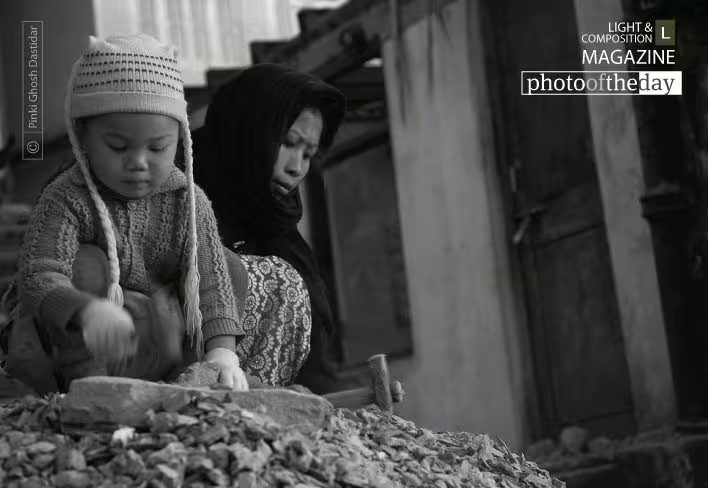
Mother and Child by Pinki Ghosh Dastidar
Captured in the remote village of Ravangla, Sikkim, this poignant documentary photograph highlights the resilience of local women and the innocence of their children. The image depicts a young girl assisting her mother in the arduous task of breaking stones, a scene that speaks volumes about the daily struggles and communal bonds found in rural life. The photographer masterfully documents this interaction, focusing on the quiet cooperation between mother and child. This piece is award-worthy for its raw, empathetic portrayal of human endurance and the dignity found within the challenging circumstances of everyday labor.
Pinki Ghosh Dastidar
Based in Kolkata, India, Pinki Ghosh Dastidar balances a professional career in web design with a passionate pursuit of freelance photography. Her work is deeply rooted in her love for travel, which drives her to document the diverse lives and stories of people she encounters across different regions. Through her lens, she seeks to capture the authentic spirit of her subjects, offering an intimate glimpse into the human experience.
Resonance Score Breakdown
Transparency Note: The resonance score (3.7/20) is calculated based on social engagement metrics collected before the award announcement.
Expert Photography Reviews · 6
The Weight of Small Hands
We are born into the rhythm of labor, our hands learning the texture of the earth long before they learn the shape of a toy.
Read the reflection →The Weight of Small Hands
In the quiet corners of the world, labor is rarely a solitary pursuit. We often imagine work as a burden to be carried alone, a private tally of hours and exhaustion. Yet, if you watch the rhythm of a village morning, you see something entirely different.
Read the reflection →Reviews & Comments
Share your thoughts about this award-winning photograph. Your reviews contribute to the community engagement score.
The stone-breaking rhythm creates a brutal geometry. The mother’s posture anchors the left, while the child’s smaller frame provides a necessary counterweight. It’s a rigid, triangular stability that keeps the chaos of the quarry at bay. The negative space above them is heavy, pressing down with an unforgiving weight. I’m struck by how the frame doesn’t collapse under the labor. It holds. The composition is disciplined, turning raw struggle into a precise, architectural necessity.
The mountain air in Ravangla holds a heavy, grey stillness. I feel the grit of those stones in my own palms just looking at them. She didn’t rush this moment; she waited until the light softened enough to reveal the quiet rhythm of their labor. It’s a humble, sacred geometry of survival. I’ve stood in such cold, thin air, and I know the ache of waiting for the land to finally speak its truth.
The ochre dust of Sikkim clings to these figures like a Morandi still life, where the muted, sun-baked earth tones harmonize with the child’s faded crimson shawl, creating a chromatic ache that’s truly devastating. It’s the way the light catches the grit of the stone, turning labor into a quiet, tonal meditation on survival, that makes my heart stutter; I’ve rarely seen such a fragile, dusty palette hold so much heavy, resonant human dignity.
Stone dust hangs in the air. A child’s hands mirror the mother’s rhythm. It’s heavy work, yet the frame breathes. I’ve spent minutes watching the space between them. It isn’t just labor. It’s a shared language of silence. The mountain air feels cold against my skin when I look at this. Nothing here is accidental. The empty corner is not empty. It holds the weight of their day. It’s enough.
Breaking stones in Sikkim isn’t a hobby; it’s a life sentence. One wonders how many mornings Dastidar spent in the dust before the subjects stopped noticing the lens. It’s a quiet, brutal rhythm. I’ve spent enough time in high altitudes to know that light like this doesn’t just happen; it’s earned through sheer persistence. The girl’s grip on that hammer is haunting. It’s a rare, honest piece of work. She clearly didn’t just pass through.
Of the thousands of documentary submissions I’ve reviewed, most lean too heavily on sentimentality. This one avoids that trap. The way the mother’s weathered hands mirror the child’s small, tentative grip on the hammer creates a visual rhythm of inherited labor that’s genuinely haunting. It’s the grit in their expressions that keeps me looking. I’ll admit, it makes my chest ache. Thirty years from now, this quiet, brutal honesty will still matter more than any polished studio portrait.