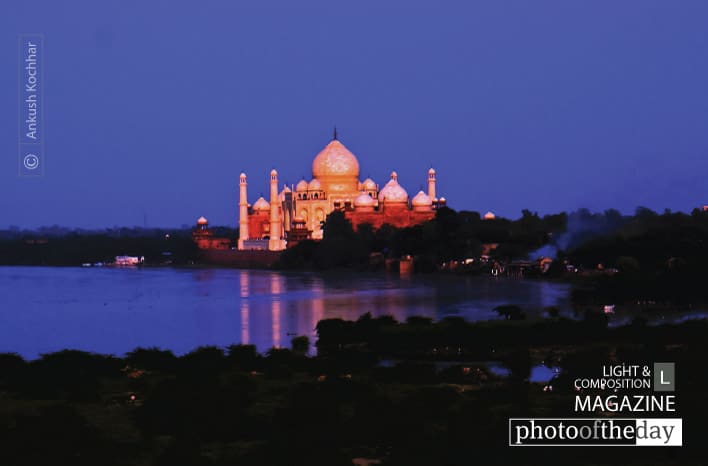
Taj Mahal Night by Ankush Kochhar
Captured under the ethereal glow of the night, this photograph presents the Taj Mahal as a breathtaking monument of love against a deepening, dark blue sky. The photographer sought to explore the architectural grandeur of the structure through a wide-angle perspective, testing how the atmospheric evening light would enhance its iconic silhouette. This image is award-worthy for its successful marriage of technical precision and artistic vision, transforming a world-renowned landmark into a serene, moody masterpiece that captures the quiet majesty of the monument after dark.
Ankush Kochhar
Born in 1987 and based in Delhi, India, Ankush Kochhar is a dedicated photographer whose passion for the craft began during his graduation in 2008. Transitioning from a hobbyist to a professional, he is known for his minimalist approach, preferring to capture the world through simple, perspective-driven compositions. Kochhar is a lifelong learner who travels extensively to document the beauty of nature and architecture, consistently refining his technical skills to translate his unique vision into compelling visual narratives.
Resonance Score Breakdown
Transparency Note: The resonance score (6.8/20) is calculated based on social engagement metrics collected before the award announcement.
Expert Photography Reviews · 4
The Architecture of Silence
We often mistake memory for a heavy thing, a stone we carry in our pockets. But perhaps it is more like the air that gathers around a monument after the crowds have departed—a cooling of the day’s fever, a settling of dust into the earth.
Read the reflection →Stone That Remembers
There is a weight to things built for eternity. We stack stone upon stone, hoping to anchor ourselves against the slow erosion of time. We believe that if we make the structure heavy enough, if we carve the marble deep enough, we might finally stop the slipping away.
Read the reflection →Reviews & Comments
Share your thoughts about this award-winning photograph. Your reviews contribute to the community engagement score.
The marble doesn’t glow; it mourns. Kochhar’s Taj Mahal isn’t a monument to love, but a tombstone carved from the night’s own ink. I’ve stared at these arches until my eyes ached, searching for the boundary where stone dissolves into the void. It’s unsettling. Most photographers fear this depth, yet here, the darkness finally forces the architecture to confess its silence. It’s a cold, heavy truth. I find myself shivering, not from the air, but from the stillness.
The marble doesn’t merely reflect light; it exhales the bruised, melancholic violet of a Turner twilight, dissolving the Taj into a spectral, pearlescent ghost against the ink-wash sky. It’s a haunting, velvet silence that I’ve found myself craving, where the shadows aren’t absences but deep, Morandi-esque reservoirs of indigo. One feels the temperature drop as the stone bleeds into the night, a chromatic surrender that’s utterly, devastatingly beautiful to witness in this quiet, cooling air.
The Taj is a tourist’s cliché, yet here it’s stripped of the usual mid-day chaos. One wonders how many nights Ankush spent dodging security or waiting for the haze to settle. It’s a quiet, cold frame. I’ve spent enough shivering hours in the dark to recognize the discipline required to keep the tripod steady while the world sleeps. It’s not a lucky snap; it’s a photograph that’s been properly earned. I find myself quite envious of the silence.
The marble doesn’t scream. It breathes. I’ve stood before this monument, but here, the night swallows the noise. The sky isn’t just dark; it’s a weight. A heavy, velvet silence. Kochhar lets the shadows do the work. He understands that the void around the dome is where the soul resides. It’s quiet enough to hear my own pulse. Nothing here is accidental. The empty corner is not empty. It is the pause.