Raindrops Keep Falling by Venkataramesh Kommoju
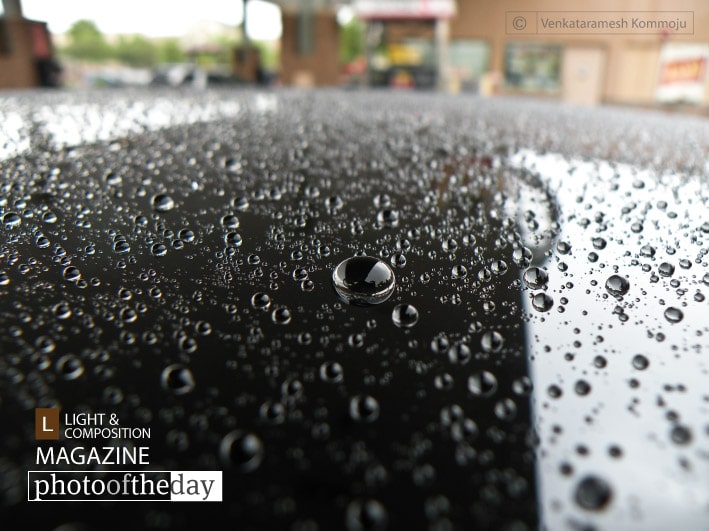
Captured during a brief stop for fuel, this image transforms a mundane moment into a study of light and geometry. The photographer observed water droplets resting on the surface of a Mercedes-Benz, seizing a fleeting opportunity to document the intricate reflections trapped within the beads of moisture. By focusing intently on the interplay between the liquid spheres and the vehicle's metallic finish, the image elevates a simple roadside observation into a compelling macro study. It is this keen ability to find profound beauty in transient, everyday details that distinguishes the work and earns it recognition as an award-winning photograph.
Venkataramesh Kommoju
Based in Hyderabad, India, Venkataramesh Kommoju balances a professional career as a software engineer with a dedicated passion for the visual arts. While he approaches photography primarily as a personal pursuit, his creative focus is increasingly drawn toward the intricate worlds of wildlife and macro photography. An avid traveler, he frequently utilizes his journeys to refine his technical eye and capture the subtle, often overlooked details of the natural and mechanical environments he encounters.
Resonance Score Breakdown
Transparency Note: The resonance score (13.3/20) is calculated based on social engagement metrics collected before the award announcement.
Expert Photography Reviews · 6
The Weight of Water
We spend our lives waiting for the sky to break. When the rain finally comes, it does not ask for permission. It simply arrives, turning the world into a series of small, trembling mirrors.
Read the reflection →The Geometry of Passing Time
In the seventeenth century, a Dutch merchant might have looked at a drop of water and seen only the threat of rot to his cargo. He would have wiped it away with a rough cloth, impatient for the sun to dry the wood.
Read the reflection →Reviews & Comments
Share your thoughts about this award-winning photograph. Your reviews contribute to the community engagement score.

The frame relies on the spherical distortion of the droplets to anchor the metallic expanse. It’s a rigid grid of liquid optics. The tension between the sharp, reflected geometry and the blurred automotive surface creates a necessary spatial friction. I’m genuinely unsettled by how the droplets refuse to settle into a predictable pattern. It doesn’t rely on sentiment. The composition demands total attention to the fulcrum of each bead. It holds, barely.
A fuel stop isn’t a pilgrimage, yet here we are. It’s a clever bit of geometry, I’ll grant you that. But one wonders if the photographer ever returned to the desert when the light wasn’t so convenient. I’ve spent weeks shivering in the canyons waiting for a single frame, so this feels a bit like a lucky snack. It’s sharp, certainly, but it didn’t cost him a night’s sleep. I’m left feeling rather thirsty.
The silver-grey of the Mercedes’ chassis acts as a cool, metallic canvas for those suspended liquid spheres, which hold the fractured, ochre-tinted light of an Arizona afternoon like tiny, inverted Turners. It’s a chromatic alchemy that leaves me breathless; the way the amber warmth bleeds into the steel’s cold, industrial neutrality creates a tension so exquisite, one feels as if the very atmosphere is weeping, caught between the desert’s heat and the rain’s sudden, fleeting mercy.
Most macro shots of water droplets are just technical exercises, but this one sticks. By framing the Mercedes-Benz’s metallic curve, Kommoju forces us to look at the world’s geometry rather than just the rain. I’ve seen thousands of these, yet I still find myself leaning in to trace the distorted reflections. It’s a quiet, fleeting moment that feels permanent. In thirty years, this won’t just be a snapshot; it’ll be a perfect, shimmering memory of a roadside stop.
It’s easy to overlook the mundane, yet here, the desert sky finds a home in the curve of cold metal. He stood there while the world rushed past, listening to the quiet rhythm of rain against the chassis. I’ve felt that stillness, that sudden urge to bow before a tiny, liquid lens. It’s a humble prayer of geometry. I find myself holding my breath, watching the light trapped in those fragile, fleeting spheres of water.
These droplets aren’t merely water; they’re fractured lenses distorting a world that’s already lost its grip. Kommoju traps the Arizona light, forcing it to confront its own curvature against the cold, indifferent steel of a Mercedes. It’s a claustrophobic geometry. I’ve stared at these spheres until my eyes ached, feeling the weight of the desert heat trapped inside. It doesn’t invite us in; it keeps us at a distance, shivering in the dark, unyielding reflection.
Awesome