A Gang of Friends by Ryszard Wierzbicki
Captured within the vibrant, challenging environment of a Mumbai slum, this photograph documents a poignant moment of youthful camaraderie. Ryszard Wierzbicki observed how the shared experiences of youth foster deep bonds, even amidst the hardships of impoverished surroundings. By focusing on this specific 'gang of friends,' the photographer highlights the resilience and unity that transcend socioeconomic barriers. The image is award-worthy for its raw, empathetic storytelling, which elevates a candid street encounter into a powerful visual testament to the universal human need for connection and belonging, framed with a keen eye for genuine emotion.
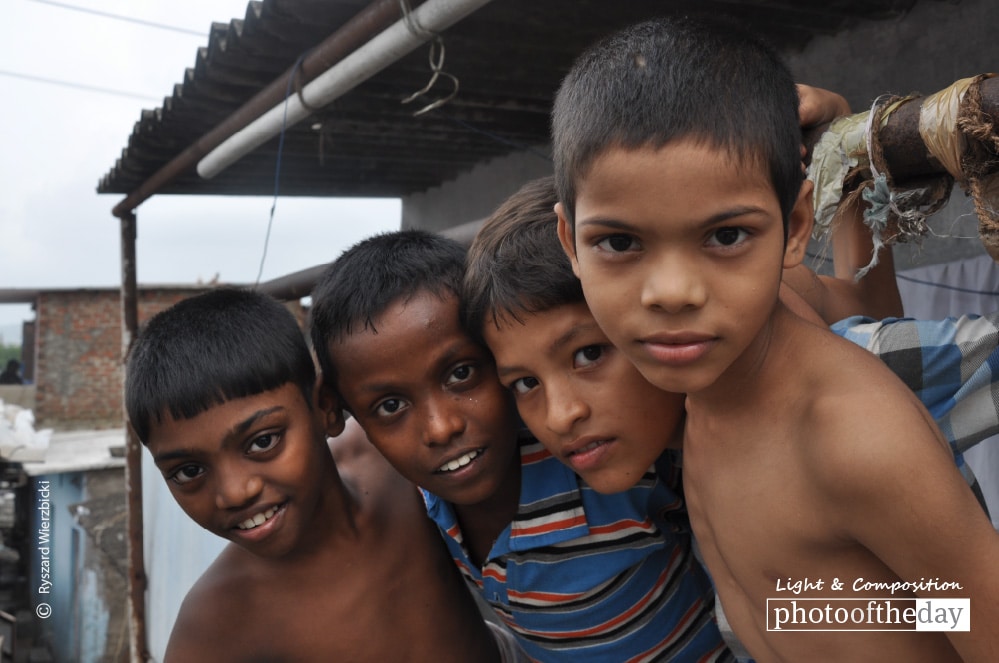
Exposure 1/60sec @ f/5.6 | ISO 800 | Focal Length 135mm
Ryszard Wierzbicki
Born in 1963 and originally from Poland, Ryszard Wierzbicki is a dedicated traveler and photographer currently based in Swindon, United Kingdom. After a diverse career in social sciences and marketing, he transitioned into a life of exploration, focusing his lens on the cultures and landscapes of South-East Asia. His work is deeply influenced by his commitment to humanitarian efforts, including his volunteer work with orphans, and his passion for documenting the human experience through his travel photography platforms, Instant Travelling and World Around.
Resonance Score Breakdown
Transparency Note: The resonance score (12.4/20) is calculated based on social engagement metrics collected before the award announcement.
Expert Photography Reviews · 7
The Architecture of Belonging
We often mistake the city for its infrastructure—the concrete, the steel, the zoning lines that dictate where one life ends and another begins.
Read the reflection →The Salt of Shared Breath
The air in a crowded room always tastes of iron and damp wool, a thick, humid blanket that clings to the back of the throat.
Read the reflection →Reviews & Comments
Share your thoughts about this award-winning photograph. Your reviews contribute to the community engagement score.
One suspects Wierzbicki didn’t just stumble upon these lads. Street work is often a frantic affair, yet here, the camera feels invisible. It’s a rare, quiet intimacy that only arrives when you’ve sat in the dust long enough to become part of the furniture. I’ve spent enough afternoons waiting for a scene to settle to know this wasn’t a drive-by. It’s earned. I find myself genuinely envious of the trust he clearly secured.
The light here doesn’t announce itself; it settles into the dust of Mumbai, softening the edges of their shared world. Ryszard must have held his breath, waiting for that precise alignment of gaze and shadow. I’ve spent enough hours in the field to recognize the stillness required to capture such intimacy. It’s a quiet, heavy grace. Looking at them, I feel a sudden, sharp ache for the simplicity of belonging that I’ve often chased in the hills.
The frame holds a heavy, humid stillness. Mumbai’s concrete walls press in, yet the boys occupy the center with a quiet gravity. I’ve spent minutes watching their hands. They don’t reach for the edges. They exist in the pause between the chaos of the slum and the lens. It’s a rare restraint. Nothing here is accidental. The empty corner is not empty. It’s the silence I’ve been looking for. I feel a sudden, sharp ache.
We look at these boys in Mumbai and we see the weight of the world held up by laughter. They’ve leaned into each other, creating a fortress of friendship that defies their surroundings. I’ve spent hours staring at their eyes, and I’m struck by how much they’ve already told Ryszard. It’s a quiet, beautiful conversation captured in the dust. This is a photograph that asks to be returned to, again and again. It’s truly haunting.
The urban fabric here isn’t just a backdrop; it’s a dense, layered datum of corrugated metal and shadow. Wierzbicki’s framing forces us to confront the threshold between these boys and the void of their narrow alleyway. The light raking across those rusted surfaces reveals a brutal materiality, yet the composition feels surprisingly intimate. It’s haunting how the architecture compresses them. I find myself wanting to step into that frame, just to feel the scale of their resilience.
Before the eye identifies the Mumbai slum, something in the chest tightens. It’s the sudden, sharp activation of shared history. These boys don’t just stand there; they anchor the frame with a defiance that makes my own pulse quicken. I’ve returned to this shot for years, and the grit still feels like sand in my throat. It’s not about their poverty. It’s the way their proximity demands we acknowledge that belonging is a physical necessity.
1/60sec at f/5.6, ISO 800, 135mm. It’s a precarious balance. The shutter speed is dangerously slow for a handheld 135mm focal length, yet the motion blur is negligible. That’s a win for stabilization. The depth of field at f/5.6 isolates the subjects effectively against the chaotic Mumbai backdrop. I’ve spent hours pixel-peeping this, and honestly, the technical restraint here is impressive. Wierzbicki didn’t overreach. He let the optics do the heavy lifting. It’s a clean, calculated execution.