Time to Harvest by Nirupam Roy
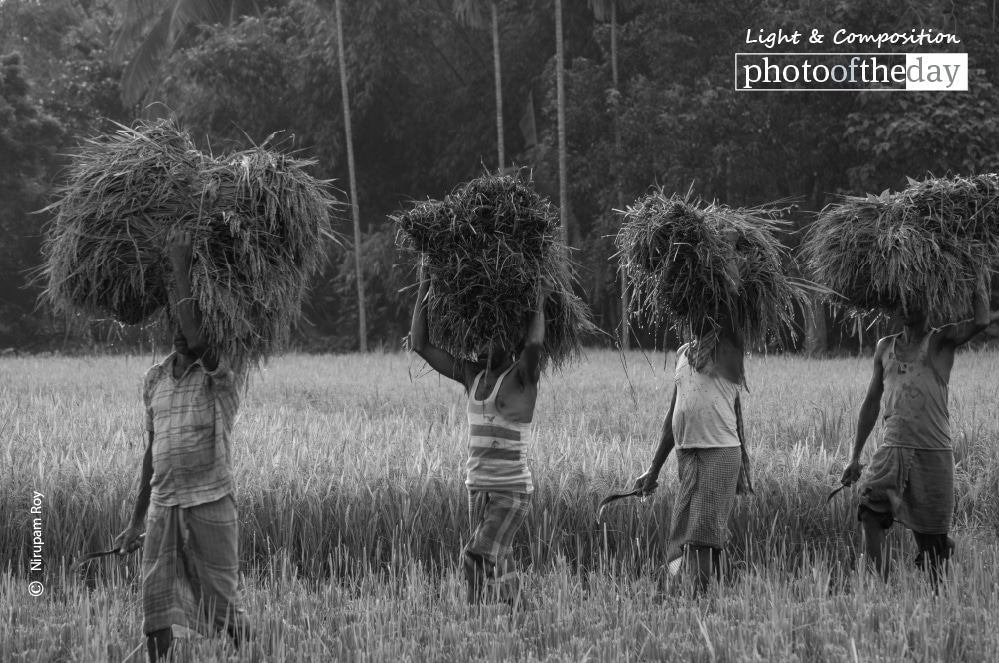
Time to Harvest captures the profound joy and relief of the agricultural season in West Bengal. As farmers gather their crops, their smiling faces reflect the culmination of months of hard labor, transforming the field into a scene of communal triumph. The photographer masterfully documents this rhythmic cycle of life, focusing on the human element of the harvest. The image is award-worthy for its authentic portrayal of rural tradition, capturing the genuine connection between the land and those who cultivate it, while maintaining a warm, evocative aesthetic that celebrates the dignity of the agricultural lifestyle.
Nirupam Roy
Nirupam Roy is a school teacher based in Tufanganj, West Bengal, India, whose transition into photography began as a quest to document the beauty of his surroundings and his family. His work is deeply influenced by his observations of societal phenomena and a desire to represent the common, beautiful aspects of daily life through a fresh lens. Since acquiring his first DSLR, Roy has developed a passionate, obsessive approach to his craft, viewing photography as a transformative medium that provides him with a sense of peace and a deeper connection to nature and humanity.
Resonance Score Breakdown
Transparency Note: The resonance score (11.1/20) is calculated based on social engagement metrics collected before the award announcement.
Expert Photography Reviews · 6
The Debt of the Soil
Can we ever truly own the earth, or are we merely guests who have forgotten to leave? We spend our lives carving lines into the dirt, planting seeds with the desperate hope that the future will be kinder than the past.
Read the reflection →The Labor of the Land
We often mistake the city for the only site of human history, forgetting that the most fundamental urban contract—the one that feeds the metropolis—is written in the soil. Agriculture is the original infrastructure.
Read the reflection →Reviews & Comments
Share your thoughts about this award-winning photograph. Your reviews contribute to the community engagement score.
It’s easy to snap a harvest, but capturing the grit in those smiles requires more than a casual stroll through the paddy. One wonders how many mornings Roy spent in the mud before the light hit just right. I’ve spent enough time in wet fields to recognize the fatigue behind the joy here. It’s a rare, honest bit of work. He didn’t just find this moment; he clearly earned it by staying until the light softened.
The golden light here feels almost too convenient, doesn’t it? Roy captures the harvest, but he’s curated a performance of rural contentment that ignores the grueling reality of Cooch Behar’s labor. Why are we so eager to romanticize this exhaustion as communal triumph? It makes me uncomfortable, honestly. I’m left wondering whose gaze we’re inhabiting. Is this a genuine connection to the land, or just a picturesque aesthetic designed to soothe our own urban anxieties?
Before the eye identifies the golden stalks, something in the chest loosens. It’s the sudden, rhythmic relief of the harvest. I’ve felt my own pulse sync with their communal labor, a quiet expansion of the lungs. When I return to this scene, the faces don’t just smile; they anchor me to a simpler, heavy-handed joy. It’s an ache, really—that visceral, sun-drenched connection to the earth that we’ve traded for screens and silence. It lingers.
f/5.6 at 1/500s, ISO 200, 55mm. A standard kit lens configuration. The shutter speed is adequate to freeze the motion, but the aperture choice leaves the background distracting. It’s a safe, middle-of-the-road technical execution. I’ve seen this exact exposure a thousand times in rural documentation. It doesn’t push the sensor, but it’s sharp where it counts. Honestly, the lack of depth control frustrates me. It’s competent, but it’s technically uninspired. It’s just a record.
Architecture isn’t just stone; it’s the rhythm of labor against the land’s datum. Roy captures the harvest, but I’m struck by the threshold between the human form and the vast, golden void of the field. The light rakes across the grain, defining mass through texture rather than structure. It’s a fleeting, temporal architecture of movement. I find myself wanting to step into that frame, to feel the weight of the crop and the sun’s heat.
Most harvest photos are sentimental clutter, but Roy’s work avoids that trap. Of the thousands I’ve reviewed, this one endures because the focus isn’t on the crop, but on the specific, weary lines around the farmers’ eyes. It’s the grit in their skin that makes me believe in their relief. It’s honest. I’ve looked at this for years, and it still feels like a quiet, necessary document of a world that’s rapidly changing.