Playing in Water by Jabbar Jamil
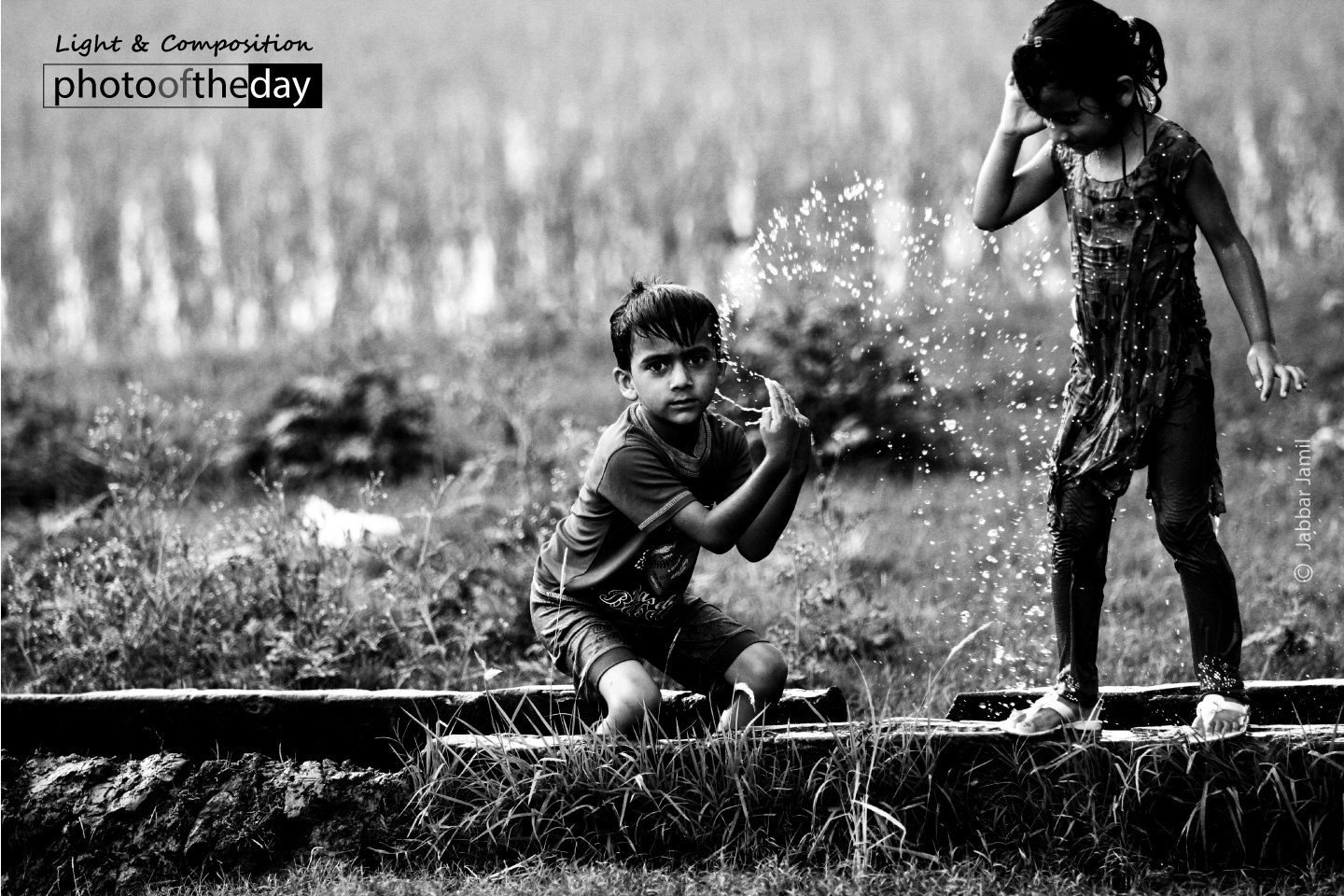
Captured during a summer excursion into the countryside, this image documents a spontaneous moment of childhood joy. Faced with the challenge of muddy terrain and standing water, the photographer utilized a long focal length to maintain a respectful distance, allowing the subjects to remain undisturbed. This candid approach successfully preserves the authenticity of the scene, highlighting the carefree nature of the children at play. The photograph is award-worthy for its raw, emotional resonance and the photographer's ability to transform a fleeting, everyday encounter into a timeless narrative of innocence and discovery.
Jabbar Jamil
Based in Sialkot, Pakistan, Jabbar Jamil is a dedicated street photographer who views his craft as a vital bridge to the outside world. By stepping beyond his comfort zone, he captures authentic human connections that transcend the frame, using photography as both a creative outlet and a personal sanctuary. His work is characterized by a commitment to documenting reality as he finds it, often exploring the unvarnished beauty of everyday life through a lens of empathy and observation.
Resonance Score Breakdown
Transparency Note: The resonance score (1.8/20) is calculated based on social engagement metrics collected before the award announcement.
Expert Photography Reviews · 4
The Geography of Unmapped Joy
There is a particular rhythm to the heat of mid-afternoon, a heavy, golden stillness that settles over the pavement and turns the air into something you can almost touch. It is in these hours that the city sheds its formal skin.
Read the reflection →The Weight of Water
We forget the feeling of earth against skin. The way the mud pulls at the heel, a soft, insistent gravity. As children, we understood that to be clean was to be separate from the world.
Read the reflection →Reviews & Comments
Share your thoughts about this award-winning photograph. Your reviews contribute to the community engagement score.
The vertical axis here is anchored by the central figure, creating a perfect tension against the horizontal ripples. I’ve mapped the negative space in the upper quadrant; it’s a precise 1:2 ratio that balances the chaotic splash below. The geometry of the water’s displacement forms a series of concentric vectors that pull the eye inward. It’s a beautifully solved spatial equation. Honestly, the way those intersecting arcs resolve into pure kinetic energy just makes me smile.
Distance isn’t always respect; sometimes it’s just detachment. By using a long lens to capture these children in Sialkot, Jamil creates a clinical barrier between himself and their joy. Why does he feel the need to hide in the tall grass? It makes me feel like an intruder peering through a keyhole. Is this truly their innocence, or is it just a curated aesthetic of poverty? I’m left wondering who actually owns this moment.
The mud in Sialkot doesn’t just swallow light; it demands a reckoning. Jamil’s shadows here aren’t mere absences, but heavy, viscous voids that anchor these children to the earth. It’s a brutal, honest gravity. I’ve stared at the way the darkness clings to their limbs, and it makes my own chest tighten with a strange, ancient ache. They aren’t just playing; they’re resisting the inevitable erasure of time. It’s a haunting, necessary weight.
The architecture here isn’t stone, but the threshold between the solid earth and the fluid void of the water. Jamil’s frame captures how light skims the surface, defining the children’s movement against the horizon’s datum. It’s a fleeting spatial sequence that architecture rarely achieves. I’m genuinely moved by how the water’s reflection softens the harshness of the landscape. It doesn’t just document play; it maps the way bodies inhabit space when structure disappears entirely.