Streets of Sialkot by Jabbar Jamil
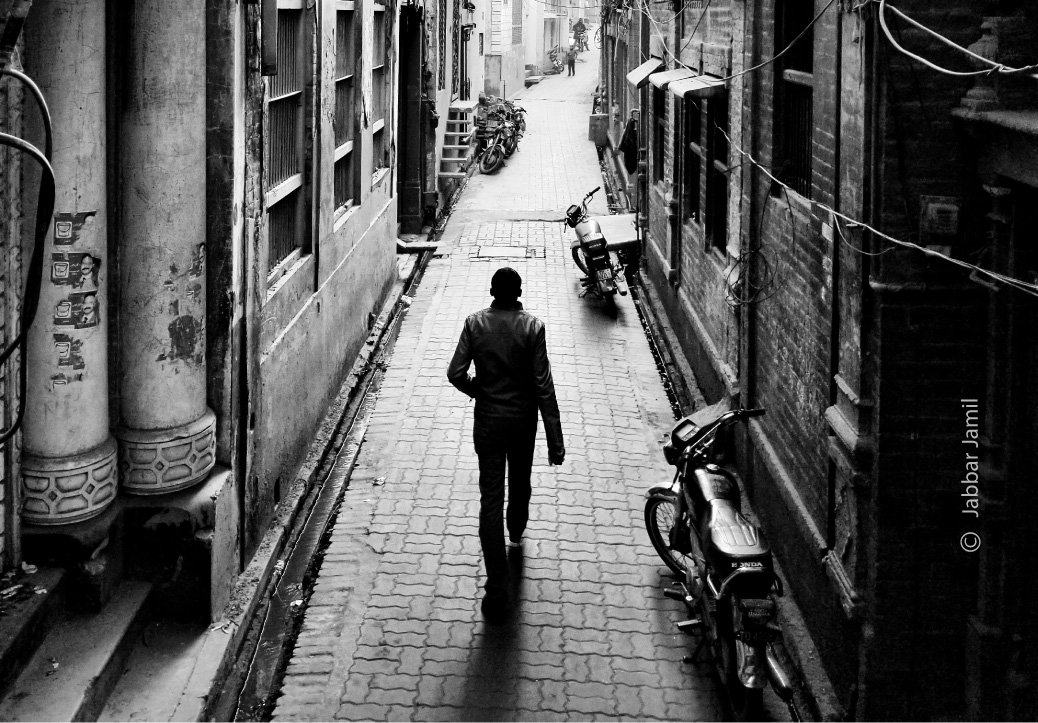
Captured within the ancient, narrow streets of Sialkot, this photograph masterfully utilizes the city's historic architecture as a backdrop. The photographer, intimately familiar with this elevated vantage point, strategically waited for the perfect interplay of light and subject. By positioning the camera to catch the illumination streaming from the far end of the alley, the photographer transformed a familiar urban scene into a compelling narrative moment. The image is award-worthy for its precise timing, masterful use of natural light, and the evocative way it captures the timeless character of Sialkot’s architectural heritage.
Jabbar Jamil
Based in Sialkot, Pakistan, Jabbar Jamil is a dedicated street photographer who views his craft as a vital bridge to the outside world. Through his lens, he explores the raw and authentic facets of urban life, finding that photography serves as both a profound creative outlet and a therapeutic escape. His work is defined by a commitment to documenting the world as it truly appears, often venturing far beyond his comfort zone to capture the human connections that exist within the bustling streets.
Resonance Score Breakdown
Transparency Note: The resonance score (11.2/20) is calculated based on social engagement metrics collected before the award announcement.
Expert Photography Reviews · 8
The Echo of Footsteps
I keep a small, rusted skeleton key in a velvet pouch, though I have no idea which door it once opened. It is heavy for its size, cold to the touch, and worn smooth by hands that have long since turned to dust.
Read the reflection →The Architecture of Shadows
I often find myself wandering the labyrinthine alleys of my own memory, where the walls seem to lean in, whispering secrets of the centuries they have held.
Read the reflection →Reviews & Comments
Share your thoughts about this award-winning photograph. Your reviews contribute to the community engagement score.
You waited for that light to hit the alley just right, and it pays off. I’ve walked streets like these, and there’s a heavy, ancient silence in your frame that makes me hold my breath. You didn’t just capture architecture; you captured the pulse of Sialkot. Because you were patient, the human element feels earned rather than staged. There’s something honest happening here. It’s a quiet, beautiful moment of life unfolding in the shadows.
Light floods the alley, but it feels staged, doesn’t it? Jamil captures Sialkot’s architecture, yet he renders the local figures as mere silhouettes against the glow. Why are they anonymous props in their own neighborhood? I find myself frustrated by this aesthetic distance. Does the photographer belong to this street, or is he just passing through with a lens? It’s a beautiful frame, but it treats history like a backdrop rather than a living, breathing home.
The diffraction of light across those weathered Sialkot walls is, in the strictest physical sense, extraordinary. By stopping down, Jamil has pushed the focal plane deep into the alley’s texture, resolving micro-contrasts the human eye would typically blur. It’s a rare, visceral delight to see such clarity in the shadows. I’m genuinely moved by how the lens captures the particulate dust dancing in that sliver of light; it’s optics revealing the very breath of the city.
The alley’s vanishing point anchors a perfect isosceles triangle, drawing the eye toward the light-drenched aperture. Jamil’s vertical axes are perfectly plumb, creating a rigid frame that forces the human subject into the negative quadrant. It’s a brilliant spatial equation where the shadows act as heavy, dark coefficients against the brilliant white of the street. I’m genuinely thrilled by how the architecture’s geometry dictates the movement; it’s a solved problem of light and strict, linear order.
The crumbling masonry of Sialkot’s alleyways acts as a textured frame, holding the light like a Caravaggio canvas. I’m struck by how the shadows cling to the brickwork, grounding the subject in a history that feels almost tactile. When I look at the man, he doesn’t just exist in this space; he’s woven into it. The architecture isn’t merely scenery—it’s the silent partner defining his solitude. It’s a beautiful, haunting dialogue between stone and soul.
Sialkot’s alleyways aren’t merely stone; they’re a throat through which light struggles to breathe. Jamil understands that darkness isn’t an absence, but a weight. When I look at that distant, blinding aperture, I feel a sudden, sharp ache for the secrets buried in the foreground’s obsidian depths. It’s a brutal, honest geometry. Most photographers fear these voids, but here, the shadows don’t just frame the architecture—they define the very silence of the city.
The light in this Sialkot alley is gorgeous, but I’m left wondering about the person walking through it. Did they know they were being framed, or were they just a prop for the architecture? There’s a distance here that feels cold. I’ve spent my life chasing the truth in a subject’s eyes, and I don’t see it here. It’s a beautiful scene, sure, but it feels like a capture, not a gift. I’m still waiting.
The ochre dust of Sialkot doesn’t merely coat these walls; it breathes, caught in a light reminiscent of a Vermeer interior, where the sun-bleached terracotta bleeds into the bruised violet of deep shadows. It’s a chromatic ache that I find utterly intoxicating, a symphony of earth tones that makes one’s heart stutter. One feels the heat radiating from the stone, a tactile, golden resonance that turns a simple alleyway into a sacred, shimmering, suspended moment.
This is an amazing photo,nicely taken.