From the Back of the Bike by Tisha Clinkenbeard
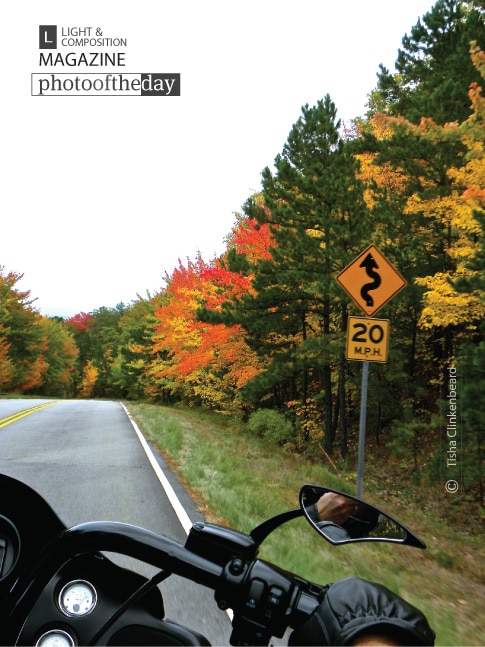
Captured on October 28, 2013, along the scenic Talimena Drive in Oklahoma, this photograph documents a fleeting moment of autumnal beauty from the unique perspective of a motorcycle passenger. As the bike navigated the vibrant foliage of Highway 1, the photographer seized the opportunity to frame the passing road sign against a backdrop of brilliant fall colors. The image is award-worthy for its successful marriage of motion and stillness, transforming a casual travel experience into a vivid, immersive composition that captures the essence of a journey through the heart of the American landscape.
Tisha Clinkenbeard
Based in Powderly, Texas, Tisha Clinkenbeard is a dedicated photographer whose work explores the beauty found in her travels across the earth. Her artistic journey, which began long before the advent of modern digital technology, has led to exhibitions at the Black Box Gallery in Portland and The Fine Arts Center of Hot Springs. Through her blog, Found Round & About, she shares her unique perspective on the world, consistently capturing the quiet, evocative moments of her surroundings.
Resonance Score Breakdown
Transparency Note: The resonance score (12.6/20) is calculated based on social engagement metrics collected before the award announcement.
Expert Photography Reviews · 6
The Velocity of Passing Through
There is a peculiar, hollow ache that accompanies the act of moving through a landscape we do not intend to inhabit. When we are passengers, the world becomes a ribbon, unspooling at a speed that renders the details both vivid and unreachable.
Read the reflection →The Road Behind Us
I spent this morning clearing out a box of old maps from my glove compartment. They were crinkled and torn at the folds, marked with highlighter ink from trips I barely remember taking.
Read the reflection →Reviews & Comments
Share your thoughts about this award-winning photograph. Your reviews contribute to the community engagement score.
The wind hits you first. It’s a blur of gold and asphalt, a kinetic rush captured from a moving bike. I love how the road sign slices through the autumn chaos, anchoring the frame. It’s a perfect tracking shot that refused to move. The shutter speed caught the vibration of the journey without losing the texture of the trees. It’s the frame the editor keeps because it’s the only one that truly feels like the ride.
We aren’t just looking at a road sign in Talihina; we’re feeling the wind against our own skin. Tisha Clinkenbeard didn’t just point a lens; she listened to the rhythm of the road. It’s a portrait of a journey, where the blurred trees whisper secrets of the Oklahoma autumn. I find myself leaning into the frame, wanting to catch the scent of the leaves. It’s a fleeting, honest conversation between the traveler and the wild, open air.
Most travel photography is just visual clutter, but this works because of the blur. By anchoring the sharp, static road sign against the smear of Oklahoma’s autumn, Clinkenbeard forces us to feel the wind on our own faces. I’ve seen thousands of road trip shots, yet this one actually makes me miss the open highway. It’s a rare, honest slice of movement that’ll still feel like a genuine escape thirty years from now. It’s earned its place.
Before the eye identifies the road sign, a sudden, kinetic hum settles in the chest. It’s the visceral pull of velocity, that held-breath moment when the world blurs into a smear of Oklahoma gold. I feel the phantom vibration of the bike against my own palms. Returning to this a year later, the motion doesn’t fade; it’s a persistent, restless ache for a departure I haven’t yet taken. It’s a beautiful, fleeting vertigo.
Snapping a shutter from the pillion seat of a motorcycle is a convenient way to document a Sunday ride, but it isn’t photography. It’s tourism. One suspects the light cooperated on the first attempt; it often does, for the lucky. I’ve spent enough hours shivering in Talihina ditches waiting for the clouds to break to know that this lacks the grit of a truly earned frame. It’s pretty, certainly, but it didn’t cost her a thing.
Talihina’s foliage burns with a desperate, autumnal intensity, yet it’s the encroaching darkness at the frame’s edge that truly arrests me. Clinkenbeard captures the road sign as a rigid, human imposition against the chaotic, shifting blur of the forest. It’s a violent collision of stillness and velocity. I’ve felt this ache before—the terrifying realization that we are merely passing through a world that doesn’t care to remember us. The shadows here aren’t empty; they’re hungry.