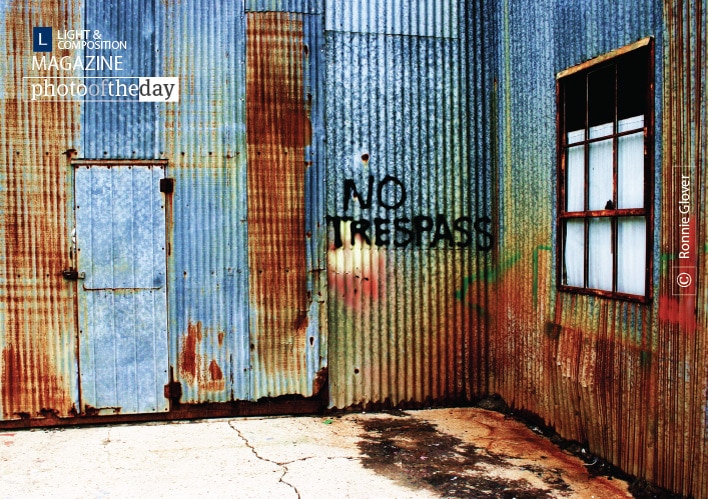
No Trespass by Ronnie Glover
Captured at an abandoned cotton gin in Slocomb, Alabama, this photograph serves as a poignant exploration of decay and personal heritage. Drawn to the striking juxtaposition of rusted textures, vibrant graffiti, and the building's historical weight, the photographer meticulously documented the site before its inevitable disappearance. The image gains profound emotional resonance through the discovery of the photographer’s grandfather’s past employment at the mill. This work is award-worthy for its ability to transform a derelict structure into a compelling narrative of time, memory, and the fleeting nature of industrial history, rendered with technical precision and deep cultural sensitivity.
Ronnie Glover
Based in Gig Harbor, Washington, Ronnie Glover is a versatile photographer whose journey began with formal training at the Southeastern Center for the Arts in Atlanta. His extensive experience includes fourteen years spent in Alaska, where he honed his ability to capture the raw beauty of nature and diverse cultural landscapes. Beyond his dedication to traditional photography, Glover actively explores the intersection of sports and travel, while embracing modern mobile photography to document human movement and athletic events with a unique, insightful perspective.
Resonance Score Breakdown
Transparency Note: The resonance score (12.7/20) is calculated based on social engagement metrics collected before the award announcement.
Expert Photography Reviews · 6
The Architecture of Echoes
We often mistake stillness for an ending, as if the silence of a room is merely the absence of breath. But places have a way of holding onto the ghosts of our labor, soaking up the rhythm of hands that once moved with purpose.
Read the reflection →The Weight of Old Walls
I spent this morning clearing out the back of my closet, pulling out boxes I haven’t touched in years. I found a sweater that still smells faintly of my grandmother’s house, and suddenly, I was back in her kitchen, listening to the hum of the old refrigerator.
Read the reflection →Reviews & Comments
Share your thoughts about this award-winning photograph. Your reviews contribute to the community engagement score.
Before the eye identifies the rusted iron, a heavy stillness settles in the chest. It’s the sensation of a held breath, waiting for a ghost to turn the corner. I’ve felt that specific, hollow ache before—the weight of a grandfather’s forgotten labor pressing against the present. When I return to this frame, the graffiti’s vibrant defiance feels less like art and more like a desperate, human pulse against the inevitable, quiet decay of Slocomb.
Rust doesn’t merely corrode; it consumes the light, leaving behind a hollowed architecture of memory. In Glover’s Alabama, the shadows aren’t hiding the decay—they’re anchoring it. I’ve stared at these jagged, darkened beams until my own pulse slowed to match the stillness of that cotton gin. It’s a brutal, honest confrontation with erasure. When the sun hits that peeling paint, it doesn’t invite us in; it demands we acknowledge what we’ve already lost to the dark.
1/250sec at f/9, 22mm. ISO 400. The aperture choice is correct; it keeps the rusted textures sharp from foreground to the graffiti-stained back wall. It’s a rigid, clinical approach to decay. I’ve spent years looking at these files, and honestly, the technical discipline here is refreshing. It doesn’t lean on shallow depth of field to hide a lack of focus. Glover’s math holds up. It’s a cold, precise document of a dying structure.
The light here doesn’t demand; it lingers, tired and heavy against the rusted iron. I feel a strange ache in my chest looking at these peeling layers, knowing his grandfather once walked these floors. He stood in the cooling hour, waiting for the shadows to soften the decay. It’s a quiet conversation between a man and his ghosts. You can’t rush a memory like this. It’s beautiful, really, how the silence finally settles in.
The ochre of oxidized iron, bleeding into the bruised, chalky violet of the graffiti, creates a dissonance that’s frankly heartbreaking. It’s as if Morandi had wandered into a Slocomb ruin, finding beauty in the decay of industrial ghosts. I’m genuinely moved by how the light clings to those rusted surfaces, turning neglect into a symphony of bruised pigments; it’s a visceral, chromatic ache that lingers long after one has turned away from the frame.
At f/9, the Canon’s sensor resolves the oxidation on these rusted surfaces with clinical sharpness. The 22mm focal length pushes the diffraction limit just enough to maintain deep focus across the gin’s decaying architecture. I’m genuinely moved by how the light renders the graffiti’s pigment against the iron’s coarse texture. It’s a rare moment where the optics don’t just capture a ruin; they reveal the molecular breakdown of history itself. It’s hauntingly precise.