The Boy with Crab by Shahnaz Parvin
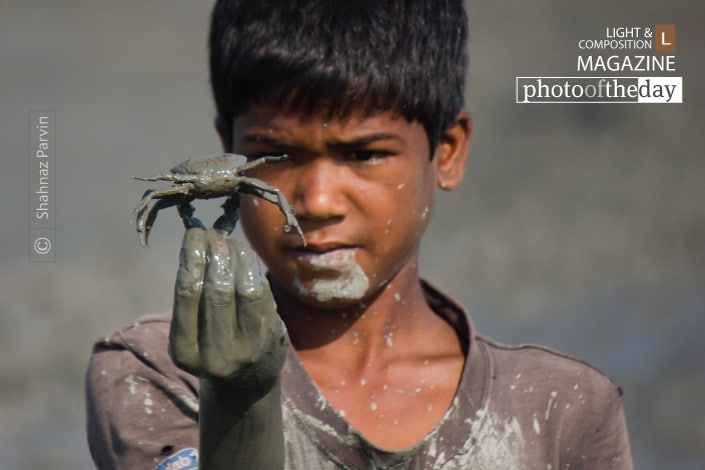
In the rural landscapes near Dhaka, the post-monsoon season brings a unique tradition of hand-fishing, where village children wade into the waters to catch their own dinner. During one such session, a young boy captured the attention of onlookers by fearlessly clutching an aggressive crab. Despite the creature's persistent pinching, the boy remained undeterred, playing with the crustacean and showcasing a remarkable, playful bravery. This image is award-worthy for its candid storytelling and the raw, authentic emotion captured in the boy's expression, perfectly encapsulating the resilient and adventurous spirit of childhood in rural Bangladesh.
Shahnaz Parvin
Based in Bangladesh, Shahnaz Parvin balances a professional career as a systems administrator with a profound dedication to documentary photography. She is driven by a desire to represent the vibrant culture and daily life of her home country through her lens. Her evocative work has garnered international recognition, appearing in numerous renowned magazines across the globe, and continues to highlight her keen eye for capturing authentic human moments.
Resonance Score Breakdown
Transparency Note: The resonance score (12.8/20) is calculated based on social engagement metrics collected before the award announcement.
Expert Photography Reviews · 8
The Weight of Small Things
In the quiet corners of a garden, one often finds that the smallest creatures possess the most formidable defenses. A shell, a claw, a sudden snap of pincers—these are not merely biological imperatives, but a language of boundaries.
Read the reflection →The Weight of Small Things
There is a specific kind of courage that belongs only to the very young. It is not the courage of grand gestures or loud declarations. It is the quiet, stubborn grip on something that wants to escape, or something that wants to hurt.
Read the reflection →Reviews & Comments
Share your thoughts about this award-winning photograph. Your reviews contribute to the community engagement score.
Darkness here isn’t merely the absence of light; it’s the boy’s silent accomplice. As he grips that crab, the shadows clinging to his skin feel like a heavy, encroaching tide. It’s unsettling. I’ve stared at his expression for an hour, and I’m struck by a sudden, cold dread—he isn’t just playing, he’s negotiating with pain. The light doesn’t reveal him; it forces him to endure. It’s a brutal, necessary truth captured in mud.
At 235mm, the lens compresses the focal plane, isolating the boy against a soft, creamy bokeh that’s a function of f/5.6. It’s a delicate optical balance. I’m genuinely moved by how the glass resolves the crab’s jagged, chitinous texture against the boy’s soft skin. There’s no chromatic aberration to distract from that tension. It’s a precise, beautiful capture of a fleeting, tactile moment where the physics of light perfectly serves the raw, human narrative.
The ochre silt of the Dhaka shallows bleeds into the boy’s skin, a tonal convergence reminiscent of a Morandi still life, yet it’s the crab’s sharp, chitinous vermillion that truly arrests the eye. It’s a violent, beautiful punctuation against the muted, watery greys. I’m breathless at how the light catches that pinch; it’s not merely a documentary capture, but a chromatic struggle where the boy’s resilience is painted in the mud’s soft, earthen resonance.
The light here is flat, the heavy, diffused glow of a humid Dhaka afternoon. It’s a quiet, patient observation of a boy’s small, defiant struggle. I’ve spent enough hours in the mud to know that tension; he’s holding his breath, listening to the crab’s rhythm. It makes my own hands ache just looking at him. He didn’t rush the moment, and neither did she. It’s a rare, honest stillness found in the middle of a fight.
The water stretches. A vast, grey stillness. The boy holds the crab. It’s a small, violent tension against the quiet. I’ve spent minutes watching his grip. He doesn’t flinch. The frame is mostly water, yet it’s heavy. It pulls at me. Nothing here is accidental. The empty corner is not empty. It’s the weight of the monsoon. The boy’s bravery is just a ripple. I find myself holding my breath. It’s enough.
Before the eye identifies the boy, a sharp, sympathetic ache pulls at my own knuckles. It’s the visceral anticipation of the pinch. When I return to this, I don’t see a documentary subject; I feel the boy’s reckless, kinetic joy vibrating against my skin. It’s a rare, quiet bravery that lingers. I’ve found myself thinking of his grip during my own moments of hesitation. It’s a small, stinging reminder of how we endure.
One suspects the light cooperated on the first attempt. It often does, for the patient. Yet, there’s a grit here that suggests Parvin didn’t just stumble upon this boy. She’s clearly spent hours in that humid, unforgiving mud, waiting for the moment the crab’s pinch met the boy’s grin. I’ve spent enough time in the damp to know that look isn’t staged. It’s earned. It’s a rare, honest bit of bravery captured in the muck.
Most documentary work from this region leans on pity, but this boy’s defiance shifts the narrative entirely. I’ve seen thousands of portraits, yet the way he grips that crab—ignoring the pinch to hold his prize—is what makes this endure. It’s not just a record of rural life; it’s a visceral reminder of childhood grit. Honestly, it makes me smile every time I look at it. That’s why it’s still relevant a decade later.