The Dandelions by Mazhar Hossain
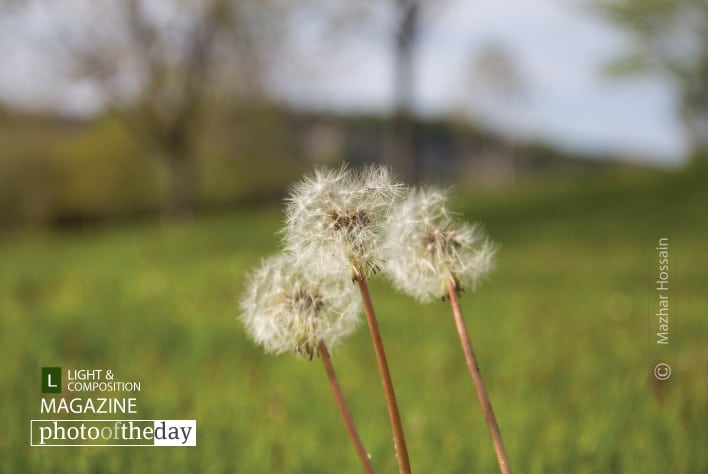
Captured at Toronto’s scenic Bluffer's Park, this image shifts the focus from the typical floral subjects to the humble dandelion. While other photographers were drawn to more conventional blooms, the photographer chose to highlight the overlooked beauty of these resilient wildflowers. By isolating the subject against the park’s natural backdrop, the image invites viewers to appreciate the intricate details often ignored in nature. This thoughtful perspective and the deliberate choice to celebrate the mundane make the photograph a compelling example of nature photography, demonstrating a keen eye for finding wonder in the everyday landscape.
Mazhar Hossain
Born in Dhaka, Bangladesh, and currently based in Toronto, Canada, Mazhar Hossain is a dedicated photographer who balances a professional career in Human Resources with a deep-seated passion for the visual arts. Since acquiring his first DSLR in 2010, he has focused on refining his craft across diverse genres, including architecture, portraiture, and nature. Driven by a desire to explore the world through his lens, he continues to evolve as an artist, seeking to capture the unique character of cities and landscapes across the globe.
Resonance Score Breakdown
Transparency Note: The resonance score (12.3/20) is calculated based on social engagement metrics collected before the award announcement.
Expert Photography Reviews · 7
The Beauty of the Overlooked
I remember sitting on a rusted bench in a forgotten corner of a public garden in Leeds. A gardener named Arthur was busy pulling weeds, his hands stained dark with soil. He stopped for a moment, holding a common dandelion between his thumb and forefinger.
Read the reflection →The Persistence of Small Things
We walk past the common things. We name them weeds, we pull them from the earth, we dismiss them as interruptions in the garden we try to impose upon the wild. But there is a quiet stubbornness in the things that grow without permission.
Read the reflection →Reviews & Comments
Share your thoughts about this award-winning photograph. Your reviews contribute to the community engagement score.
The dandelion’s placement lacks the necessary geometric anchor. It’s adrift, failing to command the picture plane. While the negative space attempts to isolate the subject, the spatial tension collapses under the weight of an unconsidered background. It’s a missed opportunity for structural clarity. I’ve grown weary of such aimless framing; it doesn’t hold the eye. The composition demands a more rigorous fulcrum to justify its existence. Without that discipline, the frame simply leaks.
The wind hits the frame and the dandelions hold their breath. It’s a tight, rhythmic close-up that refuses to cut away. I’ve spent hours watching landscapes, but this stillness feels like a director’s final take. The background blurs into a soft, cinematic bokeh, isolating the resilience of the weeds. It’s honest. I actually felt my pulse slow down looking at it. That’s the frame the editor keeps. It’s a quiet, perfect moment of suspended time.
The focal plane here is razor-thin, pushing the limits of the lens’s resolving power against the dandelion’s pappus. At this aperture, the bokeh isn’t just a blur; it’s a soft, creamy transition that isolates the intricate, fractal geometry of the seeds. I’m genuinely moved by how the light catches those delicate filaments. It’s a masterclass in managing diffraction; the clarity doesn’t just reveal the subject, it forces us to confront the physics of the unseen.
Most people walk past these weeds, but he stopped. He stood there in the cooling hour, waiting for the light to soften against the bluff’s edge. It’s a quiet act of devotion, finding grace in the overlooked. I’ve spent enough dawns in the grass to know that feeling—the sudden, breathless stillness when the world finally reveals its secret. It makes me want to kneel. He didn’t just capture a flower; he listened to the earth.
We often walk past the dandelion, dismissing it as a weed. But here, Mazhar has sat with it, listening to the quiet resilience in its seeds. It’s a portrait of a survivor, standing tall against the vast, blurred backdrop of Bluffers Park. I find myself leaning in, wanting to hear the story hidden in those delicate, fraying petals. It’s a humble, beautiful conversation. This is a photograph that asks to be returned to, again and again.
Dandelions at Bluffers Park aren’t just weeds; they’re an assertion of presence in a manicured landscape. Why do we label them resilient instead of invasive? Hossain isolates these yellow heads, yet I can’t help but feel a strange, sharp loneliness looking at them. Does the frame exclude the park’s human-made order to pretend this nature is wild? It’s a pretty shot, but it ignores the tension between the gardener’s shears and the flower’s stubborn, quiet survival.
The vertical axis here is anchored by the dandelion’s stem, creating a precise 1:2 ratio between the foreground bloom and the blurred background strata. It’s a masterclass in depth-of-field geometry. The radial symmetry of the seed head disrupts the horizontal landscape lines, forcing a sharp focal shift. I’m genuinely struck by how the negative space balances the mass of the sphere. It’s a perfectly solved spatial equation that turns a common weed into a rigorous, floating coordinate.
Amazing shot