When the Moon is Near by Moslem Azimi
Captured in the rugged landscapes of Iran, this image represents a fleeting, unrepeatable moment of natural beauty. Moslem Azimi, traveling with friends, was struck by the scene’s unique composition and immediately halted his journey to document the vista. Eschewing digital manipulation, the photograph relies on the raw, authentic interplay of light and terrain to convey its message. The image stands out for its genuine, untouched quality, showcasing the photographer’s keen eye for identifying extraordinary visual narratives in the midst of everyday travel, ultimately earning recognition for its striking composition and atmospheric depth.
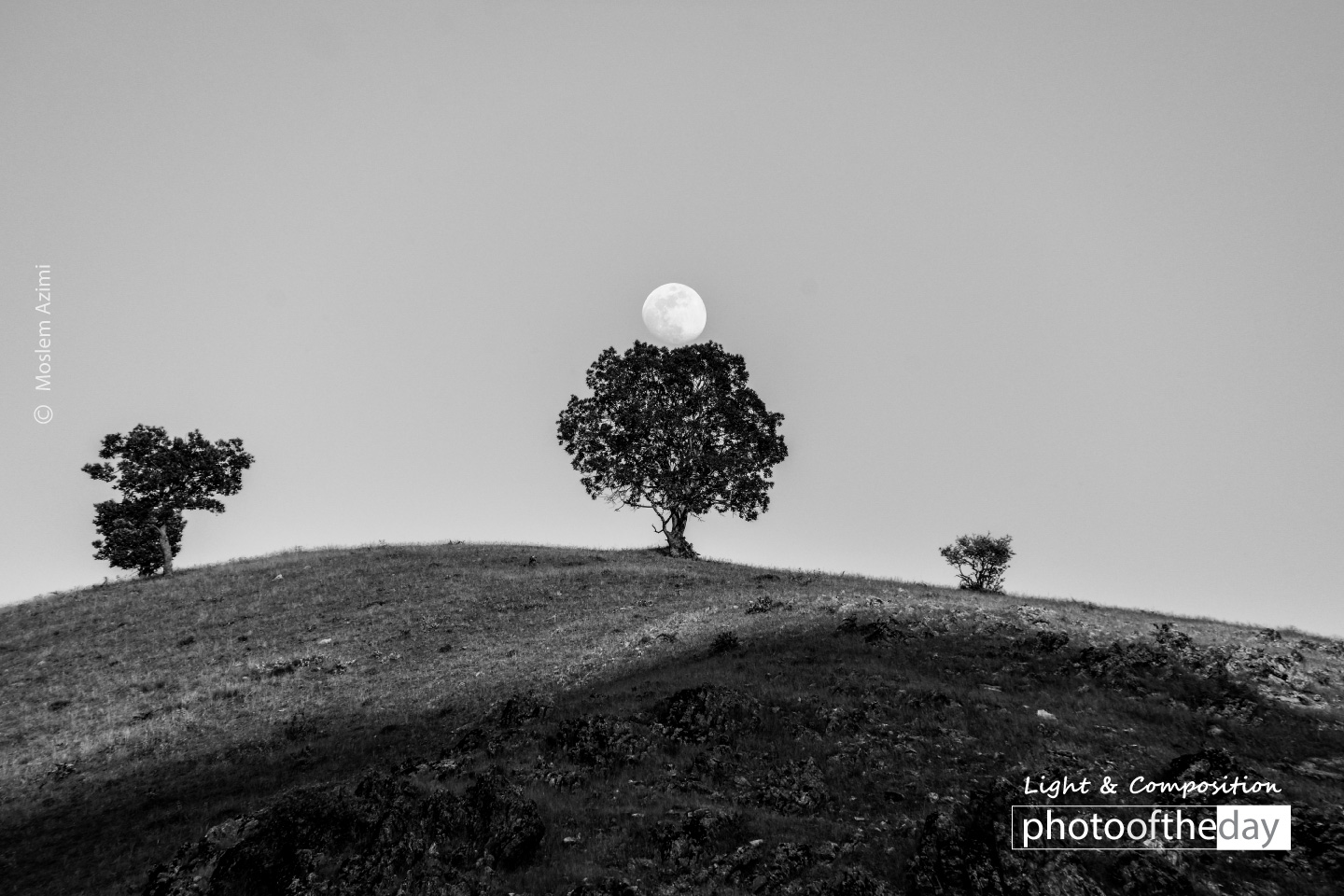
Exposure 1/200sec @ f/8 | ISO 100 | Focal Length 140mm
Moslem Azimi
Of Kurdish origin and currently based in Melbourne, Australia, Moslem Azimi is a self-taught photographer who holds a Bachelor of Arts in English Translation. Despite lacking formal academic training in the arts, he has cultivated a sophisticated visual language through active participation in national and international exhibitions. His work is deeply rooted in his heritage, focusing on the documentation of Kurdish lifestyle, cultural traditions, and the unique methods of living that define his community.
Resonance Score Breakdown
Transparency Note: The resonance score (12.7/20) is calculated based on social engagement metrics collected before the award announcement.
Expert Photography Reviews · 5
The Weight of the Sky
I keep a small, smooth river stone on my desk, worn down by years of being turned over in my palm. It is heavy for its size, a dense anchor that reminds me of the earth’s patient, silent endurance.
Read the reflection →The Weight of the Sky
I remember sitting on a stone wall in the Scottish Highlands, waiting for a fog to lift. An old shepherd named Hamish sat down beside me, his hands stained with the dark earth of the valley. He didn't look at the mountains; he looked at the space between them.
Read the reflection →Reviews & Comments
Share your thoughts about this award-winning photograph. Your reviews contribute to the community engagement score.
The horizon line bisects the frame at a precise 1:3 ratio, anchoring the rugged terrain against the lunar void. Azimi’s geometry relies on the tension between the moon’s circular mass and the jagged, diagonal vectors of the Kermanshah slopes. It’s a beautifully solved spatial equation. I’m genuinely breathless at how the negative space forces the eye to reconcile that singular, luminous point. It’s not just a landscape; it’s a perfectly balanced, cold, mathematical elegance.
Before the eye identifies the jagged ridges of Javanroud, something in the chest tightens. It’s the silence of high altitude, a sudden, cold clarity. I find my breath hitching, matching the stillness of that pale, distant moon. It doesn’t just show a landscape; it triggers a primal, lonely recognition. When I return to it, the ache remains—a quiet, persistent reminder of how small we are against the vast, indifferent curve of the earth.
It’s a pretty vista, but let’s be honest: this is a snapshot born of convenience, not field craft. The curator calls it a fleeting moment, but I see a lack of commitment. You don’t capture the soul of the Kermanshah landscape by pulling over on a whim. It’s technically clean, yet it feels hollow. I’ve spent weeks in similar terrain waiting for the light to shift; this just doesn’t have that earned weight.
At 140mm and f/8, the Nikon’s sensor captures the atmospheric haze with surprising fidelity. The diffraction limit hasn’t softened the distant ridges, allowing the light to resolve the terrain’s micro-contrast beautifully. It’s a rare moment where the optics don’t struggle against the vastness. I’m genuinely moved by how the lens renders the moon’s proximity; it’s a crisp, physical reminder of our scale. It doesn’t just show a landscape; it maps the very physics of the horizon.
The moon hangs low, a quiet witness to the rugged silence of Javanroud. I’ve stood in such places, feeling the air thin as the day retreats. Moslem didn’t rush; he let the landscape dictate the frame. It’s the way the light clings to the ridges that catches my breath—a soft, honest glow that feels almost sacred. He was patient enough to let the earth reveal its own stillness. It’s a rare, beautiful kind of listening.