Trapped in a Box by Ryszard Wierzbicki
While traveling through the remote mountain regions of Northern Laos, the photographer ventured beyond the village of Muang Ngoi to explore the banks of the Nam Ou river. Armed with gifts for the local children, he captured a poignant, candid moment in the center of a village road where youngsters were found playing inside simple wooden boxes. This image is award-worthy for its authentic portrayal of childhood innocence and resourcefulness in a challenging environment. The photographer’s ability to document this fleeting, human-centric scene with such warmth and technical precision highlights the beauty of everyday life in rural Southeast Asia.
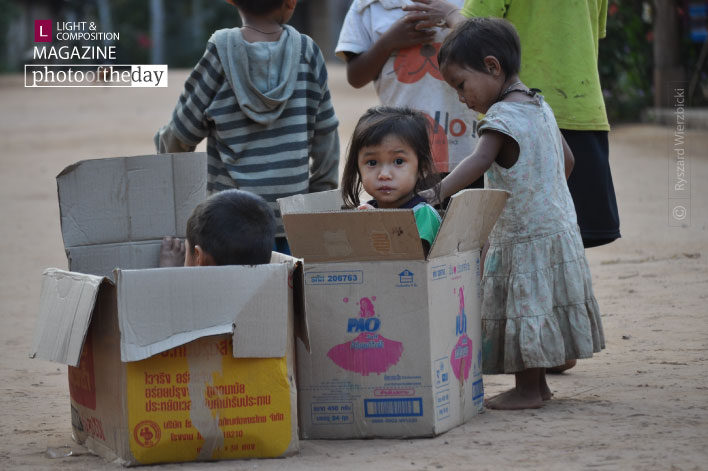
Exposure 1/125sec @ f/5.6 | ISO 280 | Focal Length 120mm
Ryszard Wierzbicki
Born in Poland in 1963, Ryszard Wierzbicki holds a Master’s degree in Social Sciences and spent years working in child care and corporate management before relocating to the United Kingdom in 2006. This transition marked the beginning of his dedicated pursuit of photography and global exploration, with a particular focus on Southeast Asia. A passionate traveler and PADI scuba instructor, he balances his creative work with humanitarian efforts, including volunteering for orphanages and managing online communities for photographers and travelers worldwide.
Resonance Score Breakdown
Transparency Note: The resonance score (12.9/20) is calculated based on social engagement metrics collected before the award announcement.
Expert Photography Reviews · 8
The Architecture of Play
Is a boundary a wall that keeps us in, or a vessel that defines our world? We spend our lives building structures—physical, social, and mental—believing that by enclosing a space, we gain control over it.
Read the reflection →The Architecture of Play
We often mistake boundaries for limitations. We see a frame, a wall, or a container, and we assume the spirit inside is held back, waiting for release. But watch how a child occupies a space.
Read the reflection →Reviews & Comments
Share your thoughts about this award-winning photograph. Your reviews contribute to the community engagement score.
The light here is soft, diffused by the humid canopy of Muang Ngoi. It doesn’t demand attention; it simply rests upon the wooden crates. I’ve spent enough mornings in the mountains to know the stillness that precedes such a moment. He waited, quiet and unseen, until the children’s play became a prayer of pure presence. It makes my heart ache, remembering how easily we forget that joy doesn’t require a horizon, only a box and a friend.
At 120mm, the compression of the focal plane isolates the children within their wooden frames, turning the boxes into optical apertures themselves. The f/5.6 aperture renders the background blur with a soft, creamy transition, preventing the chaotic environment from distracting the eye. I’m genuinely moved by how the light catches the dust motes; it’s a delicate, fleeting physics that makes me want to reach out and touch the grain of that weathered timber.
Before the eye identifies the children, something in the chest tightens. It’s the sudden, claustrophobic weight of those wooden crates. I feel a strange, phantom pressure in my own ribs looking at them. They’ve turned confinement into a game, yet the image lingers, haunting my peripheral vision like a half-remembered dream. When I return to it, the joy feels fragile, a temporary shelter against the vast, indifferent dust of the road. It’s unsettlingly beautiful.
The ochre dust of Muang Ngoi rises to meet the sun-bleached timber of these crates, creating a palette that feels like a dusty Morandi still life brought to life by the humid breath of Laos. It’s the way the light catches the children’s skin—a warm, toasted almond—that makes my heart ache with a sudden, sharp nostalgia for a simplicity I’ve never truly known. The harmony here isn’t merely seen; it’s felt in the bones.
1/125sec at f/5.6, 120mm. A telephoto choice that flattens the space, isolating the subjects within their wooden confines. It’s a calculated compression. The shutter speed is adequate for candid movement, though the depth of field is thin enough to demand focus precision. I’ve seen enough soft focus in travel work to be cynical, but this hits the mark. It’s technically sound. I actually find the children’s expressions here surprisingly haunting. The math holds up.
The wooden crate frames a small life. It’s a boundary, yet the children don’t seem to notice. They’ve turned confinement into a game. I’ve spent minutes watching their stillness. It’s quiet. The dust settles around the edges of the box. Nothing here is accidental. The empty corner is not empty; it’s where the world waits. I feel a sudden, sharp ache for that simplicity. They’ve found freedom in a box. It’s enough.
Children confined within wooden crates—it’s a haunting geometry. The light here doesn’t illuminate; it interrogates the boundary between play and imprisonment. I’ve stared at these shadows, and they don’t offer comfort. They suggest that even in innocence, we are already carving out our own enclosures. It’s a heavy, unsettling truth. When I look at those dark, hollow boxes, I don’t see a village game. I see the architecture of our inevitable, solitary confinement.
Most travel photography is just visual tourism, but this hits differently. Of the thousands of candid shots I’ve reviewed, few capture such raw, unscripted joy. The wooden boxes aren’t just props; they’re the entire world for these children. It’s a simple, fleeting moment, yet it makes me smile every single time I look at it. That’s the mark of an image that’ll still matter in thirty years. It’s honest, unforced, and deeply human.