Mother of the Leaf by Erfaneh Nikpendar
While exploring the rugged terrain of Masal, the photographer discovered a delicate leaf intertwined with a nearby branch. This intimate encounter prompted a creative intervention; by carefully cleaning and positioning the subject, the photographer transformed a simple botanical find into a profound visual metaphor. The resulting image transcends the physical leaf, evoking the vast, ancient forest from which it originated. This work is award-worthy for its ability to find grand, atmospheric narratives within the smallest details of nature, demonstrating a keen eye for composition and the poetic potential of light and texture.
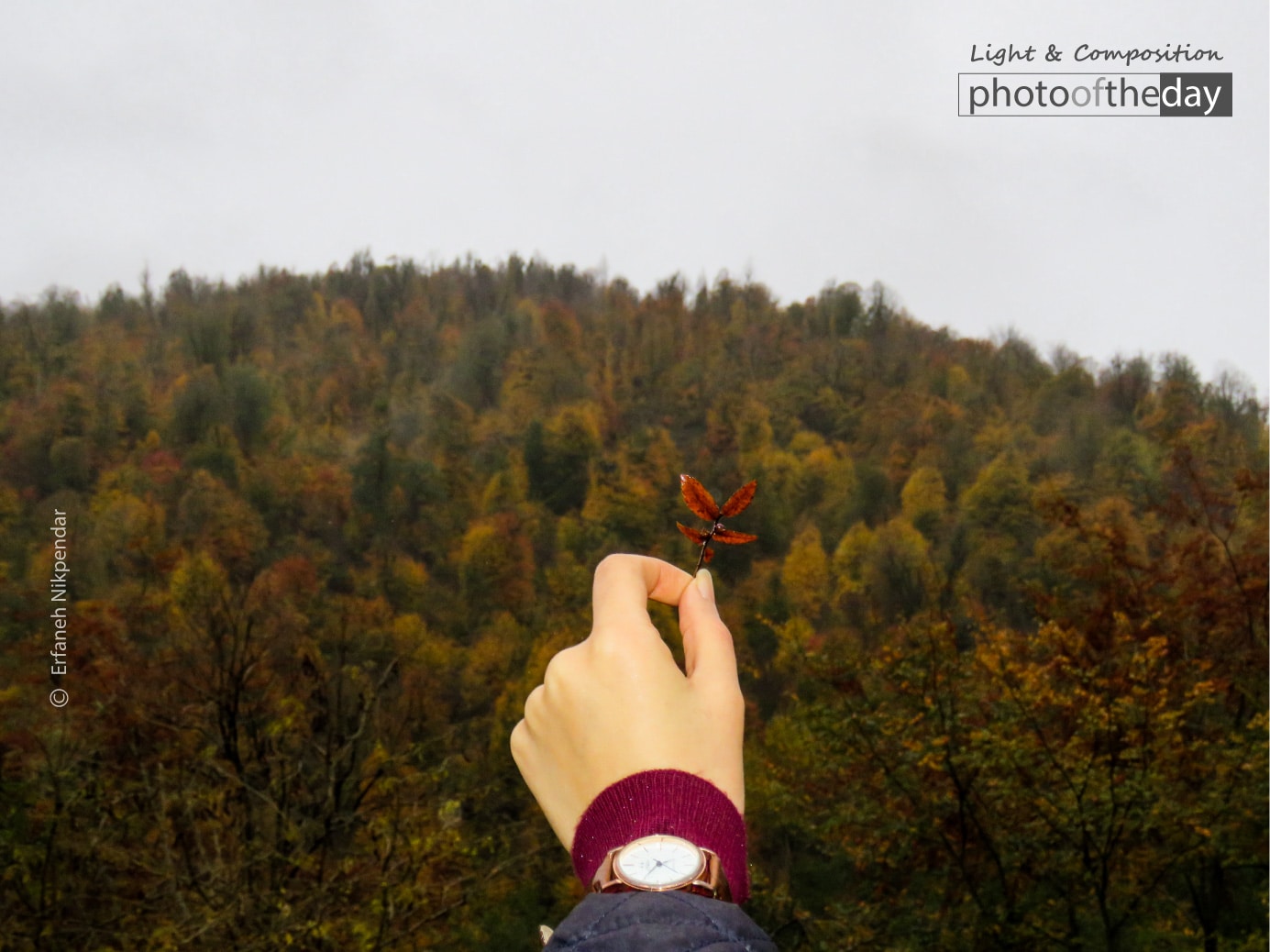
Exposure 1/125sec @ f/4.0 | ISO 1250 | Focal Length 70mm
Erfaneh Nikpendar
Born in Iran, Erfaneh Nikpendar is an emerging artist currently based in Isfahan. As a dedicated student and passionate photographer, she finds deep motivation in the creative process, viewing art as a vibrant medium through which to color her world. Her work, which has already garnered recognition in local competitions, reflects a burgeoning talent for capturing the subtle beauty of her surroundings during her seasonal travels across the Iranian landscape.
Resonance Score Breakdown
Transparency Note: The resonance score (11.3/20) is calculated based on social engagement metrics collected before the award announcement.
Expert Photography Reviews · 8
The Architecture of Small Things
I often find myself lingering near the old iron gates of the botanical gardens in the city center, watching how the moss claims the stone, turning the hard edges of our human-made world into something soft and ancient.
Read the reflection →The Weight of Veins
I keep a pressed fern inside the pages of a dictionary, its edges brittle as parchment and dark as dried tea. It was plucked from a garden I no longer visit, a place where the air felt heavy with the scent of damp earth and coming rain.
Read the reflection →Reviews & Comments
Share your thoughts about this award-winning photograph. Your reviews contribute to the community engagement score.
Nature isn’t the street, but the eye remains the same. You’ve staged this leaf, and it’s beautiful, sure. But where’s the pulse? I’m looking for the chaos of Masal, the wind that doesn’t wait for a tripod. It’s technically sharp, yet it lacks that frantic, unrepeatable heartbeat I crave. I’d trade this perfect stillness for one blurry, messy second of life. You’ve captured a leaf, but you’ve missed the rush of the world passing by.
The frame breathes. It’s a tight, macro close-up that feels like a wide-angle landscape, the depth of field isolating the leaf until it’s the only thing left in the scene. I’m struck by the stillness; it’s a held breath in a forest that’s usually screaming. The composition doesn’t need a cut because the rhythm is already perfect. Nikpendar didn’t just find a leaf; she directed the light to make it the lead actor. It’s pure cinema.
In the highlands of Masal, we find a face not made of skin, but of veins and chlorophyll. It’s a portrait of the forest itself. When we look at this leaf, we aren’t just seeing botany; we’re meeting a survivor. I’ve spent my life listening to elders, and this delicate, weathered texture tells a story of endurance I recognize. It’s hauntingly human. I feel a sudden, quiet ache for the ancient woods that birthed this fragile soul.
The frame operates on a precise diagonal tension, balancing the leaf’s serrated mass against the branch’s rigid vector. It’s a masterclass in spatial equilibrium; the negative space in the upper quadrant perfectly offsets the density of the foreground textures. I’m genuinely struck by how the 70mm compression flattens the depth into a near-perfect geometric plane. It’s not just a botanical study; it’s a solved equation where every curve and line justifies its own existence within the rectangle.
You’ve staged this leaf with such care, but I’m looking for the pulse behind it. It’s technically sharp, sure, but it feels a bit curated, almost clinical. I’ve spent my life chasing the messy, unscripted truth of people, and I find myself craving a human presence here. Because you’ve got a great eye for light, I’d love to see you turn that lens toward the people of Masal. There’s a story waiting there that’s breathing.
Nikpendar’s leaf evokes the meticulous botanical studies of Anna Atkins, yet it’s stripped of her cyanotype rigidity. The soft, diffused light across the veins recalls the quiet intimacy of Sudek’s garden series, though it’s rendered with modern digital precision. I’m genuinely struck by how she’s elevated a mere fragment into a landscape. It’s a rare, haunting stillness that avoids the cliches of nature photography. It’s not just a leaf; it’s a quiet, ancient forest breathing.
Most macro work feels clinical, but this holds a rare, quiet gravity. Of the thousands of botanical studies I’ve reviewed, few possess this level of intentionality. By isolating the leaf against the blurred, deep greens of Masal, Nikpendar forces us to confront the fragility of the forest itself. It’s an intimate portrait of decay and rebirth. Honestly, it makes me ache for the woods. It’s a small, perfect anchor for a world that’s moving too fast.
Architecture isn’t just stone; it’s the rhythm of the forest. Nikpendar’s leaf acts as a structural datum, defining the void around it. The light grazing those veins mimics the way sun hits a facade, revealing mass through texture. It’s a masterclass in scale. I’ve spent my career obsessing over grand thresholds, yet this tiny, delicate intervention captures the vastness of Masal better than any wide-angle shot. It’s hauntingly quiet. I’m genuinely moved by its structural honesty.
Nice ?
I’d like that ?
Exellent???