Underpass by Fatemeh Pishkhan
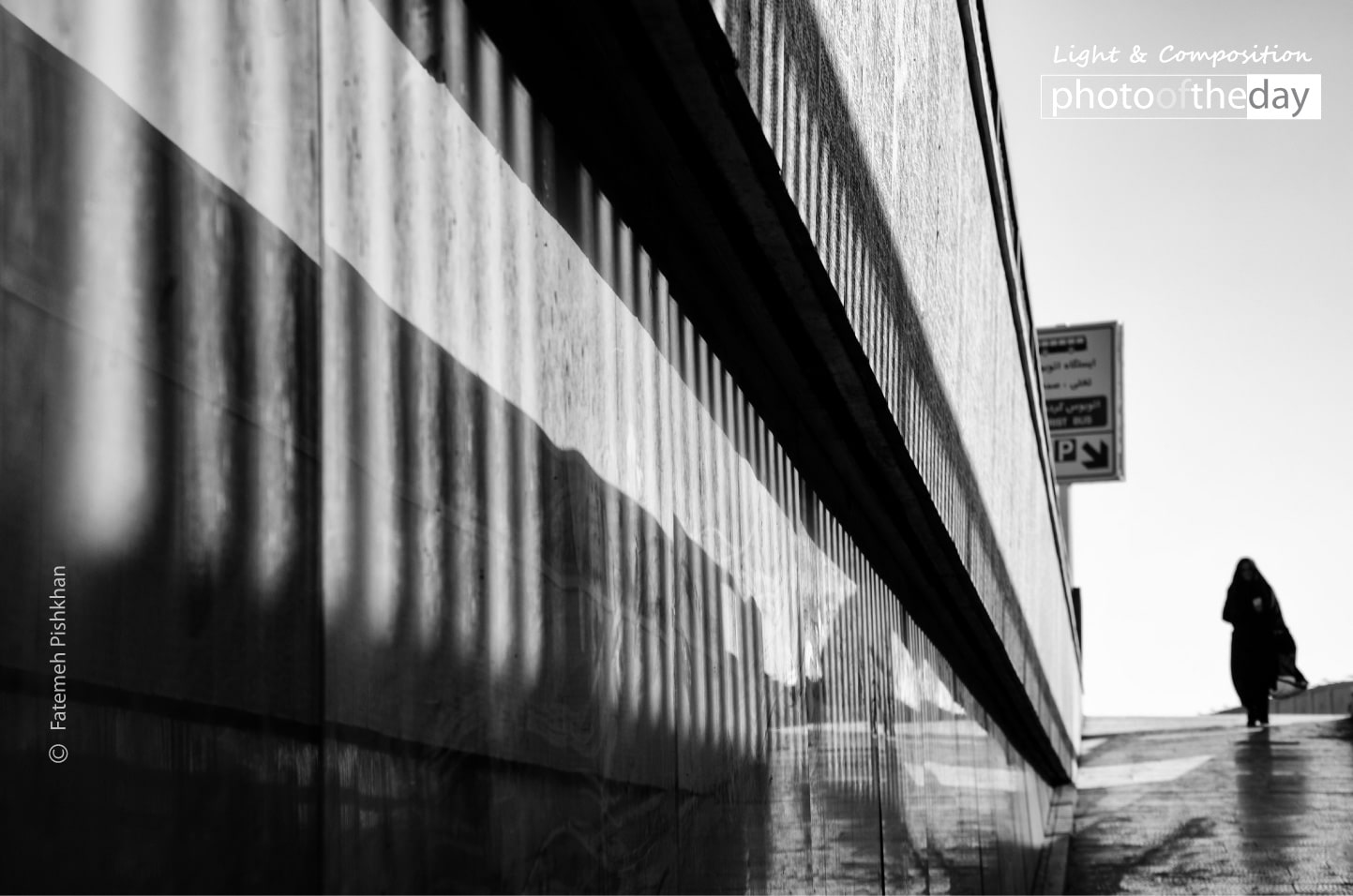
Captured during the quiet transition of late afternoon, this photograph documents the rhythmic flow of human movement within the underpass of Imam Ali Square. The photographer spent hours observing the commuting crowds until a specific Iranian woman caught her eye, prompting a deliberate decision to freeze the fleeting moment. The image is award-worthy for its keen ability to isolate a singular, poignant narrative amidst the chaotic energy of a busy urban thoroughfare, showcasing a masterful balance between candid street observation and formal composition.
Fatemeh Pishkhan
Based in Isfahan, Iran, Fatemeh Pishkhan is a dedicated artist who balances her time between exploring the streets for unique shapes and refining her vision within the studio. With a background spanning a vast range of photographic genres, she currently focuses on contemporary fine art photography. Her work is defined by a rigorous exploration of minimalistic and formalistic aesthetics, often enhanced by creative editing techniques that elevate her subjects into compelling visual narratives.
Resonance Score Breakdown
Transparency Note: The resonance score (11.7/20) is calculated based on social engagement metrics collected before the award announcement.
Expert Photography Reviews · 6
The Architecture of Transit
Mycelium networks beneath the forest floor operate in a state of constant, silent negotiation, moving nutrients through the soil to sustain the collective health of the grove.
Read the reflection →The Weight of Passing Through
I keep a small, rusted iron key in my desk drawer that no longer opens any door I know. It is heavy for its size, cold to the touch, and carries the faint, metallic scent of a house that was sold long before I was born.
Read the reflection →Reviews & Comments
Share your thoughts about this award-winning photograph. Your reviews contribute to the community engagement score.
The geometry of Imam Ali Square’s concrete arches echoes the stark, rhythmic isolation found in Kertész’s early Parisian street work, yet Pishkhan injects a distinctly contemporary Iranian cadence. It’s that singular figure, caught in the transition of light, that stops me cold. I’ve spent decades tracing the lineage of the candid frame, but the way she balances this fleeting human narrative against such brutalist architecture feels fresh. It’s a rare, quiet dialogue between tradition and modern urban alienation.
Most street photography is noise, but here, the geometry of the Imam Ali underpass acts as a cage for the solitary woman. I’ve seen thousands of commuters blurred into oblivion, yet Pishkhan’s decision to anchor the frame on her singular, defiant posture creates a stillness that feels rare. It’s haunting. In thirty years, we won’t care about the architecture, but we’ll still feel the weight of her walk. That’s why it earned its place.
You waited for the right soul to emerge from that concrete blur, and it shows. Most people would have chased the chaos, but you stayed still until the rhythm aligned. I feel a strange, quiet ache looking at her—that solitary figure cutting through the noise of Isfahan. It’s not just a frame; it’s a moment of genuine solitude you pulled out of the rush. You didn’t force it. You just let her be.
The geometry of Imam Ali Square’s underpass traps this woman in a rigid, concrete frame. Why does Pishkhan isolate her so clinically against the blur of commuters? It feels voyeuristic, turning a private transit into a public specimen. I find myself wincing at the coldness of the composition. Does the photographer see a person, or just a compositional element? Whose narrative are we actually consuming here, and why does it feel like she’s being erased?
In the underpass of Imam Ali Square, the crowd is a blur, but she is a steady pulse. We look at her face and we understand something about the weight of a long day. Fatemeh didn’t just capture a commuter; she waited until the rhythm of the city aligned with the woman’s own quiet story. I’m moved by her solitude here. It’s a portrait that asks to be returned to, again and again.
f/2.8 at 1/250s, ISO 800, 35mm. A wide aperture choice that isolates the subject from the concrete chaos of Imam Ali Square. It’s a calculated risk. The shutter speed barely freezes the motion, leaving just enough blur to suggest the underpass’s kinetic energy. I’ve spent years analyzing these files, and honestly, the focus precision here is irritatingly perfect. It’s a sharp, clinical execution that forces the viewer to acknowledge the woman’s isolation. It works.
Wonderful composition!
Thank you very much
Nice shot ??
Thankful
Love it ?
Thanks alot