The Naughty Gang by Somnath Chakraborty
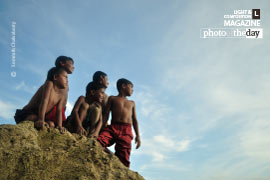
Captured along the banks of the Ganga near Pujali, this photograph documents a group of spirited children preparing for a game of cricket. The photographer was drawn to their boundless energy, observing how they embraced the mud and the chaos of play with innocent enthusiasm. By positioning himself amidst their daily ritual, he successfully froze a moment of pure, unscripted childhood joy. The image is award-worthy for its authentic storytelling and the vibrant, candid interaction it portrays, effectively highlighting the universal, carefree nature of youth against the backdrop of the riverbank.
Somnath Chakraborty
Based in Batanagar, Kolkata, India, Somnath Chakraborty balances a professional career as a network engineer with a deep-seated passion for photography. Identifying as a dedicated enthusiast, he maintains a rigorous creative discipline, ensuring he captures at least one photograph every single day. His work is driven by a desire to learn from the global photographic community while refining his own technical and artistic perspective through constant practice and exploration.
Resonance Score Breakdown
Transparency Note: The resonance score (13.3/20) is calculated based on social engagement metrics collected before the award announcement.
Expert Photography Reviews · 8
The Grit of Unfinished Games
The smell of damp earth after a sudden downpour always brings me back to the feeling of cool, thick mud squelching between my toes. It is a heavy, grounding sensation, the kind that anchors you to the ground while your heart is busy racing toward the horizon.
Read the reflection →The Architecture of Dust
We begin as architects of the unmade, building empires out of loose earth and the friction of our own palms. There is a specific, sacred gravity to the soil when we are young; it is not merely dirt, but the medium of our first intentions.
Read the reflection →Reviews & Comments
Share your thoughts about this award-winning photograph. Your reviews contribute to the community engagement score.

It’s easy to snap a shutter when children are running about, but capturing the dust and the specific, frantic geometry of a cricket match requires more than a quick trigger finger. One suspects Chakraborty didn’t just wander by; he likely spent hours in that riverbank mud, becoming part of the scenery until the boys stopped noticing him. I’ve been that damp and uncomfortable, and frankly, it’s worth it. He earned this chaos. It’s quite lovely.
Most street photography of children feels staged or patronizing, but this captures the raw, unvarnished grit of a Pujali riverbank. The low-angle perspective forces us into the mud with them, making the cricket bat feel like a scepter of absolute power. I’ve seen thousands of candid shots, but the sheer, messy defiance in their expressions makes me smile every time. It’s a rare, honest slice of life that will still matter thirty years from now.
The riverbank stretches wide. It’s a vast, grey stage. The children are small, dark shapes against the silt. They don’t crowd the frame. They occupy the edges. I’ve spent minutes watching their stillness before the game begins. It’s quiet. The mud holds their weight. Nothing here is accidental. The empty corner is not empty. It’s the breath before the run. I feel a sudden, sharp ache for that silence. It’s rare to see play so contained.
At f/3.5, the Nikkor’s focal plane is razor-thin, isolating these children against the Ganga’s soft, chaotic bokeh. It’s a delicate balance; the lens resolves the grit of the mud and the texture of their skin with startling clarity, pushing right to the edge of the diffraction limit. I’m genuinely moved by how the light catches their movement. It’s not just a snapshot; it’s a precise optical capture of pure, unscripted kinetic energy. I’ve rarely seen such joy.
The Ganga’s mud doesn’t just coat these children; it anchors them to a primal, heavy reality. While the curator sees joy, I see the encroaching dark of the riverbank swallowing their fleeting play. It’s unsettling. When I look at the deep, unyielding shadows beneath their feet, I’m reminded of Heidegger’s “thrownness”—we are cast into the world without consent. They’re running toward a future that’s already casting long, cold silhouettes against the light. It’s haunting.
The frame’s geometry is compromised. While the children’s kinetic energy disrupts the frame, the spatial tension lacks the necessary anchor. The riverbank’s horizon line cuts the picture plane with a jarring, diagonal instability. It’s messy. I’ve seen enough chaotic play to know that without a rigid fulcrum, the composition collapses into mere noise. It doesn’t hold. The visual weight shifts too heavily toward the lower left, leaving the upper register entirely hollow. It’s frustrating.
The ochre mud of Pujali clings to these children like a painterly impasto, echoing the earthy, muted tones of a Morandi still life, yet it’s the sudden, electric shock of their saturated garments—that searing, sun-drenched saffron and the deep, bruised indigo of a monsoon sky—that truly captures one’s breath. It’s a riotous, chromatic symphony that makes my heart ache with the sheer, unvarnished intensity of a childhood lived in such vibrant, unfiltered light.
The riverbank at Pujali doesn’t just hold these children; it breathes with them. I’ve spent enough dawns waiting for the light to settle to recognize the humid, heavy air of this afternoon. Somnath didn’t impose himself here. He waited until the mud and the laughter became one. It’s a quiet, messy grace. Looking at their tangled limbs, I feel a sudden, sharp ache for the simplicity of a game played under such vast, indifferent skies.
congratulations………
congratulations…
Congrats…………
Somnath Chakraborty: welcome :)
Thanx a lot to all ma friends and ma elders and Shilpi Sinha.