Slum Games by Jabbar Jamil
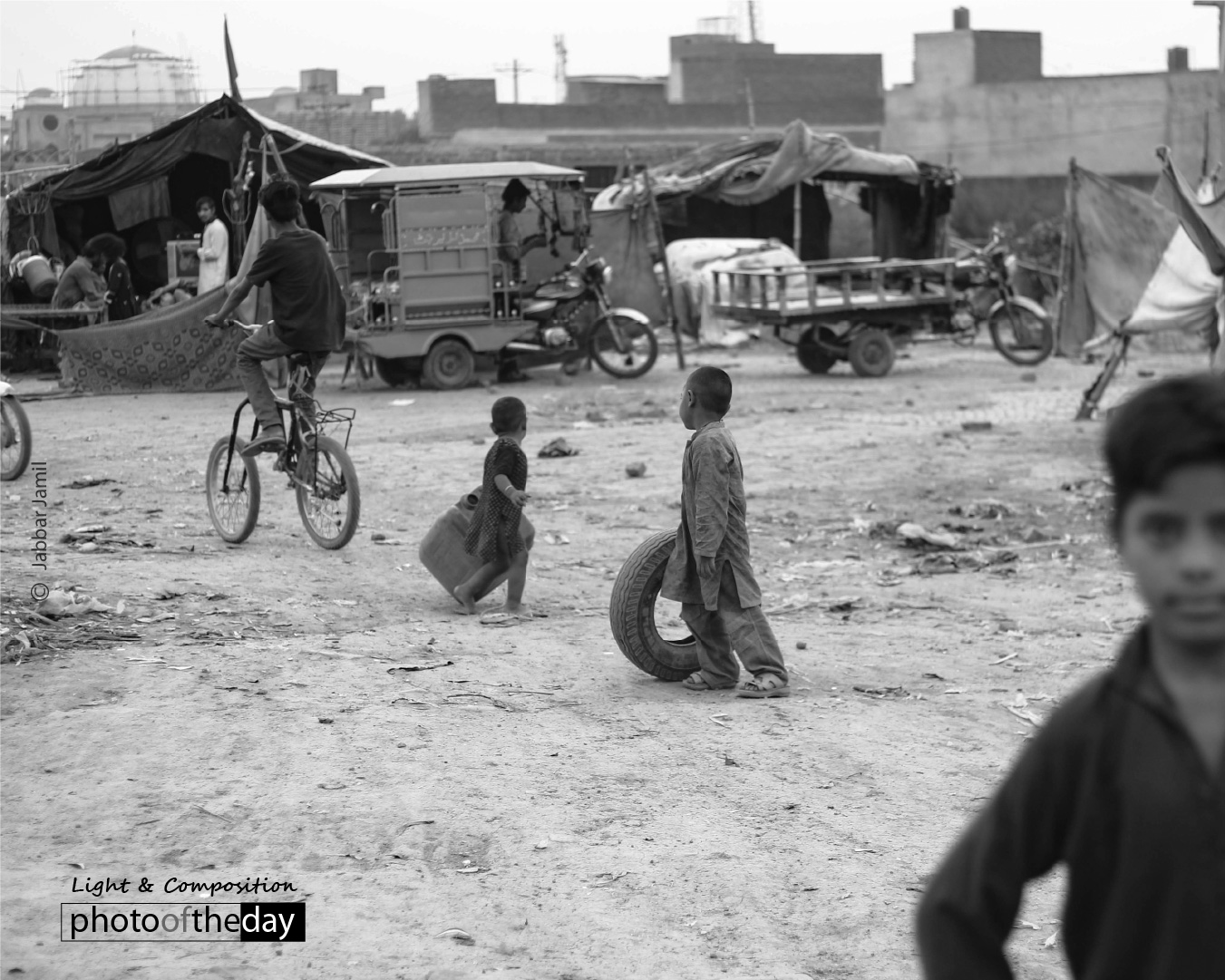
In the bustling streets of Sialkot, Pakistan, Jabbar Jamil captures a poignant contrast to the digital age. While many children today are tethered to consoles and mobile screens, these youngsters find joy in the discarded remnants of their environment, transforming broken bicycle parts and damaged tires into instruments of play. The photographer’s keen eye highlights the resilience and ingenuity of childhood, where imagination flourishes despite limited resources. This image is award-worthy for its raw, empathetic storytelling, turning a scene of poverty into a powerful testament to the universal human capacity for happiness and creative play.
Jabbar Jamil
Based in Sialkot, Pakistan, Jabbar Jamil is a dedicated street photographer who views the camera as a bridge to the outside world. His practice serves as both a creative outlet and a vital means of connecting with the diverse realities of his community, often documenting scenes that challenge conventional notions of beauty. Through his lens, Jamil explores the human condition, finding profound stories in the everyday lives of those around him.
Resonance Score Breakdown
Transparency Note: The resonance score (10.6/20) is calculated based on social engagement metrics collected before the award announcement.
Expert Photography Reviews · 7
The Architecture of Play
We often mistake the city for its infrastructure—the concrete, the glass, the planned zones of commerce and transit. But the true city is found in the margins, in the spaces where the official design fails to account for the human spirit.
Read the reflection →The Architecture of Joy
I remember a summer in a small village outside of Lucca where the local boys played football with a bundle of rags tied together with twine.
Read the reflection →Reviews & Comments
Share your thoughts about this award-winning photograph. Your reviews contribute to the community engagement score.
Sialkot’s urban fabric isn’t just a backdrop here; it’s a brutal, textured datum for these children. The crumbling masonry and jagged fenestration create a harsh rhythm, yet the way light catches the dust and those discarded tires softens the solid-void relationship. It’s a spatial negotiation I find deeply moving. You can almost feel the heat radiating off those walls. It’s not just a game; it’s a masterclass in reclaiming a space that wasn’t built for them.
You didn’t just snap a picture of kids playing with trash; you caught the exact second their imagination turned a rusted tire into a kingdom. I’ve spent years in places like Sialkot, and it’s easy to get lost in the grit. But you looked past the poverty and saw the joy. It’s infectious. My chest tightened when I saw that grin. You waited for the truth, and you found it. There’s something honest happening here.
Of the thousands of street scenes I’ve reviewed, most fade because they rely on pity. This doesn’t. The way those boys grip the rusted tire rim—it’s not about poverty, but the sheer velocity of their focus. I’ve seen countless kids playing, but the blur of the spinning wheel here feels like a heartbeat. It’s a rare, honest capture of joy that’ll still matter in thirty years. It’s the kind of resilience that makes me smile.
Henri Cartier-Bresson’s decisive moment often feels clinical, but Jamil’s Sialkot street scene breathes with a tactile, gritty urgency that recalls Helen Levitt’s New York children. The way these boys manipulate discarded rubber tires echoes the kinetic energy of Kertész’s early street studies. I’ve spent decades cataloging the aesthetics of poverty, yet the sheer, unvarnished joy here genuinely caught me off guard. It’s a rare, visceral reminder that play is the ultimate human rebellion against circumstance.
The focal plane here is razor-thin, isolating the rusted tire rim against a soft, atmospheric bokeh that’s a function of a wide aperture. I’m struck by how the lens resolves the fine, gritty texture of the rubber, pushing past what the naked eye registers in that dusty Sialkot light. It’s a beautiful optical compromise; the diffraction of light across those jagged metal edges is, in the strictest physical sense, extraordinary. It’s honestly quite moving to see.
Sialkot’s dust doesn’t just settle; it consumes. These children chase rusted rims through a void where light is a scarce, violent intruder. I’ve stared at the way the darkness swallows their limbs, and it’s haunting—it’s where their struggle truly resides. They aren’t playing; they’re negotiating with absence. When the shadows stretch this long, the joy feels like a desperate, beautiful defiance against an inevitable erasure. It’s a heavy, quiet ache in my chest.
Dust settles on the Sialkot street. A tire rolls. The children don’t need the clutter of a digital world. They’ve found the center of the frame in a discarded rim. It’s quiet here. I’ve spent minutes watching the way the light hits the dirt. The space around them isn’t missing anything. It’s holding the weight of their movement. Nothing here is accidental. The empty corner is not empty. It’s where the silence lives.