The Architecture of Play
We often mistake the city for its infrastructure—the concrete, the glass, the planned zones of commerce and transit. But the true city is found in the margins, in the spaces where the official design fails to account for the human spirit. When a neighborhood lacks the sanctioned playgrounds of the affluent, the street itself becomes a laboratory of invention. Here, the discarded debris of industry is reclaimed, transformed by the hands of those who refuse to be defined by their lack of resources. This is not merely play; it is a radical act of spatial reclamation. It reminds us that children are the most perceptive urbanists, seeing potential where adults see only waste. They do not wait for a permit to build their world; they simply occupy the gaps left behind by the formal economy. When we look at these spaces, we must ask ourselves: what does it say about our priorities when the most vibrant expressions of life occur in the cracks of our neglect?
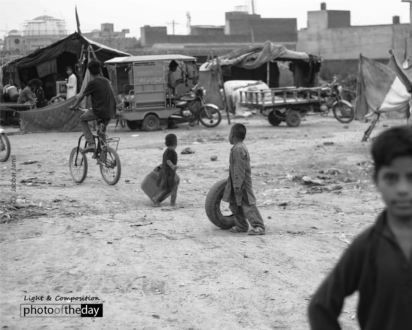
Jabbar Jamil has captured this reality in his image titled Slum Games. It serves as a stark reminder that the city is shaped as much by those who live in its shadows as by those who draw its maps. How do we ensure that the city remains a place for everyone to thrive, rather than just survive?