Tower Bridge by Stefan Thallner
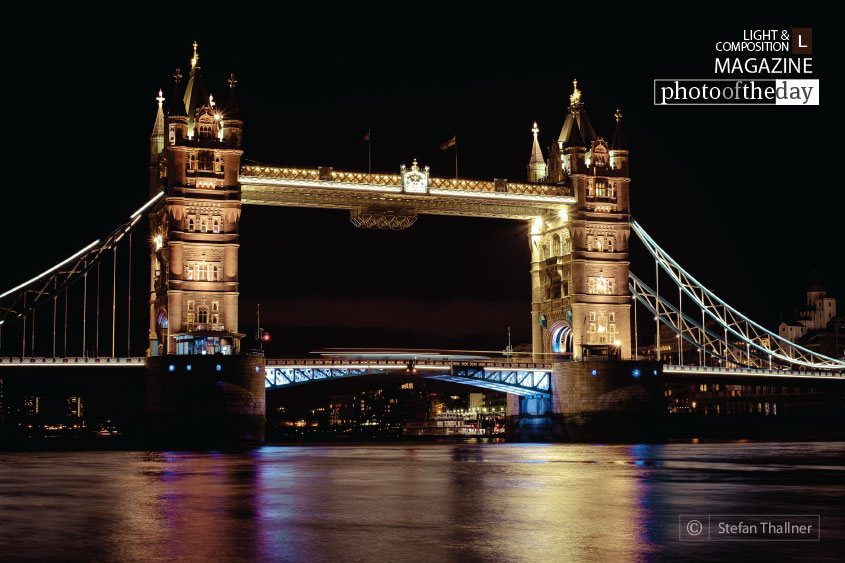
Stefan Thallner captures the iconic Tower Bridge in London, illuminated against the dark expanse of the River Thames. Faced with the challenge of shooting at night without a tripod, the photographer demonstrated remarkable ingenuity by utilizing the railing of the Tower Millennium Pier to stabilize the camera for a long exposure. This creative technical decision allowed for a crisp, vibrant capture of the bridge's architectural details and its shimmering reflections. The image is award-worthy for its masterful handling of low-light conditions and the evocative, serene atmosphere it creates, transforming a familiar landmark into a timeless nocturnal study.
Stefan Thallner
Born in 1987 and based in Allhartsberg, Austria, Stefan Thallner is a web developer and dedicated photographer whose passion was ignited by his grandfather's vintage camera equipment. After honing his skills through early DSLR experimentation and academic studies in informatics, he has developed a photographic style defined by technical precision and a sense of creative freedom. His commitment to exploring new challenges has earned him recognition, including a victory in Scott Kelby's Worldwide Photo Walk, as he continues to balance his professional IT career with his pursuit of artistic expression through the lens.
Resonance Score Breakdown
Transparency Note: The resonance score (12.2/20) is calculated based on social engagement metrics collected before the award announcement.
Expert Photography Reviews · 8
The Weight of Stillness
I spent an hour this morning trying to fix a wobbly chair in my kitchen. I kept shifting the legs, adding folded bits of cardboard, and holding my breath, hoping for a moment of perfect balance.
Read the reflection →The Weight of Water
The river does not care for the stone or the steel. It moves with a heavy, rhythmic indifference, carrying the city’s discarded light toward the sea. We build monuments to hold our place in time, anchoring ourselves to the banks, hoping the current will recognize our permanence.
Read the reflection →Reviews & Comments
Share your thoughts about this award-winning photograph. Your reviews contribute to the community engagement score.
The bridge’s verticality anchors the frame, yet the composition doesn’t collapse under the weight of the Thames. It’s a rigid geometry. The long exposure flattens the water into a dark, obsidian plane, forcing the eye toward the illuminated ironwork. I’ve grown weary of such landmarks, but the structural discipline here is undeniable. The railing provided the necessary fulcrum. It’s a cold, precise arrangement. The frame holds. It’s a rare moment of architectural equilibrium.
London’s Tower Bridge usually demands our gaze, but here, it’s the river that tells the story. By resting his camera on the pier’s cold railing, Stefan didn’t just capture light; he listened to the Thames. We see the bridge’s reflection shivering in the dark water, a silent, liquid conversation between stone and tide. It’s hauntingly still. I find myself holding my breath, waiting for the water to speak. It’s a portrait of a city finally resting.
Most night shots of Tower Bridge are postcard clutter, but Thallner’s restraint here is what earns its place. By bracing against the pier railing, he achieved a stillness that feels almost architectural. I’ve seen thousands of long exposures, yet the way the light bleeds into the Thames without losing the bridge’s structural integrity genuinely stops me. It’s not just a souvenir; it’s a quiet, enduring study of London’s pulse that won’t feel dated in thirty years.
The shutter stays open for four seconds, and the Thames turns into black silk. It’s a long take, a breath held in the dark. Thallner didn’t need a tripod; he used the pier’s iron as a dolly track. The bridge glows, sharp and cinematic. I’ve walked this pier a hundred times, but I’ve never seen the light hit the water quite like this. It’s the frame the editor keeps. A perfect, silent cut.
4.3 seconds at f/8.0, ISO 200, 35mm. A calculated risk. Using a pier railing as a makeshift tripod is a gamble that paid off here. The X-E1’s sensor stays clean at base ISO, and f/8.0 keeps the bridge’s architecture sharp across the frame. It’s a rigid, disciplined choice. I’ve spent years fighting camera shake, so I’ll admit, seeing this level of stability without a tripod actually makes me smile. It’s technically sound work.
The river isn’t just water. It’s a black void, swallowing the light. I’m drawn to the dark stretch beneath the bridge. It’s quiet there. Thallner didn’t crowd the frame with the city’s noise. He let the shadows breathe. Nothing here is accidental. The empty corner is not empty. It’s a pause. I’ve stood on that pier, and for a moment, I felt the cold air settle. It’s a rare, still grace.
The bridge glows with the bruised, electric violet of a dying neon bulb, bleeding into the Thames’s ink-black depths like oil on water. It’s a Morandi-esque meditation on stillness, where the artificial amber of the lamps hums against the cold, tidal indigo of the night. I’m utterly breathless at how the light clings to the steel, turning industrial metal into a soft, shimmering ghost that haunts the river’s dark, velvet throat. It’s hauntingly, achingly beautiful.
At f/8, the X-E1’s 35mm lens sits comfortably above the diffraction limit, resolving the bridge’s steel lattice with clinical precision. The long exposure renders the Thames as a laminar flow, smoothing the photon scatter into a velvet dark. I’m genuinely moved by how the pier’s railing stabilized the sensor, preventing micro-jitter. It’s a rare moment where the physics of the glass perfectly aligns with the architecture, turning cold light into something hauntingly, beautifully still.