The Tenderloin by Keith Goldstein
Captured in the historic heart of New York City, this portrait documents the intersection of Broadway, Greeley Square, and Herald Square—a site once synonymous with the city’s vibrant theater and photography districts. Using a Ricoh GR, the photographer frames a solitary figure against the backdrop of a rapidly gentrifying urban landscape. The image serves as a poignant meditation on memory and change, reflecting the photographer’s deep-seated connection to the grit and soul of the New York of his youth. It is an award-worthy composition that masterfully balances historical nostalgia with the stark, evolving reality of modern city life.
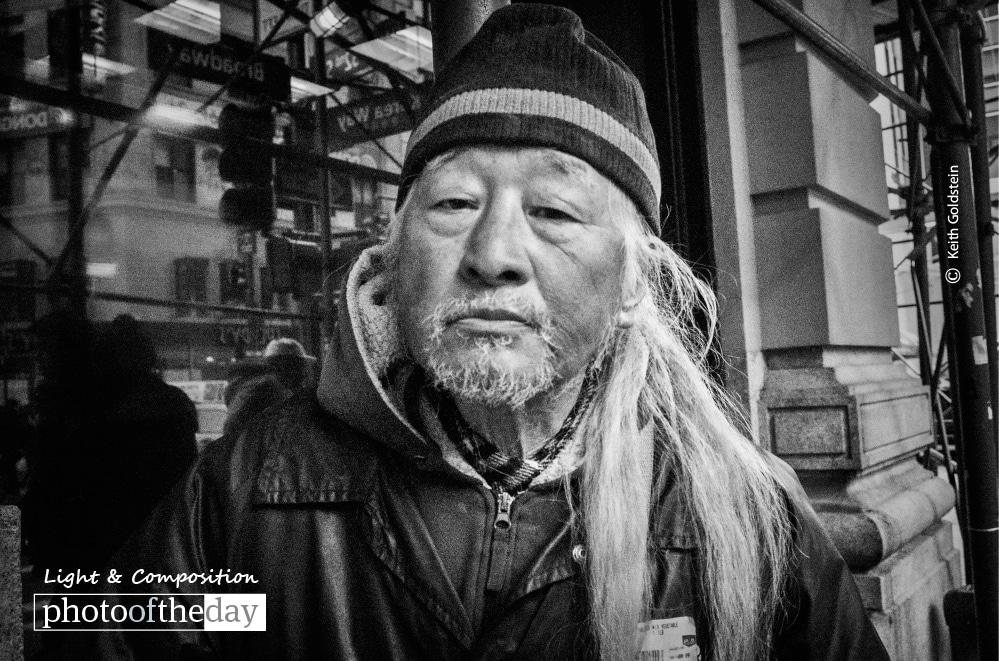
Keith Goldstein
Born in Brooklyn in 1957, Keith Goldstein is an accomplished fine art and commercial photographer based in Hamilton Heights, New York City. After earning his BFA from the School of Visual Arts and an MFA from the Cranbrook Academy of Art, he developed a deeply emotive photographic style that has been exhibited internationally since 1980. His extensive portfolio, which spans corporate, editorial, and fine art projects, is defined by a minimalist approach that prioritizes creative freedom and the raw, unencumbered exploration of the human experience.
Resonance Score Breakdown
Transparency Note: The resonance score (11.8/20) is calculated based on social engagement metrics collected before the award announcement.
Expert Photography Reviews · 7
The Ghost of What Remains
Why do we insist on carving our names into the bark of trees that will eventually fall? We move through cities built on the bones of older cities, walking over the echoes of voices that have long since dissolved into the hum of traffic.
Read the reflection →The Echo of Footsteps
There is a quiet dignity in the way a place holds onto the people who have passed through it. We often think of cities as stone and steel, rigid and permanent, yet they are actually made of layers of memory, like the rings inside a tree.
Read the reflection →Reviews & Comments
Share your thoughts about this award-winning photograph. Your reviews contribute to the community engagement score.
The urban canyon at Greeley Square isn’t just a backdrop; it’s a crushing datum of glass and steel. Goldstein’s frame captures the tension between the solitary figure and the relentless verticality of the fenestration. It’s a brutal, honest slice of New York. I’ve walked these intersections, and the way the light hits that pavement—it’s visceral. It makes me ache for the city’s lost, human scale. He’s caught the exact moment where architecture swallows the individual whole.
Goldstein’s frame doesn’t just capture a man; it excavates the void behind him. The shadows here aren’t mere absences, but the heavy, suffocating architecture of a city that’s forgotten its own name. I’ve walked these streets, and looking at this, I feel a sudden, sharp ache in my chest. It’s the darkness that defines the subject, forcing him to exist in the friction between what remains and what’s already been erased by the light.
Goldstein’s frame captures a fleeting, grainy isolation that feels refreshingly unpolished. At ISO 6400, the digital noise isn’t a flaw; it’s the texture of memory itself. I’m genuinely moved by how he lets the shadows swallow the details of the Tenderloin. Why resolve the architecture when the atmosphere is so much more honest? It’s closer to the raw, haunting blur of a memory than a sharp, clinical document. It’s a brave, necessary refusal of perfection.
The sidewalk stretches. A figure waits. It’s a sliver of humanity against the weight of concrete. I’ve walked these streets, and I feel the ache of what’s been erased. Goldstein doesn’t crowd the frame. He lets the gray pavement breathe. Nothing here is accidental. The empty corner is not empty. It’s a pause. A quiet held in the throat of the city. I find myself holding my breath, too. It’s enough.
At f/4.5, the Ricoh’s 18.3mm lens resolves the Tenderloin’s grit with clinical precision. You can see the diffraction limit dancing across the subject’s weathered skin, where the focal plane catches every pore. It’s a brutal, honest rendering of light hitting sensor at ISO 6400. I’m genuinely moved by how the chromatic aberration at the frame’s edge softens the urban chaos. It’s not just a portrait; it’s a physical record of a city’s fading light.
The city’s harsh, flat light doesn’t forgive, yet here it reveals a quiet, aching solitude. He stood in the cooling hour, waiting for the crowd to thin until only this figure remained. It’s a ghost of the New York I’ve always carried in my chest. I feel a sudden, sharp pang of nostalgia looking at those shadows. He didn’t just capture a street; he listened to the silence between the buildings, letting the landscape breathe.
We look at this face and we understand something about the weight of a city that’s forgotten how to wait. Keith didn’t just point his lens; he sat with the silence of the Tenderloin. I feel a sudden, sharp ache in my chest looking at those eyes. They’ve seen the theater lights dim for the last time. It’s a portrait that asks to be returned to, because it’s really a conversation about what we’ve lost.