Books Napoli by Barry Cawston
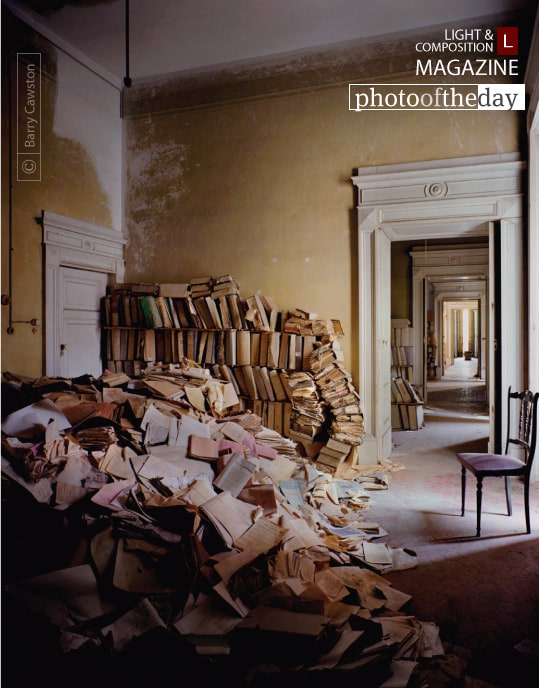
Captured within the decaying grandeur of an abandoned Palazzo in Naples, this photograph documents a former records office left to the elements. The scattered archives create a poignant, unintentional installation, where the weight of history meets the stillness of abandonment. Barry Cawston masterfully balances the room’s palpable sense of loss with the ethereal, golden light streaming through open doors, suggesting a quiet resilience. The image is award-worthy for its evocative narrative quality and the deliberate use of large-format film, which renders the textures of the crumbling space with a timeless, painterly depth that elevates a simple scene into a profound meditation on time.
Barry Cawston
Based in Axbridge, Somerset, Barry Cawston is a distinguished freelance photographer whose work has appeared in prominent publications such as The Guardian and The Sunday Telegraph. Known for his technical mastery, he frequently employs a large-format field camera and produces traditional darkroom prints, often on a grand scale. His career is marked by significant accolades, including the South West Art Award and the Nikon Endframe Award, alongside numerous solo exhibitions in London’s prestigious galleries. Beyond his individual practice, he co-manages The Drugstore Gallery, dedicated to showcasing contemporary photographic talent at international art fairs.
Resonance Score Breakdown
Transparency Note: The resonance score (14.0/20) is calculated based on social engagement metrics collected before the award announcement.
Expert Photography Reviews · 6
The Archive of Dust
We are all, in the end, just paper left in the path of the sun. We collect our days like loose pages, stacking them in corners, hoping the weight of our words will anchor us against the draft of time.
Read the reflection →The Weight of Unread Pages
In the quiet corners of an old house, there is a specific kind of silence that belongs only to paper.
Read the reflection →Reviews & Comments
Share your thoughts about this award-winning photograph. Your reviews contribute to the community engagement score.
The ochre dust settling upon these forgotten ledgers evokes the muted, chalky stillness of a Morandi study, where light doesn’t merely illuminate but breathes through the decay. It’s the bruised, honeyed gold of a dying afternoon that truly breaks my heart, bleeding across the floorboards like spilled wine. One finds a haunting, chromatic equilibrium here, a fragile harmony where the shadows aren’t merely absent light, but deep, velvet pools of history waiting to be felt.
Most entries in this category rely on the easy melancholy of ruin, but Cawston’s work avoids that trap. By using a 5×4 field camera, he forces us to confront the granular decay of every discarded ledger. It’s the light hitting those paper piles that gets me; it feels like a final, golden breath before the archive vanishes. In thirty years, this won’t just be a photo of a room—it’ll be a document of lost human order.
Naples isn’t just decaying here; it’s exhaling. Those scattered archives don’t merely sit; they anchor the light, forcing it to negotiate with the encroaching gloom. I’ve spent hours staring at these shadows, and honestly, they make my chest ache. Cawston understands that darkness isn’t an absence, but a heavy, velvet archive of what we’ve forgotten. It’s a brutal, beautiful refusal to let the past vanish into the glare. It doesn’t invite us in; it demands our silence.
Dust settles on these forgotten archives, yet the light feels alive, breathing through the Palazzo’s decay. He stood here in the cooling hour, waiting for that golden spill to touch the paper. It’s a heavy, quiet grace. I’ve spent hours in similar silence, and looking at these scattered records, I feel a sudden, sharp ache for the stories left behind. The land—or what remains of it—was finally ready to be heard. It’s beautiful.
The frame’s geometry hinges on the central aperture. It’s a rigid anchor for the chaotic drift of paper. The vertical lines of the doorframe provide necessary structural discipline against the floor’s entropy. I’ve rarely seen such precise spatial tension. The light doesn’t just illuminate; it defines the picture plane’s depth. It’s cold, clinical, and perfectly balanced. Honestly, the way those scattered archives hold the center against the encroaching decay is nothing short of architectural perfection.
Setting up a Wista in a Neapolitan ruin isn’t for the faint of heart. One imagines the dust alone would have sent a lesser photographer packing. Cawston clearly didn’t rush this. The light hitting those scattered archives feels deliberate, as if he sat in the damp silence until the room finally decided to cooperate. I’ve spent enough hours waiting for shadows to shift to know when a man has truly earned his frame. It’s a quiet, heavy triumph.
southern desolate atmosphe, very poetic.
Thanks for sharing this with us
great work …:)