Rainy Good Bye by Shahnaz Parvin
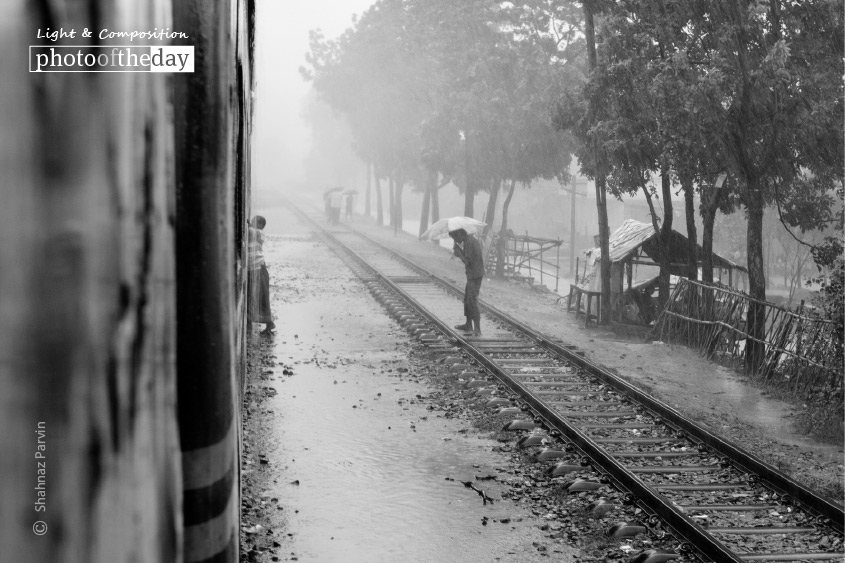
Captured at Pagla Railway Station, this poignant image documents a moment of departure amidst a torrential downpour. The photographer, drawn to the emotional weight of the scene, stepped out into the rain to frame a young boy bidding farewell to his loved ones. The composition masterfully balances the atmospheric gloom of the heavy rain with the raw, human vulnerability of the subject. This photograph is award-worthy for its ability to transform a fleeting, everyday transit encounter into a timeless narrative of connection and loss, rendered with technical precision and deep empathy.
Shahnaz Parvin
Shahnaz Parvin was a celebrated award-winning photojournalist based in Bangladesh, recognized globally for her profound documentary work. Throughout her career, she consistently ranked among the world’s top photographers, capturing the essence of South Asian culture, conflict, and daily life with a distinctive lens. As a dedicated contributor to Light & Composition, she left an indelible mark on the field of photography before her untimely passing in 2016, remembered for her unwavering passion for storytelling and her commitment to representing her homeland.
Resonance Score Breakdown
Transparency Note: The resonance score (13.5/20) is calculated based on social engagement metrics collected before the award announcement.
Expert Photography Reviews · 6
The Weight of Water
In the nineteenth century, it was believed that rain could wash away the sins of a city, a cleansing deluge that left the cobblestones polished and the air scrubbed of its heavy, industrial soot.
Read the reflection →The Salt of Leaving
The smell of wet iron and crushed gravel always pulls the breath from my lungs. It is a heavy, metallic scent, the kind that clings to the back of your throat like the taste of a copper coin held too long under the tongue.
Read the reflection →Reviews & Comments
Share your thoughts about this award-winning photograph. Your reviews contribute to the community engagement score.
In ‘Rainy Good Bye’, shadow is not merely the absence of light—it is where the psychological weight of the image resides. The rich contrast and textured darks sculpt the contours of the subject with dramatic intensity. The interplay between luminous highlights and contemplative shadows creates an atmosphere that invites sustained, thoughtful reflection. It is an image that acknowledges the complexity of existence.
What strikes me immediately in ‘Rainy Good Bye’ is the raw, unforced authenticity. Shahnaz Parvin has a rare gift for stepping into a community and capturing moments of profound human dignity without intrusion. The subject’s expression and posture speak with complete honesty; there is no performance here, only life witnessed with deep empathy and respect. You waited for the exact right second, and the result is timeless.
Optically and technically, ‘Rainy Good Bye’ delivers exceptional execution. The depth of field is measured to isolate the vital textural details while maintaining context in the background. Exposure values are tightly controlled, retaining subtle highlight gradations without crushing the shadow details. The shutter speed captures the organic cadence of the environment cleanly, proving that intentional camera craft is the bedrock of powerful imagery.
Most people would have retreated to the shelter of the platform, but Parvin clearly didn’t. Standing in a monsoon with a 5D isn’t for the faint of heart; it’s a recipe for ruined gear and pneumonia. I’ve been that wet, and it’s miserable work. Yet, the boy’s expression through that grey curtain of rain feels entirely earned. She didn’t just happen upon this; she endured the deluge to capture the ache of leaving. It’s a proper photograph.
Stripped of pigment, the silver-grey tonality here evokes the melancholic, dust-choked light of a Morandi still life, yet it’s far more visceral. One feels the damp weight of the Dhaka monsoon pressing against the skin, a suffocating, monochromatic shroud that turns the boy’s grief into a tactile, liquid ache. It’s haunting; I’ve found myself shivering, as if the charcoal shadows of Pagla station were leaching the very warmth from my own tired bones.
The frame’s geometry is tight. Rain streaks provide a vertical grid that anchors the boy’s slight form against the platform’s heavy, blurred mass. It’s a precarious balance. The negative space above the tracks creates a necessary void, preventing the sentiment from collapsing into mere narrative. I’ve rarely seen such a disciplined use of atmospheric blur to define a subject’s isolation. It doesn’t just hold; it demands a cold, structural respect for the architecture of grief.