Praying by Magda Biskup
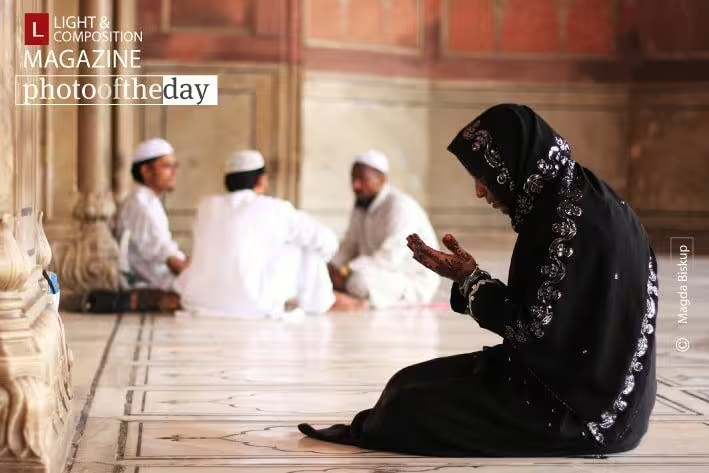
Captured within the historic walls of Jama Masjid in Old Delhi, this photograph documents a moment of quiet devotion amidst the bustling daily life of the mosque. The photographer, positioned in a corner to observe the rhythmic routine of the faithful, was drawn to a woman whose presence stood out for its grace. The image highlights the intricate details of her scarf and the delicate henna patterns on her hands, creating a poignant study of faith and culture. Its award-worthy quality lies in the intimate, respectful connection between the subject and the lens, capturing a timeless human experience.
Pesch Andreas
In the 1960s and 1970s Pesch Andreas took pictures of his class and the environment with SLR in black and white, developing the pictures in the family cellar. Later photography was more and more forgotten. In was around 2015, when Andreas started taking pictures from “Magdeburg Knabenchor” a boy’s choir where his son is singing. Later he took his camera with him, whenever he went out with his dog. With the start of pandemic situation there was more time and wildlife photographing stared to be like hunting: getting good pictures was more and more satisfaction and therefore more good gear had to be bought and more experience had to be made. That’s where he is now and experience will go on. Current Location Magdeburg, Germany Instagram https://www.instagram.com/pesc
Resonance Score Breakdown
Transparency Note: The resonance score (14.4/20) is calculated based on social engagement metrics collected before the award announcement.
Expert Photography Reviews · 6
The Architecture of Silence
We spend our lives building walls, brick by brick, to keep the chaos of the world at bay. We construct fortresses of routine and habit, hoping to find a sanctuary where the noise of the street cannot reach our marrow.
Read the reflection →The Weight of Silence
The smell of old stone always pulls me back to the earth, a cool, damp scent that clings to the back of the throat like moss. It is a heavy, grounded fragrance, the kind that settles into your skin after a long walk through a place where time has slowed to a crawl.
Read the reflection →Reviews & Comments
Share your thoughts about this award-winning photograph. Your reviews contribute to the community engagement score.
The frame’s geometry relies on the vertical alignment of the pillars to anchor the subject’s posture. It’s a tight, disciplined architecture. The negative space surrounding the figure creates a necessary vacuum, preventing the henna patterns from cluttering the visual field. I’m genuinely struck by how the shallow depth of field isolates the hands, forcing the eye to acknowledge the fulcrum of the composition. It doesn’t collapse into sentimentality. The structure holds. It’s a rare, precise equilibrium.
One suspects the photographer didn’t just stumble upon this corner. To capture such stillness amidst the chaos of Jama Masjid requires a stubborn sort of patience I’ve spent many freezing mornings trying to master. The focus on those henna patterns is sharp, intimate, and frankly, it’s earned. I find myself genuinely moved by the quietude here. It’s clear she waited until the world stopped moving around her. That’s the only way to get the shot.
Light doesn’t merely illuminate the henna on her hands; it interrogates the silence of the Jama Masjid. Biskup understands that shadow isn’t an absence, but a sanctuary where faith hides from the frantic Delhi sun. I’ve stared at these folds of fabric until my own pulse slowed. It’s a heavy, deliberate act of seeing. When the darkness is this thick, it doesn’t just frame the subject—it forces us to confront the weight of her solitude.
The ochre dust of Delhi’s Jama Masjid settles into the fabric of her scarf like the muted, chalky pigments of a Morandi still life, creating a chromatic resonance that feels almost sacred. It’s the way the light catches the hennaed skin, a burnt-sienna warmth that makes my own pulse quicken with a sudden, sharp ache of recognition. One finds here a quiet, tonal gravity that doesn’t merely exist; it breathes in the shadows of the stone.
Of the thousands of spiritual portraits I’ve reviewed, most rely on cheap exoticism. Biskup avoids this by focusing on the geometry of the hands. That tight f/1.8 depth of field isolates the henna patterns, forcing us to confront the subject’s tactile reality rather than just her surroundings. It’s an intimate, quiet victory. I felt a genuine ache looking at those fingers; it’s a rare, honest connection that will still matter in thirty years. It’s earned its place.
The light here isn’t merely illuminating the stone; it’s listening to the silence of her prayer. She’s found a pocket of stillness within the Jama Masjid’s vast, echoing history. I’ve felt that same hum in my own lungs when the world finally stops moving. The way the light catches the henna on her hands—it’s so tender, it almost hurts to look. She wasn’t posing; she was simply existing, and the camera finally caught up.