Salfeins Lake by Karin Eibenberger
Captured during a serene bivouac night above Innsbruck, this photograph documents the fleeting moments before sunrise over the Karwendel mountain range. The photographer positioned the camera at Salfeins Alm, utilizing the reflective surface of Salfeins Lake to anchor the foreground against the dramatic, jagged silhouette of the Kalkkögel mountains. By balancing the long exposure required for the pre-dawn light with a wide-angle perspective, the image captures a profound sense of stillness and scale. This work is award-worthy for its masterful composition and the evocative, ethereal quality of the alpine light, which transforms a rugged landscape into a tranquil, meditative experience.
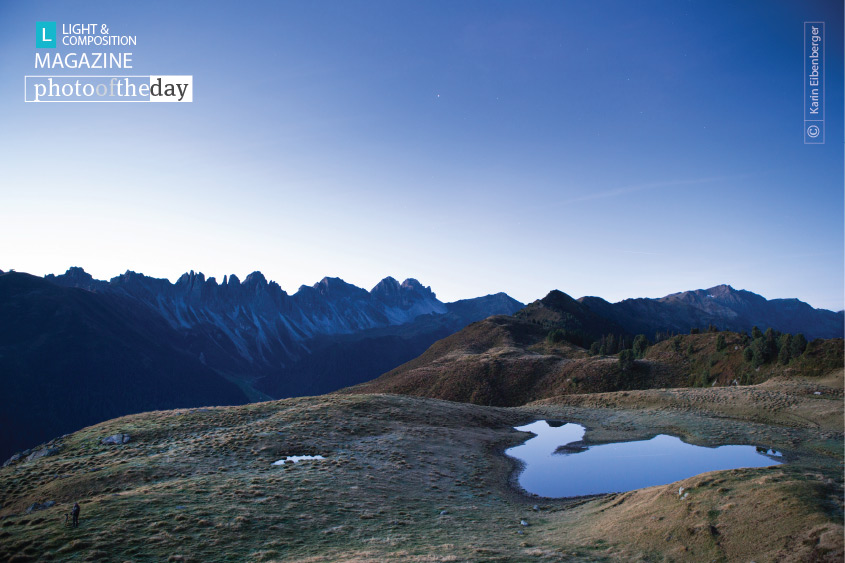
Exposure 8sec @ f/3.5 | ISO 500 | Focal Length 24mm
Karin Eibenberger
Born and raised in Waidhofen, Austria, Karin Eibenberger is a multifaceted professional who balances a career in biomedical engineering with a deep passion for the outdoors. Currently based in Baltimore, Maryland, she combines her background in literature and science with an adventurous spirit that leads her to trek, climb, and motorcycle across the globe. For Eibenberger, photography serves as a vital medium for communication, allowing her to share the raw beauty of the natural world and evoke emotional responses through her lens.
Resonance Score Breakdown
Transparency Note: The resonance score (6.1/20) is calculated based on social engagement metrics collected before the award announcement.
Expert Photography Reviews · 5
The Breath of Cold Stone
The air at high altitude has a specific metallic tang, like licking a frozen spoon. It is a sharp, clean scent that clears the sinuses and settles deep in the lungs, making every breath feel like a deliberate act of survival.
Read the reflection →The Edge of the Commons
We often speak of the wilderness as a place devoid of human footprint, a pristine sanctuary untouched by the messy negotiations of urban life. Yet, even in the highest reaches of the mountains, we are projecting our desire for stillness onto the landscape.
Read the reflection →Reviews & Comments
Share your thoughts about this award-winning photograph. Your reviews contribute to the community engagement score.
You spent the night in a bivouac just to catch this. I can feel the cold air biting at your fingers while you waited for that light to break over the Kalkkögel. It’s quiet, isn’t it? That eight-second exposure didn’t just capture a mountain; it captured your patience. I’ve been in those high places, and you’ve managed to bring that specific, lonely stillness back down with you. There’s something honest happening here. You were really there.
The water holds the mountain. It’s a mirror, but quieter. I’ve spent minutes staring at the dark, still surface of the lake. It’s not just water. It’s a breath held in the cold air of the Tyrol. The jagged peaks above don’t crowd the frame; they define the void below. Nothing here is accidental. The empty corner is not empty. It’s the weight of the silence. I feel my own pulse slow down.
The horizon line bisects the frame with surgical precision, anchoring the Kalkkögel against their own reflection. It’s a rigid geometry that demands total submission from the viewer. The negative space of the lake acts as a necessary fulcrum, balancing the jagged mass of the peaks. I’ve rarely seen such cold, structural discipline in alpine work. It doesn’t rely on sentiment. The composition holds, and frankly, the sheer architectural austerity of this stillness is quite breathtaking.
At f/3.5, the 24mm focal plane barely resolves the Kalkkögel’s jagged micro-contrast, yet the diffraction limit remains mercifully distant. The lake’s surface acts as a low-pass filter, softening the pre-dawn photons into a velvet stillness. I’m genuinely moved by how the sensor’s ISO 500 noise floor mimics the grain of high-altitude air. It’s a delicate optical dance; she’s captured the exact moment where the light’s wave-particle duality feels like a quiet, shivering breath against the mountain.
The Kalkkögel mountains don’t just loom; they interrogate the void. Eibenberger’s long exposure pulls the pre-dawn silence into a heavy, liquid stillness, yet I’m unsettled by how the lake refuses to fully surrender its depths to the light. It’s a cold, existential friction. I’ve stared at these jagged silhouettes until my eyes ached, feeling the weight of the encroaching dark. It doesn’t invite us in; it demands we acknowledge the abyss beneath the surface.