Fisherman’s Livelihood by Masrur Ashraf
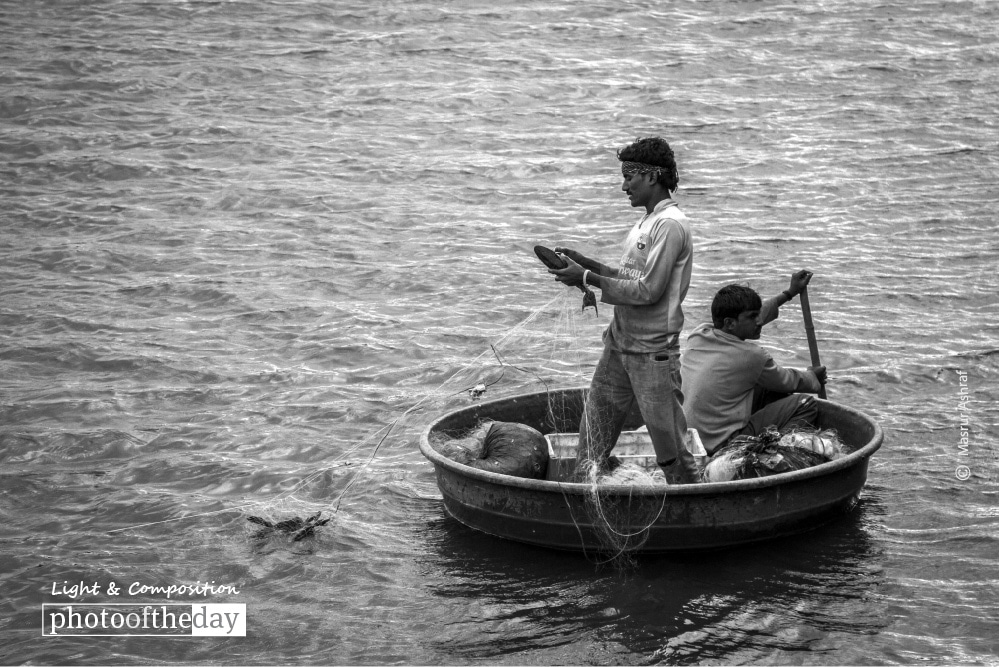
Captured during a serene day at Lal Bagh Gardens in Bengaluru, this photograph documents the quiet endurance of local fishermen. The photographer observed these individuals as they spent hours navigating the calm waters, their rhythmic movements reflecting a profound sense of patience and dedication. By focusing on the labor behind their livelihood—whether for sustenance or local trade—the image serves as a poignant meditation on the virtues of persistence. The composition is award-worthy for its ability to transform a simple, everyday task into a universal narrative about the human spirit, highlighting the dignity found in traditional ways of life.
Masrur Ashraf
Born in Dhahran, Saudi Arabia, to Indian parents, Masrur Ashraf is a multifaceted professional who balances a career in investment promotion with a deep-seated passion for photography. His artistic journey began in childhood with his father’s vintage Canon AE-1, eventually evolving into a dedicated pursuit of landscape and rural life photography. Drawing inspiration from his roots in West Bengal, Ashraf focuses his lens on the humbling beauty and dynamism of Indian village life, striving to convey complex human stories through the evocative power of his images.
Resonance Score Breakdown
Transparency Note: The resonance score (12.1/20) is calculated based on social engagement metrics collected before the award announcement.
Expert Photography Reviews · 6
The Weight of the Net
I keep a small, rusted thimble in a ceramic bowl on my desk, a relic from my grandmother’s sewing kit. It is dented from years of pushing needles through heavy wool, its surface worn smooth by the repetitive labor of keeping things whole.
Read the reflection →The Rhythm of the Watershed
The caddisfly larva spends its early life submerged, meticulously gathering grains of sand and tiny twigs to construct a protective casing that it carries through the current.
Read the reflection →Reviews & Comments
Share your thoughts about this award-winning photograph. Your reviews contribute to the community engagement score.
The water in Lal Bagh doesn’t just reflect the sky; it holds the weight of these men’s morning. I’ve spent enough hours by the shore to recognize the stillness in their posture. They aren’t rushing the catch. The light here is soft, almost heavy, pressing against the ripples. It’s a quiet, rhythmic devotion I find deeply moving. He stood there for a long time, I’m sure, waiting for the water to finally speak back to him.
The frame’s geometry hinges on the diagonal sweep of the net, slicing the picture plane with surgical intent. It’s a rigid architecture that anchors the fisherman’s labor against the stillness of the water. The negative space isn’t empty; it’s a calculated void that forces the eye back to the central tension. I’ve rarely seen such disciplined placement. It doesn’t rely on sentiment. The structure holds, and frankly, it’s the only thing keeping the frame from collapsing.
Before the eye identifies the boat, something in the chest slows. It’s the stillness of the water that catches me; I feel my own pulse drop to match that rhythmic, solitary labor. Ashraf captures a quiet endurance that doesn’t demand attention, yet it lingers. When I return to this, I’m struck by the weight of the silence. It’s a heavy, grounding peace that follows me home, reminding me how rarely we truly sit with ourselves.
You waited for the rhythm, didn’t you? There’s a heavy, quiet dignity in how these men move across the water. It’s not just labor; it’s a life carved out of patience. I’ve spent enough time on the docks to know that look of focus. And honestly, it makes me miss the stillness of a morning like that. You didn’t force the frame. You let the work speak for itself. That’s the truth I’m always looking for.
The Canon 7D’s sensor resolves the water’s micro-contrast with startling precision. At this aperture, the focal plane renders the ripples as distinct, geometric interference patterns rather than mere blur. I’m genuinely moved by how the diffraction of light across the fisherman’s weathered skin reveals textures the naked eye simply misses. It’s a rare moment where the lens pushes past human perception, capturing the physics of patience itself. It doesn’t just document labor; it maps the optics of endurance.
The water here doesn’t merely reflect; it swallows. Ashraf’s shadows aren’t absences, but the heavy, silent weight of a life spent waiting for a pull beneath the surface. I’ve stared at these dark ripples until my own pulse slowed to match the fisherman’s rhythm. It’s a haunting, claustrophobic stillness. Most photographers fear this much black, but here, the darkness is where the labor actually happens. It’s where the soul of the work finally hides.