A Moment of Relief by Saniar Rahman Rahul
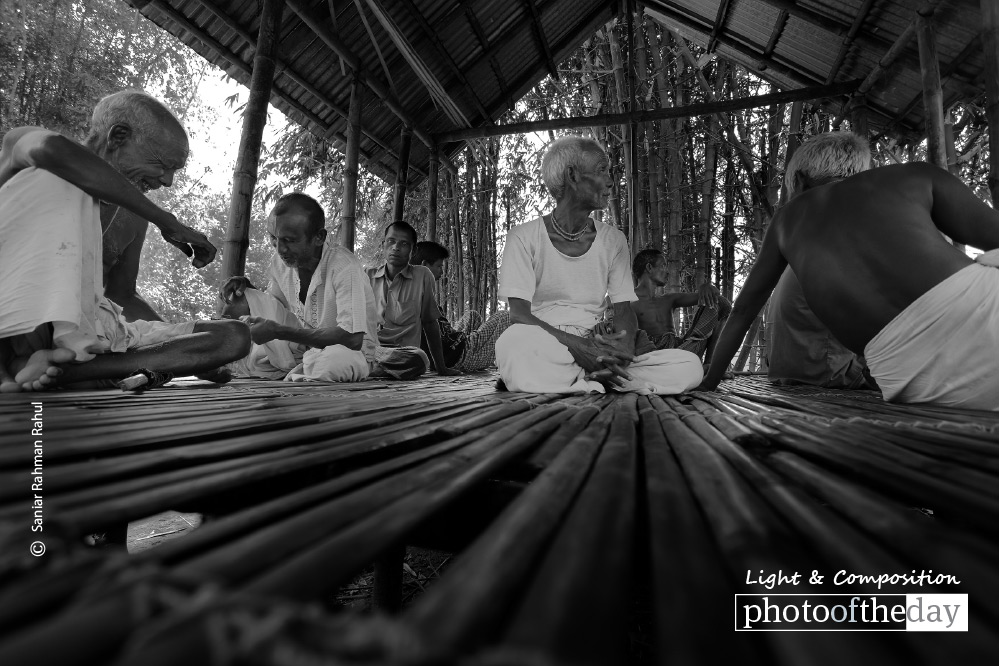
In the remote northern village of Nilphamari, Bangladesh, Saniar Rahman Rahul captures a poignant moment of communal respite. Amidst the sweltering heat, local residents gather in this shared space, finding both physical relief and social connection. The photograph serves as a sensitive documentary study of a conservative, impoverished community, highlighting the quiet rhythms of daily life. Its award-worthy quality lies in the photographer’s ability to transform a simple, candid scene into a profound narrative of human endurance and solidarity, rendered with a deep respect for the subjects' environment and cultural context.
Saniar Rahman Rahul
Based in Dhaka, Bangladesh, Saniar Rahman Rahul is an accomplished Art Director at Grey Worldwide with a career deeply rooted in the visual arts. His photographic journey began in childhood, inspired by his father’s work, and was later refined through his extensive professional background in graphic design and advertising. Since winning his first major photography award in 2010, Rahul has balanced his high-level corporate creative responsibilities with a dedicated pursuit of documentary photography, capturing the authentic human stories of his homeland with a professional’s eye for composition and narrative.
Resonance Score Breakdown
Transparency Note: The resonance score (13.2/20) is calculated based on social engagement metrics collected before the award announcement.
Expert Photography Reviews · 5
The Weight of the Shade
I remember sitting on a rusted bench in a small town in Rajasthan, waiting for a bus that was already three hours late. The heat was a physical weight, pressing down on the shoulders of everyone in the square.
Read the reflection →The Architecture of Respite
We often mistake the city for its hard edges—the concrete, the steel, the rigid lines of property and zoning. But the true life of a place is found in the soft spaces, the pockets of shade where the relentless pressure of survival momentarily relents.
Read the reflection →Reviews & Comments
Share your thoughts about this award-winning photograph. Your reviews contribute to the community engagement score.
f/5.6 at 1/250s, ISO 400, 35mm. A standard documentary aperture. It’s a safe choice, yet it keeps the village context sharp without isolating the subjects into irrelevance. The shutter speed is sufficient to freeze the motion of the crowd. I’ve seen too many soft, over-processed attempts at this. Rahul’s restraint is refreshing. It’s technically sound, and honestly, the lack of digital noise in those shadows makes me respect the discipline here. It’s a clean, honest execution.
The frame hinges on a powerful diagonal, pulling the eye from the lower-left cluster of figures toward the upper-right shadow. It’s a precise 3:2 spatial tension. The vertical axis of the central pillar anchors the composition, balancing the negative space against the dense, rhythmic texture of the crowd. I’m genuinely moved by how the geometry stabilizes such chaotic heat. It’s a perfectly solved equation of human proximity, proving that even in poverty, the math of community holds firm.
The focal plane here is razor-thin, isolating the subjects against the chaotic texture of the Nilphamari heat. I’m struck by how the lens resolves the fine dust particles suspended in the light; it’s a beautiful diffraction of photons across the skin. The bokeh, a function of a wide aperture, softens the background into a gentle blur, yet the micro-contrast on their faces remains sharp. It’s physically breathtaking how the glass captures such profound, quiet human endurance.
Before the eye identifies the dust or the heat of Nilphamari, something in the chest softens. It’s the stillness of the bodies, slumped in a shared, heavy exhaustion that feels contagious. I’ve felt that exact weight in my own shoulders, that surrender to the afternoon sun. When I return to this, I don’t see poverty; I see the quiet, rhythmic relief of simply being together. It’s a physical exhale that lingers long after I look away.
Most documentary work from Nilphamari feels like a tourist’s checklist, but Rahul’s frame avoids that trap. The way the light pools around the subjects’ weary postures isn’t just aesthetic; it’s a quiet anchor for their dignity. I’ve seen thousands of candid shots, yet this one lingers because it doesn’t pity them. It’s honest. Looking at the dust settling around their feet, I actually felt the heat. That’s why it’ll still matter in thirty years.