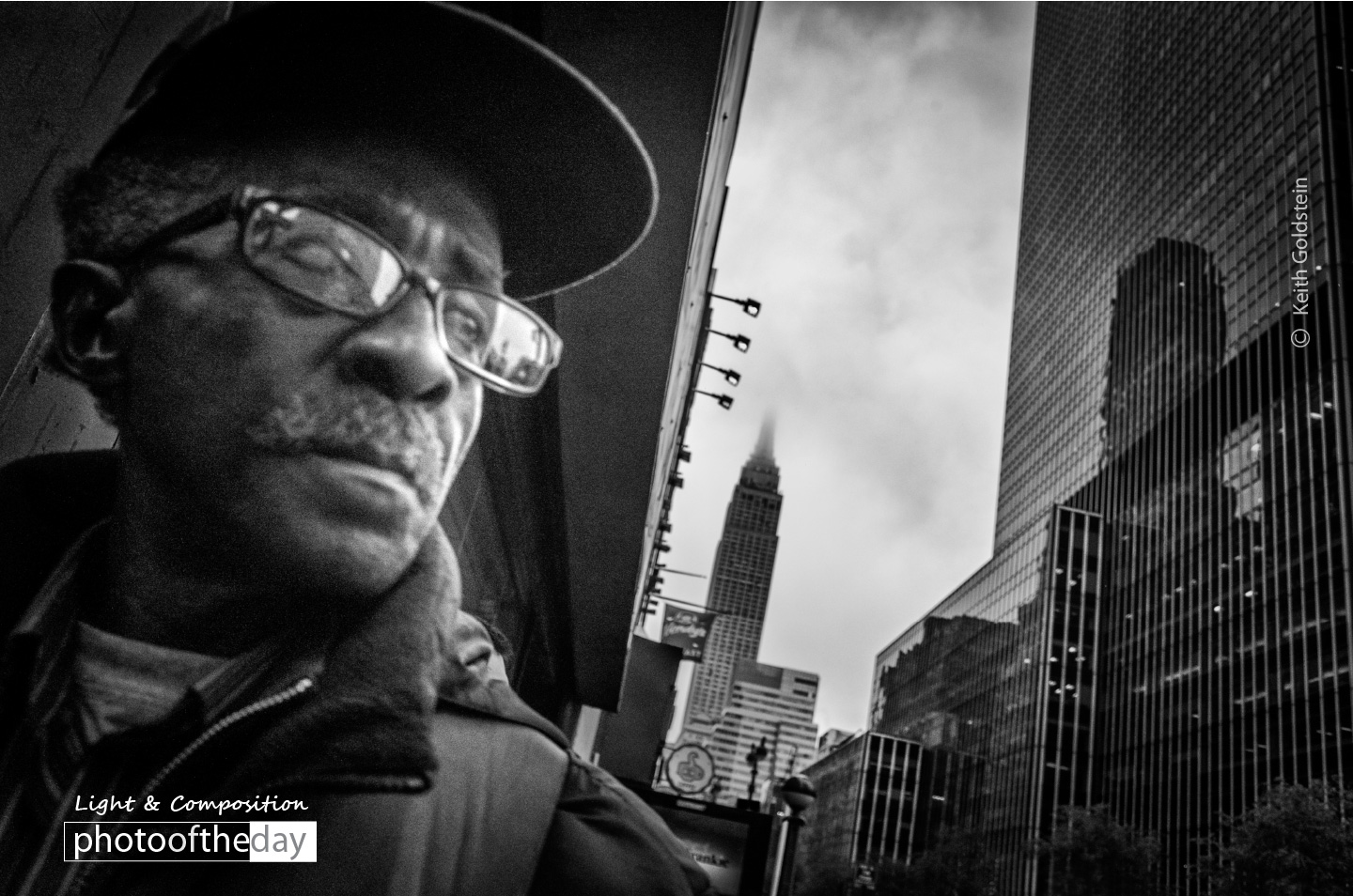
Hell’s Kitchen by Keith Goldstein
Captured during a lunch break on the far west side of Manhattan, this street portrait documents a fleeting encounter in the historic Hell's Kitchen neighborhood. The photographer sought to preserve the character of an area defined by its gritty, storied past before the encroaching influence of gentrification. By focusing on a solitary figure against the backdrop of this legendary district, the image serves as a poignant social observation. Its award-worthy quality lies in the photographer's ability to transform a spontaneous, everyday moment into a timeless narrative, capturing the raw, authentic spirit of New York City through a lens of deep cultural appreciation.
Keith Goldstein
Born in Brooklyn in 1957, Keith Goldstein is a seasoned fine art and editorial photographer based in Hamilton Heights, New York City. After earning his BFA from the School of Visual Arts and an MFA from the Cranbrook Academy of Art, he developed a deeply emotive approach to the medium, often favoring a minimalist kit to maintain creative freedom. With a career spanning over four decades, his work has been featured in numerous international publications and exhibitions, reflecting his lifelong dedication to exploring the human experience through the lens.
Resonance Score Breakdown
Transparency Note: The resonance score (12.7/20) is calculated based on social engagement metrics collected before the award announcement.
Expert Photography Reviews · 6
The Weight of Passing Through
In the nineteenth century, the flâneur was a figure of leisure, a man who walked the city streets with a turtle on a leash, setting his pace to the slow, deliberate rhythm of the animal. He was not going anywhere; he was simply existing within the architecture of the crowd.
Read the reflection →The Persistence of the Understory
In the deep forest, the mycelial network acts as a silent, subterranean nervous system, connecting individual trees through a vast, hidden web of exchange. Even when the canopy above is dense and competitive, the roots below are engaged in a constant, quiet dialogue of survival.
Read the reflection →Reviews & Comments
Share your thoughts about this award-winning photograph. Your reviews contribute to the community engagement score.
The brick wall stretches. It’s a vast, unyielding expanse of soot and history. A solitary figure leans against the edge. They don’t fight the void; they inhabit it. I’ve spent minutes staring at that shadow. It’s heavy. It’s quiet. Nothing here is accidental. The empty corner is not empty. It’s a breath held in the middle of a city that never stops. I feel a sudden, sharp ache for this stillness. It’s rare.
It’s a gritty, honest frame, but I can’t help but wonder if the subject knew they were being hunted. In my field, we call this the predator’s gaze—extracting a moment without consent. While the composition is sharp, it lacks the stillness of a shared space. I’ve spent weeks hidden in brush to earn a subject’s trust; this feels like a drive-by. It’s technically sound, sure, but it feels like a violation of the human habitat.
Gentrification isn’t a backdrop; it’s a power dynamic. Goldstein frames this solitary figure against a crumbling wall, but who granted him the right to aestheticize their displacement? I’m honestly unsettled by how the subject’s exhaustion becomes a prop for “gritty” street lore. Does the subject know they’re being curated into a narrative of loss? Why does the photographer’s lunch break require someone else’s vulnerability to feel authentic? It’s a polished frame, but it feels hollow.
The frame holds its breath. A lunch break, a ghost of old Hell’s Kitchen, and a subject caught in the amber of a shutter click. It’s a tight, rhythmic composition that refuses to blink. I’ve walked these streets, and the grit here hits me right in the chest. Goldstein didn’t cut away; he let the tension linger. It’s the frame the editor keeps because the story doesn’t need a sequel. It’s perfect, static cinema.
Hell’s Kitchen doesn’t wait for you to adjust your aperture. Goldstein caught this guy right when the light hit his face, cutting through the grit of the West Side. It’s raw. One tenth of a second later and the shadow would’ve swallowed the expression, collapsing the frame entirely. I felt a genuine jolt seeing that gaze—it’s pure New York. He was ready. He didn’t hesitate. That’s the difference between a snapshot and the truth.
Goldstein’s Hell’s Kitchen echoes the lonely, urban isolation found in Helen Levitt’s mid-century New York, yet it lacks her rhythmic vitality. The framing, while competent, feels tethered to the familiar tropes of the street genre. I’ve spent decades tracing this lineage, and frankly, I’m still waiting for a fresh perspective on the city’s shifting skin. It’s technically sound, but it doesn’t quite push the conversation forward. I’m genuinely craving a more daring, subversive visual vocabulary here.
It’s a wonderful street photograph.