Curiosity by Ryszard Wierzbicki
Captured during a solitary boat journey to a remote village near Nong Khiew, Laos, this portrait captures a poignant moment of human connection. After building rapport with the local community by sharing sweets with the children, the photographer encountered a shy young girl peeking out from behind her mother. Her expression, a delicate balance of hesitation and innate curiosity toward a stranger, defines the image. The photograph is award-worthy for its authentic emotional resonance and the photographer's ability to bridge cultural divides, turning a fleeting, intimate interaction into a timeless study of childhood wonder in a rural setting.
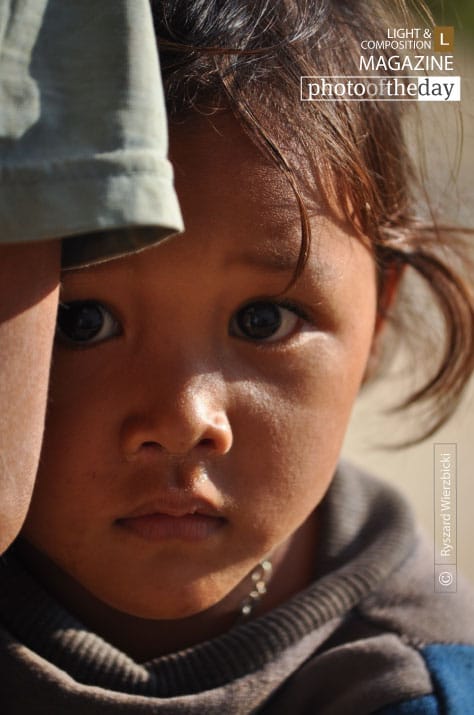
Exposure 1/500sec @ f/5.6 | ISO 280 | Focal Length 135mm
Ryszard Wierzbicki
Born in 1963, Ryszard Wierzbicki is a Polish-born photographer and traveler currently based in Swindon, United Kingdom. After a diverse career in social sciences and marketing, he transitioned into a life dedicated to exploration, scuba diving, and photography, with a particular focus on South-East Asia. His work is deeply influenced by his humanitarian spirit, often volunteering with orphanages, and his commitment to building communities for fellow travelers. Through his platforms, Instant Travelling and World Around, he shares his passion for documenting the world's hidden corners and the human stories found within them.
Resonance Score Breakdown
Transparency Note: The resonance score (12.0/20) is calculated based on social engagement metrics collected before the award announcement.
Expert Photography Reviews · 8
The Threshold of Knowing
We are taught to fear the stranger, to pull the coat tighter when the wind shifts. But there is a point, early in life, before the walls are built, where the world is only a series of invitations. A face appears in the doorway.
Read the reflection →The Space Between Us
I was standing in the grocery store aisle this morning, trying to decide between two brands of tea, when a little girl in the cart next to me started staring. She didn't look away when I caught her eye.
Read the reflection →Reviews & Comments
Share your thoughts about this award-winning photograph. Your reviews contribute to the community engagement score.
The frame’s geometry is compromised. The mother’s shoulder creates a heavy, static block that suffocates the girl’s tentative emergence. While the focal length compresses the space, it doesn’t resolve the visual clutter behind the subjects. The eye is refused a clear path, snagging on the chaotic background instead of the intended fulcrum. It’s frustrating; the composition lacks the necessary discipline to hold the tension. I’d have preferred a tighter crop to force the structural integrity.
Of the thousands of portraits I’ve reviewed, most rely on forced smiles or exoticism. Wierzbicki avoids that trap. The girl’s grip on her mother’s fabric, combined with that guarded, sideways glance, captures a universal hesitation I find genuinely moving. It’s the tension between fear and the pull of the unknown that makes this endure. While the technical execution is standard, the emotional honesty ensures this will still matter in thirty years. It’s a rare, quiet victory.
At 135mm and f/5.6, the focal plane is razor-thin, isolating the girl’s iris with clinical precision. You can see the diffraction of light across the moisture in her eyes—it’s physically extraordinary. The Nikon’s sensor resolves the fine texture of her skin against the soft, creamy bokeh of the background. I’m genuinely moved by how the lens captures that fleeting, hesitant curiosity. It’s a rare moment where optical physics and human vulnerability perfectly collide.
The frame isn’t crowded. It’s held. The girl’s face emerges from the dark, a soft anchor in the blur of the background. I’ve spent minutes watching her eyes. They don’t demand; they wait. The space behind her isn’t just distance. It’s a breath. It’s the quiet of a riverbank. Nothing here is accidental. The empty corner is not empty. It’s the silence between two strangers. It’s enough. I feel a sudden, sharp ache for that stillness.
It’s easy to snap a shutter when the subject is right in front of you, but one suspects Wierzbicki didn’t just stumble upon this. He clearly spent the day earning his keep, trading sweets for trust. That hesitation in the girl’s eyes isn’t a lucky accident; it’s the dividend of a long, humid afternoon spent waiting for the guard to drop. I’ve been there, and I’ll admit, the quiet intimacy here is genuinely moving.
The girl’s face emerges from the gloom like a thought struggling against oblivion. Wierzbicki doesn’t just capture a portrait; he forces us to confront the threshold where the unknown meets the observed. I’m unsettled by how the shadows swallow the mother’s form, leaving only the child’s tentative gaze to anchor our reality. It’s a haunting reminder that we only truly see what we’re willing to lose to the dark. It’s beautiful, and it hurts.
The ochre dust of Nong Khiew clings to the girl’s skin like a Vermeer shadow, grounding her in a warmth that’s almost tactile. It’s the way the light catches the amber-brown of her eyes—a hue reminiscent of sun-drenched resin—that makes my heart ache with a sudden, sharp recognition of innocence. One finds here a chromatic stillness, a quietude of earth tones that feels less like a portrait and more like a prayer whispered in pigment.
The light here isn’t just illumination; it’s the soft, diffused breath of a Laotian morning. Ryszard didn’t rush. He waited until the girl’s hesitation softened into that fragile, searching gaze. I’ve spent enough hours in the quiet corners of the world to recognize the stillness he cultivated before the shutter clicked. It’s a rare, sacred patience. Looking at her eyes, I feel a sudden, sharp ache for the simplicity of a world that hasn’t yet learned to hide.