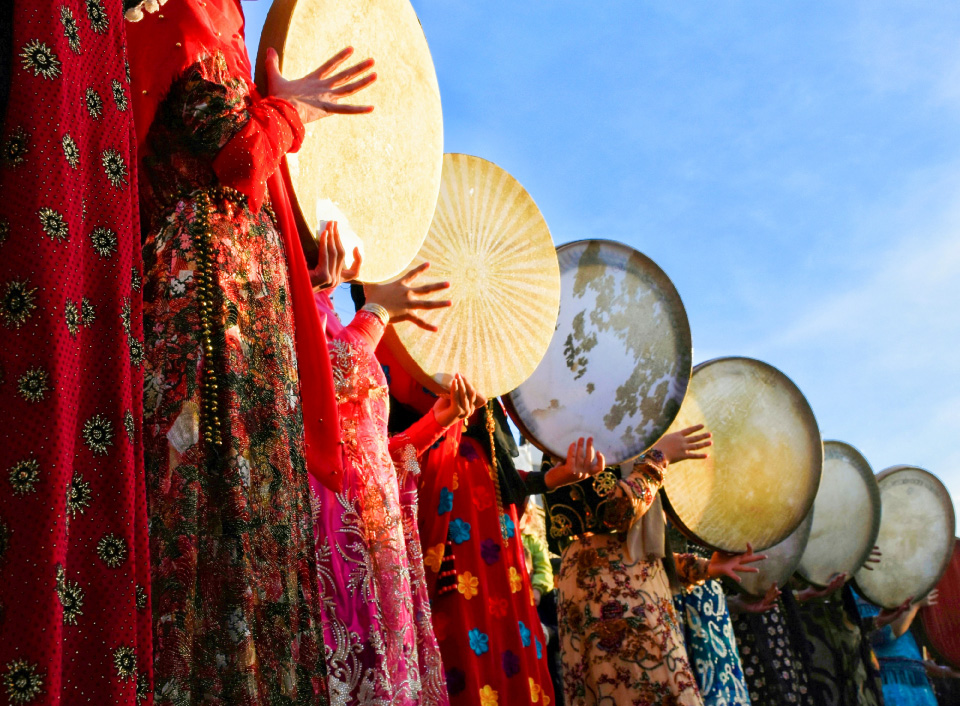
Kurdish Girls with Daf by Moslem Azimi
Captured during a traditional religious ceremony in Paveh, Iran, this evocative image highlights the cultural significance of the Daf, an ancient Kurdish musical instrument. Moslem Azimi masterfully documents a moment that transcends mere performance, illustrating the inherent equality between men and women within Kurdish society. By focusing on the girls playing the Daf, the photographer emphasizes the preservation of heritage and the strength of communal traditions. The image is award-worthy for its powerful storytelling and its ability to provide an intimate, respectful window into a vibrant cultural practice, celebrating the intersection of music, spirituality, and gender equality in the heart of the Kermanshah province.
Moslem Azimi
Moslem Azimi is a self-taught photographer of Kurdish origin currently based in Melbourne, Australia. Holding a Bachelor of Arts in English Translation, he channels his passion for his heritage into a dedicated documentary practice that explores the traditions, daily life, and cultural nuances of the Kurdish people. His work has been featured in numerous national and international exhibitions, reflecting his commitment to preserving the Kurdish identity through a lens of authenticity and deep cultural respect.
Resonance Score Breakdown
Transparency Note: The resonance score (10.1/20) is calculated based on social engagement metrics collected before the award announcement.
Expert Photography Reviews · 3
The Rhythm of Ancient Echoes
I often find myself wandering the narrow, stone-paved alleys of Paveh in my mind, where the air smells of mountain herbs and the weight of history hangs heavy on the limestone walls.
Read the reflection →The Rhythm of Stillness
There is a language that exists before words, a vibration that travels through the hands and into the air. When we gather to mark the passage of time or the turning of a season, we often look for a way to hold the intangible.
Read the reflection →Reviews & Comments
Share your thoughts about this award-winning photograph. Your reviews contribute to the community engagement score.
The circular frames of the Dafs create a rigid geometric rhythm, establishing a dominant series of arcs that intersect the vertical axis of the girls’ bodies. It’s a precise 3:2 ratio of instrument to subject that anchors the composition. I’m genuinely struck by how the negative space between the drums balances the density of the fabric. It’s a perfect spatial equation; the repetition of those circles transforms a cultural moment into a beautifully solved, rhythmic visual proof.
One senses the dust of Paveh in these frames. It’s clear Azimi didn’t just stumble upon this; he’s earned the trust required to stand that close without turning the subjects into statues. The rhythm of those Dafs is almost audible. I’ve spent enough hours shivering in remote corners to know when a photographer has put in the work. It’s a rare, quiet dignity. He didn’t just take a picture; he stayed until he belonged there.
The Daf’s rhythmic pulse almost vibrates through the frame, yet I’m unsettled by the framing. Why are these girls positioned as symbols of equality rather than individuals? It’s a beautiful scene, but does the lens capture their agency or merely the aesthetic of their tradition? I find myself wanting to know what they think of the camera’s intrusion. Are they performing for the ceremony or for the photographer’s narrative? It’s a delicate, heavy line to walk.