Bright Road by Abdellah Azizi
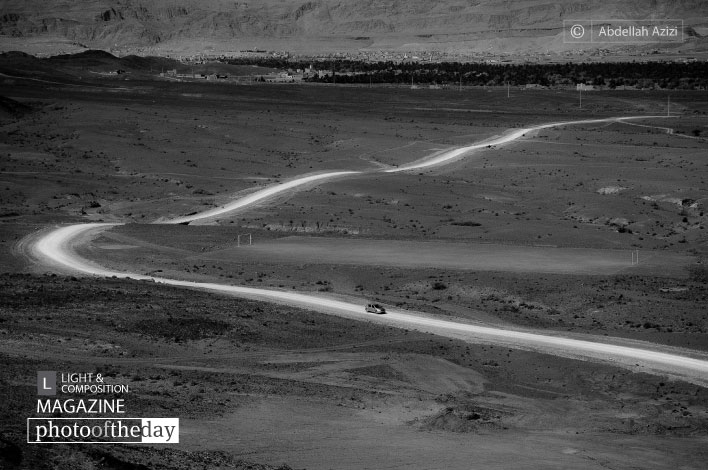
While conducting reportage in Tinghir for a local magazine, the photographer was guided to a hilltop to document an historic Amazigh residence. From this vantage point, the winding road below captured his attention, particularly as a lone vehicle approached from the distance. Recognizing the potential of the scene, he captured the moment, balancing the stark, rugged landscape with the transient presence of the car. The photograph is award-worthy for its masterful composition and the way it transforms a simple transit route into a compelling narrative of isolation and scale within the vast Moroccan terrain.
Abdellah Azizi
Born in Ouarzazate in 1987, Abdellah Azizi is a Moroccan photographer celebrated for his evocative captures of South Moroccan landscapes and local culture. After honing his technical expertise in lighting and camera work through film industry studies in Ouarzazate and Casablanca, he transitioned from a career in videography to professional photography. Azizi is driven by the creative freedom found within the medium, using his background in cinematography to craft images that highlight the vibrant life and rugged beauty of his home region.
Resonance Score Breakdown
Transparency Note: The resonance score (13.1/20) is calculated based on social engagement metrics collected before the award announcement.
Expert Photography Reviews · 3
The Architecture of the Path
There is a quiet, persistent myth that a road exists to take us somewhere. We treat the asphalt and the gravel as mere conduits, necessary evils to be endured between the comfort of where we were and the promise of where we are going.
Read the reflection →The Geometry of Distance
We are all just travelers tracing lines across a map we did not draw. There is a quiet ache in the way a road cuts through the earth, a scar that heals into a path, inviting us to believe we are going somewhere specific.
Read the reflection →Reviews & Comments
Share your thoughts about this award-winning photograph. Your reviews contribute to the community engagement score.
Tinghir’s road isn’t merely asphalt; it’s a scar carved into the indifference of the earth. Azizi forces us to confront the void, where the shadows don’t just frame the vehicle—they swallow its purpose whole. I’ve stared at this print until my eyes ached, feeling the crushing weight of that silence. It’s a brutal, honest meditation on transience. When the light hits that jagged terrain, it doesn’t reveal; it demands we acknowledge our own inevitable disappearance.
It’s a sharp, clean composition, though one wonders if the shutter was pressed the moment the car appeared. I’ve spent enough afternoons in the desert to know that waiting for the light to bite into those ridges is a miserable, necessary business. The geometry is tidy, but it feels like a lucky snatch rather than a hard-won prize. I’d have preferred to see the photographer return until the shadows truly owned that road. It’s competent, certainly.
Most aerial shots of Tinghir fall into the trap of mere documentation, but this one captures the crushing silence of the desert. The road’s serpentine curve forces the eye to track the lone vehicle, emphasizing a scale that makes human transit feel fragile. I’ve seen thousands of monochrome landscapes, yet this one haunts me because of that stark, high-contrast light. It’s a quiet, lonely piece of history that I’m certain will still matter in thirty years.
Amazing black white photo with the minimalism. I like long road and alone car.