My Grandfather by Park Se Jin
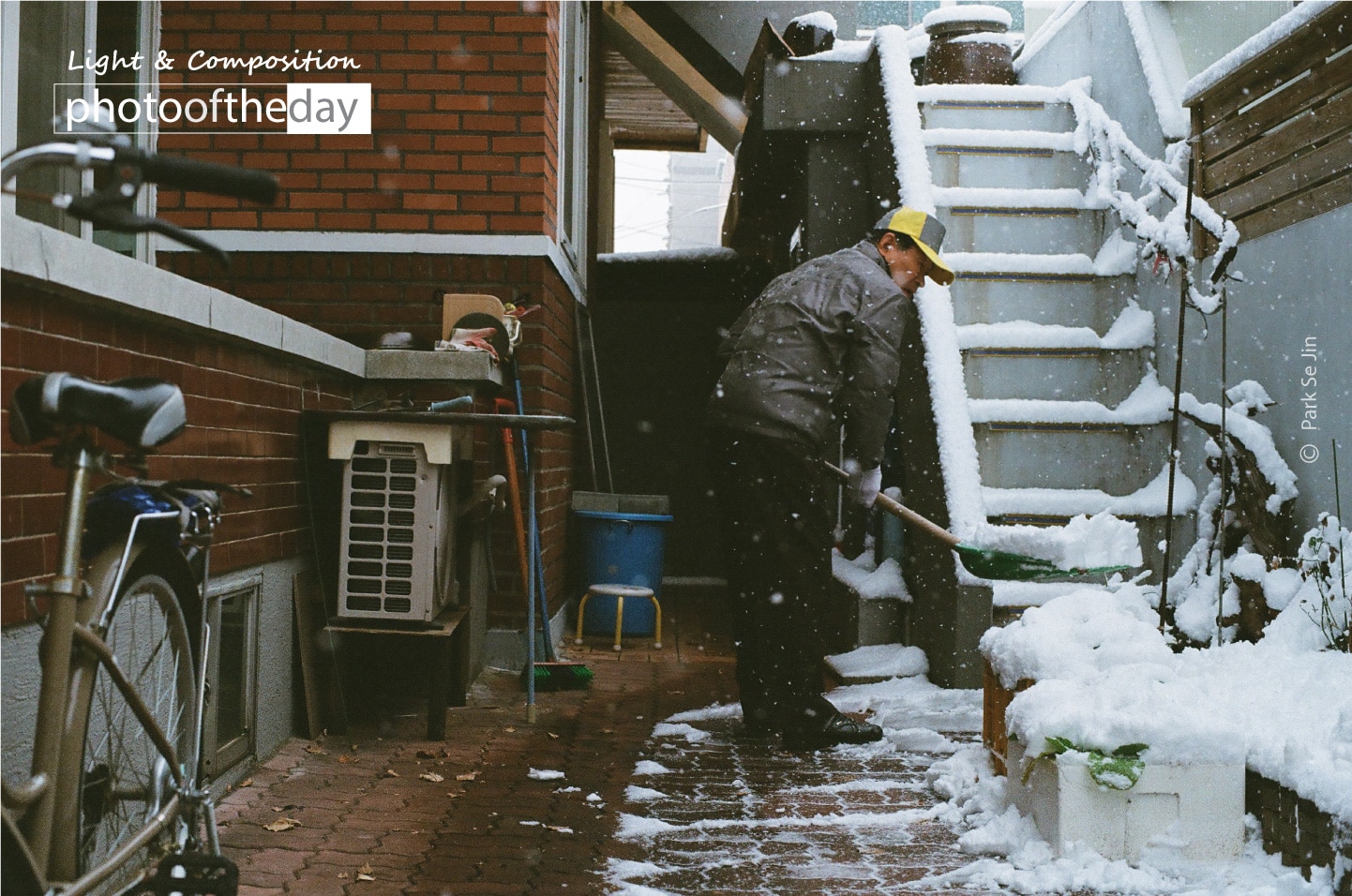
Captured during a sudden, heavy snowfall, this poignant image depicts the photographer's grandfather diligently clearing snow from their path. The scene evokes a cinematic quality, with the stark white landscape framing the quiet, rhythmic labor of an elder. The photographer, struck by the timeless nature of the moment before the temperature plummeted, acted instinctively to preserve the memory. This photograph is award-worthy for its authentic emotional resonance and the way it transforms a mundane domestic chore into a beautiful, narrative-driven portrait of family and resilience.
Park Se Jin
Born and based in Seoul, South Korea, Park Se Jin approaches photography as a spontaneous practice, preferring to capture the fleeting beauty of daily life rather than staging his subjects. He finds joy in the act of observation, often choosing to witness moments with his own eyes even when a camera is not in hand. Currently, Park is focused on expanding his artistic horizons, with a new ambition to traverse the South Korean countryside by motorcycle to document landscapes and stories beyond the familiar streets of Seoul.
Resonance Score Breakdown
Transparency Note: The resonance score (11.0/20) is calculated based on social engagement metrics collected before the award announcement.
Expert Photography Reviews · 7
The Weight of the Shovel
I remember the way my grandfather’s hands looked against the iron handle of a garden tool—knotted, steady, and entirely unbothered by the cold.
Read the reflection →The Persistence of Clearing
When the first frost settles, the deciduous trees drop their leaves to enter a state of dormancy, a necessary shedding of weight to survive the coming freeze.
Read the reflection →Reviews & Comments
Share your thoughts about this award-winning photograph. Your reviews contribute to the community engagement score.
The biting white of the snow acts as a stark, minimalist canvas, forcing the eye to focus on the rhythmic geometry of the shovel. It’s a quiet, brutal architecture of winter. The grandfather isn’t just clearing a path; he’s carving his existence into the cold. I’m genuinely moved by how the frozen air frames his posture. He’s tethered to the earth, his labor defining the space, proving that home is wherever we choose to endure.
There’s a quiet dignity in the way he grips that shovel, isn’t there? You can tell he’s not performing for a lens; he’s just tending to his home. It’s a rare, honest look at a life defined by steady, rhythmic labor. Seeing the snow cling to his coat makes me ache for my own grandfather’s hands. This isn’t a capture; it’s a gift of memory. You’ve earned this moment by simply being present, and it shows.
At f/8, the Minolta’s 50mm glass renders the falling snow with a crispness that defies the atmospheric haze. The focal plane is razor-sharp, capturing the crystalline structure of each flake against the grandfather’s weathered coat. It’s a rare moment where diffraction doesn’t soften the edges, but instead defines the cold. I’ve spent years analyzing optics, yet this quiet, rhythmic labor moves me; it’s the physics of light meeting human resilience in the most beautiful way.
The shutter snaps, and the silence of the snow fills the room. It’s a tracking shot of a life lived in rhythm. The 50mm lens keeps the distance just right, letting the labor breathe. I’ve watched a thousand scenes like this, but the way he clears that path—it hits me right in the chest. The cut would’ve been a mistake. This is the frame the editor keeps, the one that holds the weight of time.
We watch him clear the snow, his back bent against the biting cold of a Korean winter. It’s a quiet, rhythmic labor that feels like a prayer. Park didn’t just snap a shutter; he listened to the silence of his grandfather’s devotion. I feel a sudden, sharp ache in my chest seeing that solitary figure. It’s a portrait of resilience, a story told in white dust. This is a photograph that asks to be returned to.
The frame’s geometry succeeds despite the subject’s inherent sentimentality. The diagonal thrust of the shovel creates a necessary fulcrum, anchoring the figure against the oppressive negative space of the snow. It’s a disciplined arrangement of mass. The verticality of the elder’s posture provides the only structural resistance to the white void. I’m genuinely unsettled by how the composition forces the eye toward the periphery. It doesn’t collapse into nostalgia. The architecture holds.
1/250sec at f/8 with a 50mm lens. It’s a disciplined choice. The aperture provides enough depth to keep the subject sharp against the falling snow without losing the background to mush. It’s a mechanical certainty that works. I’ve seen too many street shots ruined by wide-open laziness, but this holds its ground. It’s cold, precise, and frankly, it makes me miss my own grandfather. The technical execution is correct. It’s a job well done.