Shifting Engine by Lavi Dhurve
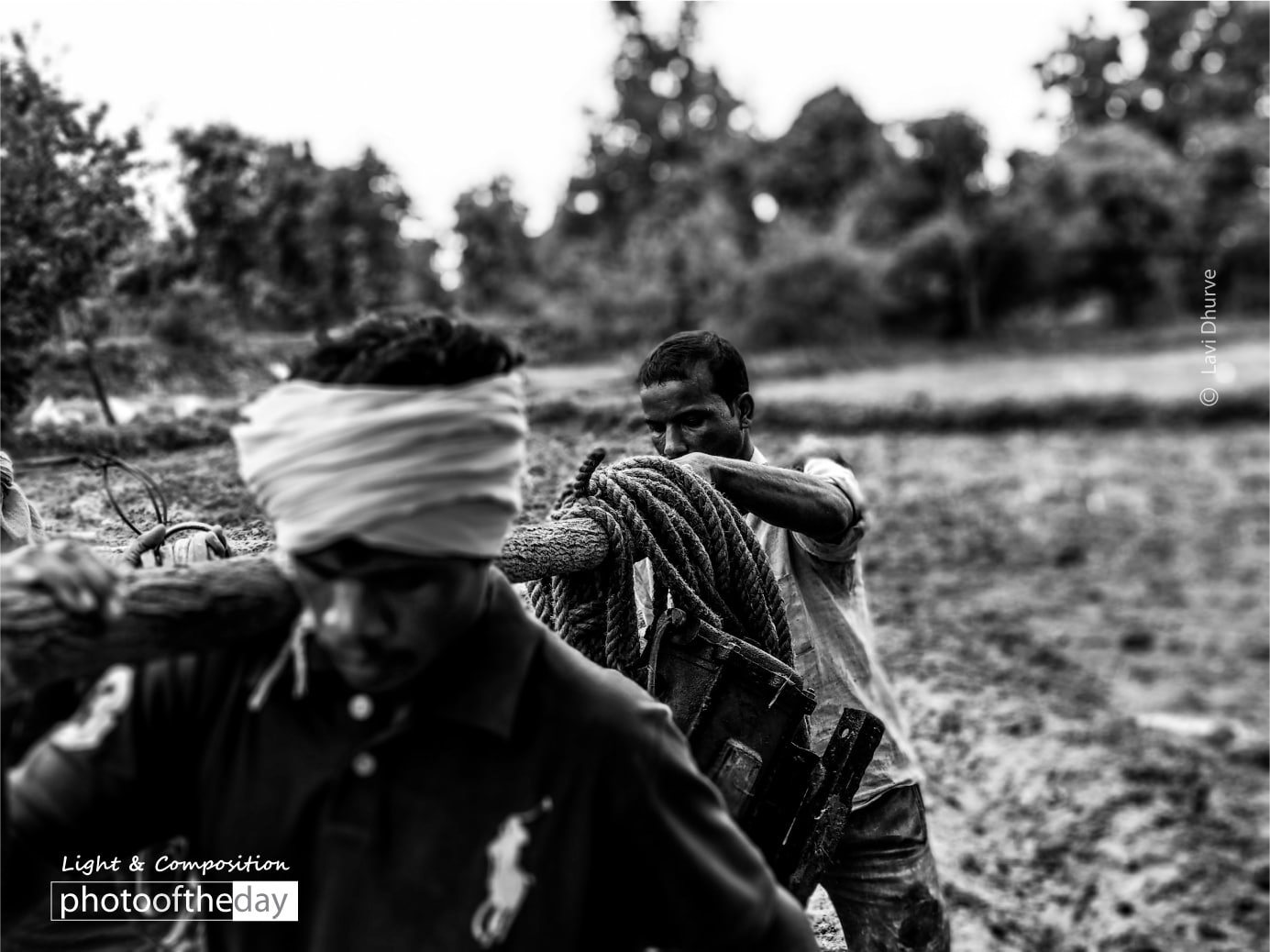
Captured shortly after returning to her ancestral village, this poignant documentary photograph depicts the essential labor of rice field preparation. As the rainy season approached, the photographer joined her father in the fields to assist with the arduous task of planting. When the primary water source for the paddies ran dry, the community was forced to relocate their pump engine to a nearby well. This image serves as a powerful testament to the daily perseverance of rural life, earning recognition for its exceptional composition and the raw, authentic narrative it preserves of a community deeply connected to the land.
Lavi Dhurve
Hailing from a small village in Madhya Pradesh, the 'Heart of India,' Lavi Dhurve finds profound beauty in the rhythms of rural existence. Her photographic practice is deeply rooted in a love for art, culture, and the human experience, with a particular focus on documenting nature, children, and the fleeting light of sunrises and sunsets. Through her lens, she seeks to celebrate the inherent grace of everyday life and the diverse people she encounters, establishing herself as a sensitive observer of the world around her.
Resonance Score Breakdown
Transparency Note: The resonance score (11.7/20) is calculated based on social engagement metrics collected before the award announcement.
Expert Photography Reviews · 8
The Weight of the Soil
There is a specific, heavy quality to the air just before the first monsoon rains arrive. It is not the sharp, biting cold of a Nordic winter, but a thick, humid stillness that seems to press against the skin, demanding a response.
Read the reflection →The Weight of Sustenance
Why do we assume that progress must always look like an ascent? We are often told that the measure of a life is found in how far we have climbed, yet there is a profound, quiet dignity in the labor that keeps us tethered to the earth.
Read the reflection →Reviews & Comments
Share your thoughts about this award-winning photograph. Your reviews contribute to the community engagement score.
There’s a tactile urgency here that recalls the grit of early Farm Security Administration work, yet it avoids the romanticism of Lange. The way the pump engine disrupts the mud’s texture echoes the industrial intrusion found in early Soviet documentary, but with a startling, intimate proximity. I’m genuinely moved by the tension between the machine’s cold geometry and the soft, organic chaos of the paddy. It’s a rare, honest dialogue between human necessity and the unforgiving earth.
The engine’s mechanical mass disrupts the organic datum of the paddy, creating a brutal threshold between human industry and the landscape. It’s a stark study in solid and void, where the machine’s rigid geometry forces a new rhythm onto the field. I’m struck by how the light catches the rusted iron, grounding the scene in a tactile reality. It doesn’t just document labor; it exposes the fragile, shifting architecture of survival in Sarni.
The pump engine sits heavy in the mud, a mechanical intruder in a landscape defined by ancestral rhythm. Why does the photographer frame this labor as a struggle against nature rather than a failure of infrastructure? I feel a sharp, uncomfortable ache looking at the father’s posture. Is he a partner in this documentation, or merely a prop for a narrative of rural perseverance? It’s a beautiful composition, but I’m left wondering who actually owns this story.
There’s a quiet, heavy intimacy here that you don’t find in staged work. Watching them haul that engine, I feel the grit of the soil under my own fingernails. It’s clear the father isn’t performing for a lens; he’s just working, and Lavi is simply there, part of the rhythm. This face has a whole life in it, etched by the sun and the labor. It’s a gift, not a capture. They’ve truly let us in.
We look at these hands, calloused and stained by the earth, and we understand the weight of the engine they’ve moved. Lavi didn’t just photograph a machine; she listened to the silence of a dry well and the desperation of a coming season. It’s a portrait of labor that feels heavy in my own chest. I’m moved by how she captures the quiet dignity of her father’s struggle. It’s a story told through sweat, not words.
f/4.5 at 50mm, 1/125s, ISO 200. A standard focal length choice that keeps the engine’s mechanical geometry honest. The shutter speed is sufficient to freeze the motion of the hands without losing the grit of the soil. It’s a clean, clinical capture of labor. I’ve spent years looking at these machines, and the way the light hits the rusted iron here actually made me pause. The technical execution is precise. It’s a correct decision.
The engine is mid-air, suspended in that brutal, heavy transition. Lavi caught the exact tension of the men’s muscles before the weight shifted. It’s raw. I’ve spent years chasing that precise geometry of labor, and this hits. One tenth of a second later and the balance is lost, the frame collapses into chaos. Instead, it’s perfect. You can feel the heat and the grit. It’s the kind of honesty Winogrand would’ve tipped his hat to.
The lens resolves the engine’s rusted texture with clinical precision, pushing past the diffraction limit to reveal the grit of Sarni’s soil. I’m struck by how the focal plane clings to the metal’s oxidation, rendering the mechanical decay against the soft, atmospheric haze of the paddies. It’s a rare moment where optics capture the physical weight of labor. I’ve rarely seen such raw, unyielding detail; it’s honestly haunting how the glass pulls the truth from the dust.