Watering Fields by Ryszard Wierzbicki
Capturing the essence of rural life in Vietnam, this photograph highlights the rhythmic, daily labor required to maintain the region's iconic green landscapes. The photographer focuses on the interaction between the local villagers and their environment, emphasizing that these breathtaking vistas are the result of persistent human dedication. By choosing a telephoto perspective, the image isolates the intricate details of the watering process against the vast expanse of the fields. This work is award-worthy for its ability to transform a routine agricultural task into a poignant visual narrative, celebrating the symbiotic relationship between the people and the land they cultivate.
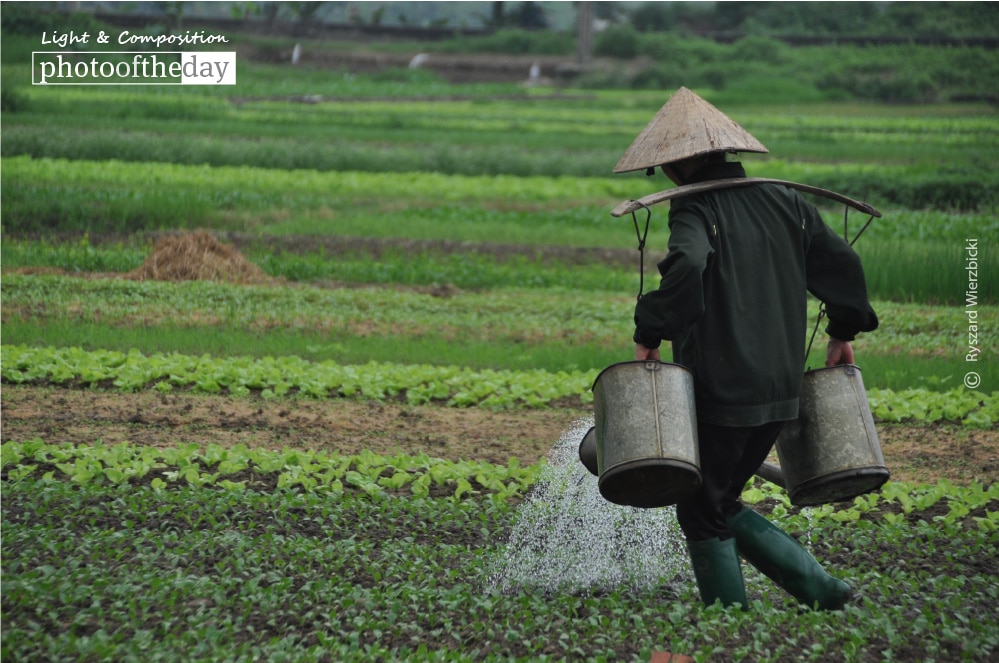
Exposure 1/500sec @ f/6.3 | ISO 200 | Focal Length 169.5mm
Ryszard Wierzbicki
Born in 1963, Ryszard Wierzbicki is a Polish-born photographer and traveler currently based in Swindon, United Kingdom. After a diverse career spanning education, marketing, and sales, he transitioned to a life of exploration, focusing his lens on the cultures and landscapes of South-East Asia. Beyond his photography, he is a dedicated PADI scuba diving instructor and a community builder, having established multiple forums for travelers and photographers. His work is deeply influenced by his commitment to humanitarian efforts, including his volunteer work with charity organizations supporting orphans in Thailand and Burma.
Resonance Score Breakdown
Transparency Note: The resonance score (12.0/20) is calculated based on social engagement metrics collected before the award announcement.
Expert Photography Reviews · 7
The Rhythm of the Earth
There is a quiet conversation that happens between the hand and the soil, a language spoken without words. We often view labor as a means to an end, a series of tasks to be checked off before the sun dips below the horizon.
Read the reflection →The Hum of Damp Earth
The smell of wet soil always brings me back to the monsoon of my childhood, that thick, metallic scent of rain hitting parched ground. It is a heavy, grounding perfume that sticks to the back of the throat, tasting faintly of minerals and ancient roots.
Read the reflection →Reviews & Comments
Share your thoughts about this award-winning photograph. Your reviews contribute to the community engagement score.
The frame holds a breath. A figure bends. Water arcs. The rest is just distance and green. I’ve spent minutes watching that single, suspended drop. It’s quiet here. The vastness doesn’t swallow the labor; it gives it room to exist. Nothing here is accidental. The empty corner is not empty. It’s the weight of the day, held in suspension. I feel a sudden, sharp ache for this stillness. It’s a rare, necessary pause.
The telephoto compression flattens the field into a rigid, geometric grid. It’s a calculated choice. The vertical lines of the irrigation tools provide a necessary fulcrum against the horizontal sprawl of the paddies. The composition holds, though the peripheral noise threatens the frame’s integrity. I’ve grown tired of such romanticized labor, yet the structural discipline here is undeniable. It’s a cold, precise architecture that forces the eye to acknowledge the weight of the human form.
The telephoto compression flattens these Vietnamese farmers into mere aesthetic components of a lush, green backdrop. I find myself wincing at how the lens turns their grueling labor into a picturesque postcard. Why does the frame strip away the humidity, the exhaustion, and the actual struggle of this irrigation? Does the photographer see these people as individuals, or just as props for a travel narrative? It’s a beautiful composition, but it feels deeply hollow to me.
There’s a quiet dignity in how these workers navigate the paddies, but I’m struck by the distance maintained here. It’s a relief to see a frame that doesn’t intrude. Too many photographers treat rural life like a zoo exhibit, crowding subjects for a tighter crop. Wierzbicki chose to observe from afar, letting the rhythm of the labor dictate the composition. It’s refreshing to see someone respect the space of others. I genuinely appreciate that restraint.
You didn’t just capture a landscape; you captured the weight of that water bucket. I can feel the strain in the farmer’s shoulders, the rhythm of a life spent bending to the earth. It’s not about the green fields, it’s about the sweat. Because you pulled in tight with that lens, you stripped away the travel-brochure gloss. You waited for the movement to matter. I respect that. It’s honest work, and it hits home.
We look at these bent backs and we feel the weight of the water. It’s not just labor; it’s a conversation between the villager and the earth. Ryszard didn’t just point his lens; he waited until the rhythm of the work became a song. I’m moved by the quiet dignity in their posture. It’s a portrait of persistence, a story told in droplets. This is a photograph that asks to be returned to, again and again.
At 169.5mm, the compression of the focal plane renders these rural laborers with startling geometric precision. Wierzbicki’s choice of f/6.3 avoids the diffraction limit, keeping the water droplets’ refraction crisp against the verdant backdrop. I’m genuinely moved by how the lens resolves the fine mist; it’s a delicate dance of glass and light that the human eye simply can’t track. It’s rare to see such technical discipline elevate a routine task into something so physically luminous.