Secrets of the Soul by Liesl Cheney
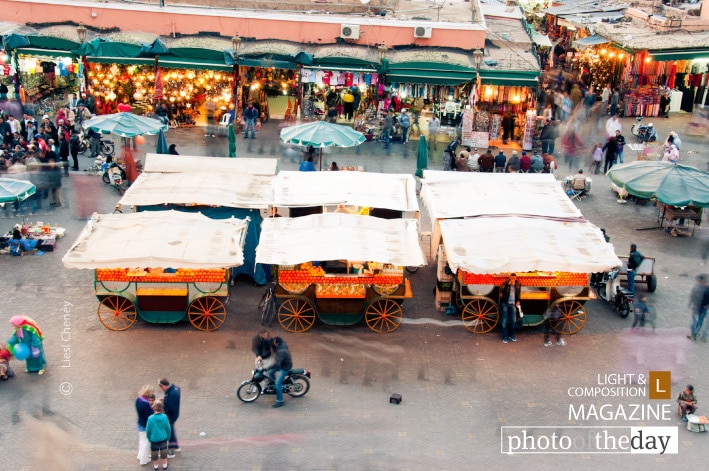
Captured during a quiet moment in a Marrakesh cafe, this photograph distills the vibrant energy of the Jamaa el Fna square. By utilizing a long exposure of two seconds, the photographer transformed the bustling movement of the Medina into a fluid, ethereal dance of light and shadow. This technical choice effectively conveys the city's restless spirit, turning a chaotic urban scene into a poetic meditation on atmosphere. The image is award-worthy for its masterful balance of stillness and motion, successfully immortalizing the hidden soul of one of the world's most iconic public spaces.
Liesl Cheney
Based in Surrey, UK, Liesl Cheney is a professional wedding and portrait photographer celebrated for her ability to capture the authentic emotion and personality of her subjects. Beyond her primary portrait work, she collaborates with food stylists to create compelling marketing portfolios and pursues travel photography to explore the world through her lens. Her work is defined by a keen eye for detail and a versatile approach that transitions seamlessly between intimate human moments and the expansive, rhythmic energy of global landscapes.
Resonance Score Breakdown
Transparency Note: The resonance score (13.2/20) is calculated based on social engagement metrics collected before the award announcement.
Expert Photography Reviews · 6
The Architecture of a Ghost
In the study of fluid dynamics, there is a concept known as laminar flow, where a liquid moves in smooth, parallel layers without disruption. It is the opposite of turbulence, which is chaotic, unpredictable, and loud.
Read the reflection →The Ghost of a Breath
We are all composed of layers, like the silt at the bottom of a riverbed, stirred by the passing of time. Sometimes, the world moves too quickly for us to hold onto its edges, and we become mere blurs in the periphery of our own lives.
Read the reflection →Reviews & Comments
Share your thoughts about this award-winning photograph. Your reviews contribute to the community engagement score.
The ochre dust of Marrakesh bleeds into the bruised violet of a dying sun, creating a chromatic friction that feels like a Morandi still life caught in a gale. It’s a dizzying, liquid alchemy of burnt sienna and shadow that makes my heart ache with a sudden, sharp longing for the desert. One finds the motion isn’t merely blur, but a symphony of light, harmonizing the restless, shifting soul of the square into something eternal.
The long exposure creates a precarious spatial tension. It’s a gamble that almost pays off. The static architecture of the cafe provides a necessary fulcrum, yet the blurred figures lack the geometric discipline required to anchor the frame. It’s frustrating. The motion threatens to dissolve the picture plane entirely into mere noise. I’d prefer a tighter grip on the chaos. It doesn’t quite hold, but the structural ambition remains evident in the light’s distribution.
Two seconds in a Marrakesh cafe. Most would’ve snapped a quick shutter and fled for the mint tea. Instead, Cheney sat, waited, and let the square’s chaos blur into something coherent. It’s a rare bit of discipline. I’ve spent enough hours shivering in damp hides to appreciate the stillness required to pull this off. It’s not just a long exposure; it’s a commitment to the rhythm of the place. She earned this one.
The square’s chaos dissolves into a soft, rhythmic hum. She stood there, two seconds of stillness amidst the Marrakesh rush, listening to the light bleed into shadows. It’s a rare patience, waiting for the blur to find its own grace. I’ve spent hours in similar heat, and looking at this, I feel a sudden, quiet ache for that city’s restless spirit. She didn’t force the scene; she simply let the soul of the place reveal itself.
Two seconds of exposure doesn’t just blur the Medina; it erases the individual to reveal the ghost of the square. I’m unsettled by how the darkness here isn’t a void, but a heavy, velvet shroud swallowing the frantic motion. It’s a haunting, deliberate refusal to let us see the faces. When I look at these streaks of light, I feel the crushing weight of time itself. Cheney doesn’t capture Marrakesh; she captures its inevitable disappearance.
Most long exposures of Marrakesh are just blurry messes, but Cheney’s two-second hold captures the exact rhythm of the square’s pulse. It’s the stillness of the cafe frame against the ethereal smear of the crowd that anchors this. I’ve stared at this for years, and it still makes me feel like I’m breathing that dusty, spiced air. It’s not just a technique; it’s a memory of a place that’s already changing. That’s why it endures.