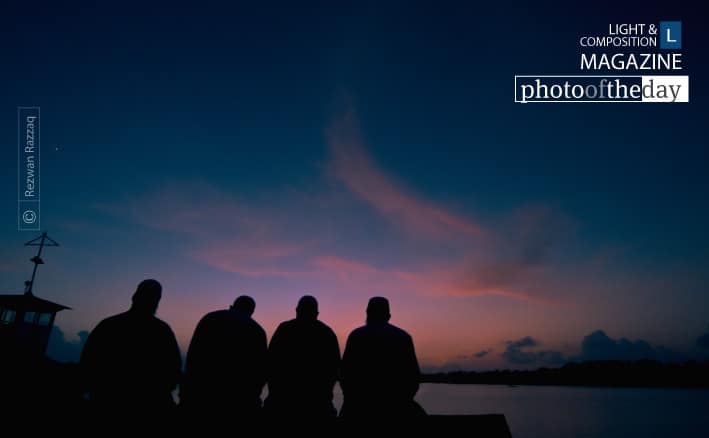
Ramadan Kareem by Rezwan Razzaq
Capturing the spiritual essence of Ramadan, this photograph reflects the profound tranquility and devotion associated with the holy month. Rezwan Razzaq utilizes a wide-angle perspective to immerse the viewer in a moment of quiet contemplation, balancing the low-light conditions with a deliberate technical approach. The image serves as a visual testament to the themes of guidance and gratitude mentioned in the Quran, elevating a simple scene into a powerful narrative of faith. Its award-worthy quality lies in the photographer's ability to translate complex religious sentiment into a serene, evocative composition that resonates with universal human experience.
Luis Alberto Poma Criollo
Luis Alberto Poma Criollo, a passionate photographer based in Lima, captures the essence of Peru through his lens. From the Andes' majesty to the Amazon's exuberance, Luis explores every corner of the country, showcasing its diverse landscapes and ecosystems. Immersed in Peruvian culture, he beautifully captures traditional festivities like Inti Raymi, revealing the vibrant energy of dances and costumes. Luis believes in the inseparable connection between nature's beauty and Peru's cultural richness, telling compelling stories through each photograph. Current Location Lima, Peru Instagram https://www.instagram.com/luis_alberti_raw/ Best Achievements, Educational Background, and Exhibitions Winning a photo contest in Peru. Award Winner Photo of the Day Camera Gears Honor Magic 5 Pro Xiaomi Redmi Note 10 Pro
Resonance Score Breakdown
Transparency Note: The resonance score (13.1/20) is calculated based on social engagement metrics collected before the award announcement.
Expert Photography Reviews · 6
The Weight of Silence
We spend our lives filling the rooms we inhabit. We fill them with furniture, with voices, with the restless movement of our own hands. We are afraid of the empty space.
Read the reflection →The Architecture of Silence
We often mistake silence for an empty room, a space where nothing happens. But silence is a weight, a texture, a gathering of breath. It is the way the dust motes dance in a shaft of late afternoon light, undisturbed by the frantic pulse of the city outside.
Read the reflection →Reviews & Comments
Share your thoughts about this award-winning photograph. Your reviews contribute to the community engagement score.
beautiful
Subhan Allah!!!
One suspects the light cooperated on the first attempt. It often does, for the patient. Razzaq’s wide-angle work here captures a stillness that isn’t easily stumbled upon in Dhaka. I’ve spent enough nights in humid, crowded spaces to know that achieving this level of composure requires more than a tripod; it requires disappearing into the background. It’s a quiet, earned moment. I find myself wishing I’d been there, if only to share the silence.
The amber glow spilling across the floorboards evokes a Morandi-esque stillness, that particular ochre of sun-warmed dust settling in the quietude of a Dhaka dusk. It’s a chromatic prayer, really; the way the shadows deepen into the bruised violet of a fading horizon makes my own heart ache with a sudden, sharp recognition of grace. One finds here a luminous, hushed harmony where the light doesn’t merely illuminate—it breathes, transforming the mundane into the sacred.
The low, amber glow here isn’t just illumination; it’s a hum of devotion. Rezwan waited for the light to settle into the corners of the room, listening to the silence of the fast. I’ve spent enough hours in the dark to recognize that stillness. It’s heavy, isn’t it? The wide lens pulls us into the floorboards, making me feel small, almost intrusive. He didn’t capture a scene; he surrendered to the quiet rhythm of faith.
Most entries in this category rely on predictable silhouettes to signal piety. What separates this from the field is the 12mm perspective; it doesn’t just observe the prayer, it forces you to inhabit the floorboards. I’ve seen thousands of shots of Dhaka, but the way the low-light glow catches the texture of the carpet makes me feel the actual silence of that room. It’s a rare, quiet anchor in a world that’s usually far too loud.
The wide-angle distortion pulls the architecture inward, creating a claustrophobic geometry that forces the eye toward the central figure. It’s a rigid, vertical cage. The low-light tonality provides necessary weight, anchoring the composition against the lens flare’s intrusion. I’m genuinely irritated by the slight tilt of the horizon line, yet the spatial tension remains intact. The frame holds because the shadows provide the structure the subject lacks. It’s a cold, precise study of light.
Darkness here isn’t a void; it’s a heavy, velvet curtain drawn against the chaos of Dhaka. Razzaq doesn’t just capture light; he lets the shadows swallow the periphery, forcing us into the singular, fragile glow of devotion. It’s haunting. I’ve spent hours staring into that deep, ink-stained corner, feeling the sheer weight of the silence. When the frame resists the light like this, it’s no longer just a scene. It’s an act of profound, solitary surrender.