Spring Lily by Tisha Clinkenbeard
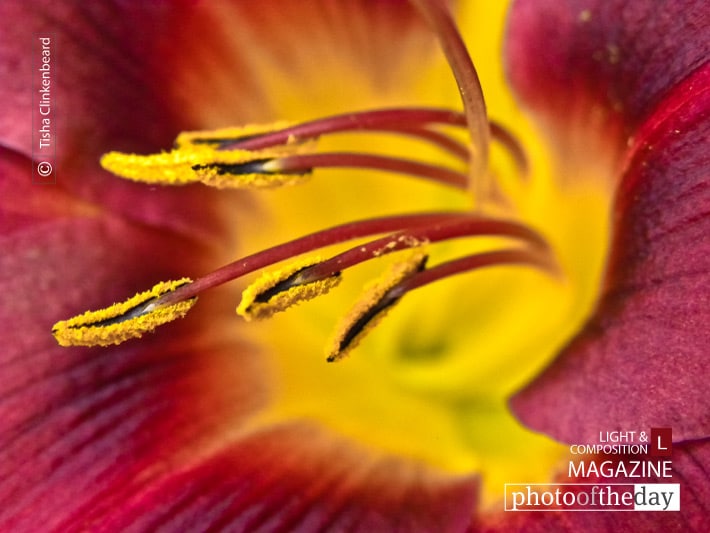
Captured during the vibrant arrival of spring, this intimate close-up of a lily highlights the delicate interplay between light and texture. The photographer was particularly drawn to the ethereal quality of the pollen, which she describes as 'pixy dust,' resting against the striking contrast of the flower's deep, dark petals. By focusing on the brightness of the inner colors, the image transforms a common garden bloom into a luminous, otherworldly subject. This photograph is award-worthy for its masterful use of macro detail and its ability to elevate a fleeting seasonal moment into a timeless, evocative study of nature’s intricate beauty.
Tisha Clinkenbeard
Based in Powderly, Texas, Tisha Clinkenbeard is a dedicated photographer whose work explores the beauty found in the everyday world. Her artistic journey, which began long before the advent of digital technology, has led to exhibitions at prestigious venues such as The Fine Arts Center of Hot Springs and the Black Box Gallery in Portland. Through her photo blog, 'Found Round & About,' she shares her unique perspective on the landscapes and natural wonders she encounters, consistently capturing the essence of her surroundings with a keen, observant eye.
Resonance Score Breakdown
Transparency Note: The resonance score (12.7/20) is calculated based on social engagement metrics collected before the award announcement.
Expert Photography Reviews · 7
The Weight of Dust
Winter is a long forgetting. We wait for the thaw, for the ground to soften, for the earth to exhale its buried intentions. When the color finally returns, it is not a shout.
Read the reflection →The Quiet Awakening
There is a specific rhythm to the turning of a season, a slow unfolding that asks us to soften our gaze. We often look for grand gestures in the world, forgetting that the most profound shifts happen in the smallest, most hidden spaces.
Read the reflection →Reviews & Comments
Share your thoughts about this award-winning photograph. Your reviews contribute to the community engagement score.
The frame holds its breath. It’s a tight, claustrophobic close-up where the pollen glows like embers against the velvet dark. I’m struck by the stillness; it’s a freeze-frame of a heartbeat. The shutter speed caught the light just before it could drift away. There’s no need for a pan or a zoom here. It’s a perfect, singular cut. I’ve seen a thousand lilies, but this one feels like it’s waiting for the film to start.
It’s a tidy bit of work, though one wonders if the Nikon P90 was dragged through the mud or merely plucked from a garden path. The pollen detail is sharp enough, I’ll grant you that. Still, I find myself wishing for signs of a struggle—a bit of wind-whipped grit or the exhaustion of a three-day vigil. It’s pretty, certainly, but did the photographer actually wait for it, or did she just happen by?
At f/4, the Nikon P90’s sensor struggles against the diffraction limit, yet the focal plane here captures the pollen’s granular structure with surprising fidelity. The chromatic aberration along the petal edges is minimal, allowing those vibrant yellows to pop against the deep, velvet shadows. It’s a delicate dance of photons. I’ve spent years analyzing macro optics, but honestly, the way this light catches those tiny, ethereal grains makes me want to reach out and touch the bloom.
Before the eye identifies the lily, something in the chest tightens. It’s that sudden, sharp intake of breath when light hits those golden grains of pollen. I’ve found myself returning to this, and it doesn’t lose its sting. The darkness of the petals feels like a quiet room I’m not ready to leave. It’s a strange, dusty ache—the kind that follows me into sleep, reminding me how fragile the arrival of spring really is.
The frame’s geometry doesn’t quite resolve. While the pollen provides a necessary focal anchor, the surrounding petals lack the structural weight to contain the composition. It’s a precarious balance that nearly collapses under its own softness. I’ve grown weary of such fragile subjects, yet the spatial tension between the dark void and the luminous center holds my attention. It’s almost enough to forgive the lack of rigor. The architecture is flawed, but it’s undeniably compelling.
That pollen, a dusting of crushed marigold against the velvet gloom of petals, evokes the quiet, dusty light of a Morandi still life. It’s a chromatic collision that makes my heart ache, really; the way that sun-drenched yellow vibrates against the bruised, nocturnal violet of the lily’s throat is nothing short of a miracle. One finds oneself breathless, caught in the tension between the bloom’s dark, heavy silence and that sudden, luminous, golden flare.
We look at this lily and we don’t just see a flower; we see a life story unfolding in the dust. Tisha listened to the bloom before she captured it. Those golden grains, that pixy dust, they’re the secrets the plant whispered to her. It’s intimate, almost like a portrait of a soul. I find myself holding my breath, feeling the quiet pulse of spring. It’s a photograph that asks to be returned to, again and again.