Dubai At Night by Bashar Alaeddin
Captured from a balcony in Jumeirah Lake Towers, this image marks a significant moment for the photographer as one of the first shots taken with a new Canon 5D Mark III. Seeking to test the camera's low-light capabilities, the photographer utilized a tripod to frame the striking contrast between the dense, high-rise architecture on the left and the expansive, glittering city lights on the right. This photograph is award-worthy for its technical precision in challenging night conditions and its masterful composition, which transforms the urban sprawl of Dubai into a luminous, balanced cityscape.
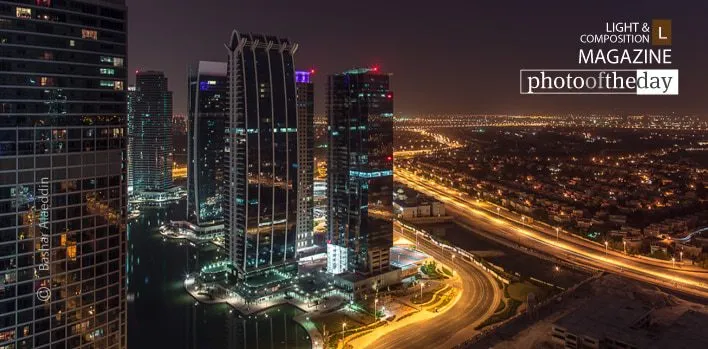
Exposure 30sec @ f/11 | ISO 160 | Focal Length 100mm
Shariful Alam
Born and raised in Bangladesh, Shariful Alam relocated to California in 2013, where he pursues photography as a dedicated passion. Though he approaches the craft as a hobbyist rather than a professional, he has refined his technical understanding through foundational coursework. Alam finds his primary inspiration in the emotional depth of portraiture and the vibrant landscapes of both urban and rural environments, consistently seeking to capture the fleeting beauty of the world around him.
Resonance Score Breakdown
Transparency Note: The resonance score (12.9/20) is calculated based on social engagement metrics collected before the award announcement.
Expert Photography Reviews · 8
The Architecture of Silence
We build upward to escape the earth, stacking glass and steel as if height could grant us a clearer view of the infinite. In the desert, the night is a heavy curtain.
Read the reflection →The Pulse of the Dark
I walked home late last night, long after the shops had pulled their shutters down. The city felt different in the dark. Usually, I am rushing from one place to another, eyes fixed on the pavement, counting the minutes until I reach my front door.
Read the reflection →Reviews & Comments
Share your thoughts about this award-winning photograph. Your reviews contribute to the community engagement score.
The city breathes. It’s a heavy, electric exhale. On the left, the towers crowd the frame, dense and demanding. Then, the right. A vast, dark void. It’s quiet there. I find myself leaning into that blackness, wanting to disappear into the stillness. Nothing here is accidental. The empty corner is not empty. It’s the weight of the pause. It’s where the light finally stops fighting. I’ve never felt Dubai this calm. It’s a rare, necessary silence.
Of the thousands of cityscapes I’ve reviewed, most are just postcards. This one survives because of the tension between the suffocating density of the left-hand towers and the vast, glittering void on the right. It’s a cold, precise study of urban ambition. I’ll admit, looking at those sharp, clinical lights makes me feel a strange, lonely shiver. It’s not just a technical exercise; it’s a document of a city that’s still trying to find its soul.
Before the eye identifies the architecture, a strange, synthetic stillness settles in the chest. The lights of Jumeirah Lake Towers don’t just glow; they hum against the retina, triggering a phantom pulse of urban isolation. I’ve returned to this frame three times today, and each time, the cold precision of the glass makes me feel profoundly small. It’s a beautiful, lonely frequency. It doesn’t just capture a city; it maps the quiet ache of being awake.
The frame’s architecture relies on a precarious equilibrium. The dense, vertical massing of the Jumeirah towers anchors the left, while the sprawling, luminous horizon pulls the eye toward the right. It’s a calculated tension. The 100mm compression flattens the depth, forcing the city into a rigid, geometric grid. I’ve grown weary of such clinical urban studies, yet the structural discipline here holds. The composition doesn’t collapse under the weight of its own light. It’s precise.
At f/11, the diffraction limit begins to soften the micro-contrast, yet the 5D Mark III’s sensor captures the city’s radiant point sources with remarkable fidelity. I’m genuinely moved by how the light refracts across those glass facades; it’s a clinical, shimmering geometry. The focal plane holds the Jumeirah towers in a crisp, cold embrace that our eyes simply can’t resolve in real-time. It’s a beautiful, precise negotiation between the physics of glass and the infinite dark.
Dubai’s glass monoliths don’t just reflect light; they consume it. Alaeddin’s frame forces a confrontation between the aggressive, artificial luminescence of Jumeirah Lake Towers and the encroaching, silent void. It’s a cold, calculated geometry. I’ve stared at these jagged silhouettes until my eyes ached, feeling the crushing weight of a city that refuses to sleep. It doesn’t invite us in. Instead, the darkness here acts as a cage, holding the frantic, glittering sprawl in place.
The electric, synthetic amber of Dubai’s high-rises bleeds into the bruised, indigo velvet of the desert night, creating a chromatic tension that reminds me of Turner’s late, feverish experiments with light. It’s a dizzying, opulent collision of artificial warmth and cool, abyssal shadows; I’m genuinely breathless at how the golden luminescence clings to the glass, refusing to surrender to the encroaching dark. One finds here a symphony of pigments that simply vibrates against the retina.
The city hums, but here, it’s held in a long, thirty-second breath. He stood on that balcony while the world slowed down, waiting for the glass and steel to stop vibrating. I feel a strange, quiet ache looking at these lights; they’ve become constellations in a man-made sky. It’s not just architecture; it’s a stillness I’ve chased myself. He didn’t force the night. He simply let the darkness settle until the city finally began to listen.