Two Coats by Barry Cawston
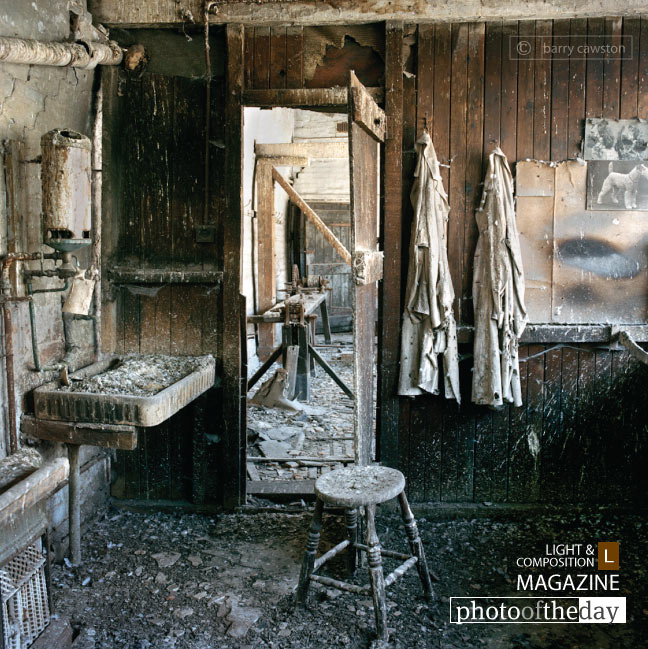
Captured within the decaying walls of the J W Evans silversmiths in Birmingham, this evocative image documents a vanishing industrial history. The photographer was drawn to the poignant juxtaposition of two abandoned coats and framed dog portraits against a backdrop of neglect. The scene is transformed into a painterly composition by the pervasive bird droppings that coat the surfaces, creating a textured, almost surreal aesthetic. This photograph is award-worthy for its ability to elevate a scene of urban decay into a profound narrative, balancing historical documentation with a striking, artistic sensibility that captures the quiet, haunting atmosphere of a site once bustling with life.
Barry Cawston
Based in Axbridge, Somerset, Barry Cawston is a distinguished freelance photographer whose work has been commissioned by prestigious outlets including English Heritage, The Guardian, and The Sunday Telegraph. Known for his large-format field photography and traditional darkroom printing techniques, he creates expansive, emotionally resonant prints that have been exhibited at major art fairs in London, Paris, and Bristol. A recipient of the South West Art Award and the Nikon Endframe Award, Cawston continues to push the boundaries of artistic photography through his solo exhibitions and his collaborative work with The Drugstore Gallery.
Resonance Score Breakdown
Transparency Note: The resonance score (7.2/20) is calculated based on social engagement metrics collected before the award announcement.
Expert Photography Reviews · 4
The Architecture of Departure
We leave behind the shells of ourselves long before we actually depart. A coat hung on a hook is a ghost of a shoulder, a hollowed-out memory of the warmth that once occupied the fabric.
Read the reflection →The Weight of Absence
The smell of damp wool always brings me back to the hallway of my childhood home, where heavy winter layers hung like ghosts against the plaster.
Read the reflection →Reviews & Comments
Share your thoughts about this award-winning photograph. Your reviews contribute to the community engagement score.
Most urban decay photography is just visual clutter, but here, the deliberate placement of those two coats against the filth creates a haunting human absence. I’ve seen thousands of derelict rooms, yet the way the bird droppings mimic a painterly texture makes me shiver—it’s genuinely unsettling. It’s not just documentation; it’s a ghost story. In thirty years, we won’t remember the factory, but we’ll still feel the weight of those empty sleeves. It’s earned its place.
It’s easy to find decay, but harder to sit with it until the dust settles into a narrative. Cawston clearly spent hours breathing in that stagnant Birmingham air, waiting for the light to graze those coats just so. I’ve spent enough time in abandoned workshops to know the smell of that neglect. It’s a grim, patient sort of beauty. He didn’t just stumble upon this; he earned the silence of that room. It’s quite haunting.
The light here isn’t searching; it’s resigned, filtering through the grime of J W Evans like a slow, dusty breath. I’ve spent enough time in abandoned places to know that silence has a weight. Looking at those two coats, I feel a sudden, sharp ache for the shoulders that once filled them. It’s a quiet haunting. Cawston didn’t just document decay; he waited until the room finally let go of its ghosts. It’s profoundly still.
The vertical alignment of the coats creates a rigid fulcrum against the chaotic, stippled texture of the wall. It’s a precarious balance. The negative space surrounding the dog portraits anchors the frame, preventing the decay from dissolving into mere mess. I’m genuinely unsettled by how the bird droppings dictate the light. It doesn’t rely on sentiment. The architecture of the frame holds the neglect in place, forcing a clinical order upon a scene of collapse.