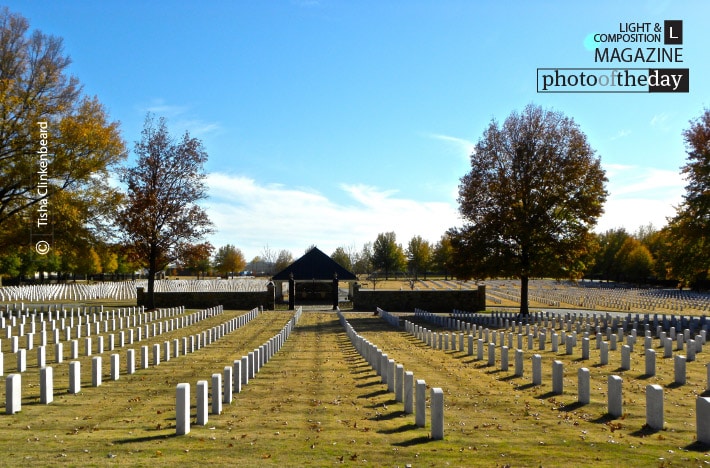
Fort Smith National Cemetery by Tisha Clinkenbeard
Captured during a visit to the Fort Smith National Cemetery, this photograph reflects the profound reverence and historical weight of the site. Tisha Clinkenbeard utilized the Nikon Coolpix P90 to frame the landscape, focusing on the serene rows of graves that serve as a final resting place for those who served the United States. The composition highlights the peaceful atmosphere and meticulous maintenance of the grounds, transforming a site of solemnity into a poignant visual tribute. The image is award-worthy for its ability to convey deep respect and quiet beauty through a balanced, thoughtful perspective of a significant national landmark.
Tisha Clinkenbeard
Based in Powderly, Texas, Tisha Clinkenbeard is a dedicated photographer whose work explores the beauty found in her travels. Her artistic journey began long before the digital era, and she now shares her discoveries through her blog, Found Round & About. Her photography has been featured in various exhibitions, including at The Fine Arts Center of Hot Springs and the Black Box Gallery in Portland, as well as in Birds & Blooms magazine. Clinkenbeard continues to document the world around her, aiming to capture and share the unique stories she encounters.
Resonance Score Breakdown
Transparency Note: The resonance score (12.7/20) is calculated based on social engagement metrics collected before the award announcement.
Expert Photography Reviews · 5
The Weight of Quiet Earth
The smell of damp earth after a long rain is a heavy thing. It clings to the back of the throat, tasting of minerals and deep, undisturbed roots. When I walk through places where the grass is kept short and the air feels thin, my shoulders instinctively drop.
Read the reflection →The Geometry of Silence
Can we ever truly measure the weight of a name once the voice that spoke it has faded into the earth?
Read the reflection →Reviews & Comments
Share your thoughts about this award-winning photograph. Your reviews contribute to the community engagement score.
Rows of white markers don’t just occupy space; they carve silence into the earth. Clinkenbeard’s frame captures a geometry of absence, where the light hits the stone with a clinical, almost cruel precision. It’s the shadows beneath these markers that haunt me. They aren’t merely dark patches; they’re the weight of the unsaid. I find myself shivering, not from the cold, but from the realization that even in death, we’re still fighting for definition.
1/150sec at f/5, 110.4mm. The P90’s small sensor struggles here. At f/5, the diffraction limit is already encroaching on the fine detail of the headstones. It’s a soft, muddy rendering of a site that demands sharp, clinical precision. I’ve walked those rows; they’re rigid and unforgiving. This gear choice doesn’t honor that geometry. It’s a blurry compromise. I find the lack of optical bite frustrating. The technical execution fails to respect the subject’s inherent order.
Before the eye identifies the rows of white markers, something in the chest tightens. It’s a rhythmic, geometric silence that forces a shallow breath. I’ve returned to this frame three times today; each visit, the repetition of stone feels heavier, like a pulse slowing down. It doesn’t just document a cemetery; it anchors a quiet, hollow ache in my own ribs. I find myself looking for a name, but the anonymity is what truly lingers.
The verdant expanse of Fort Smith breathes with the muted, melancholic greens of a Morandi still life, where the grass doesn’t merely sit beneath the sky but absorbs the light like thirsty linen. It’s a quiet, aching palette that I find deeply moving; those rows of white markers cut through the turf with the crisp, unforgiving clarity of a Vermeer highlight, grounding the soul in a silence so profound it’s as if the very air has turned to stone.
The silence here hits like a sudden cut to black. It’s a tracking shot that refuses to pan, locking the eye into the rhythmic geometry of those white markers. I’ve spent hours in edit suites, and I know this frame is the one the director keeps. It’s still, heavy, and perfectly paced. Honestly, it makes my chest tighten. Clinkenbeard didn’t just snap a landscape; she held the shutter until the history finally stopped moving.