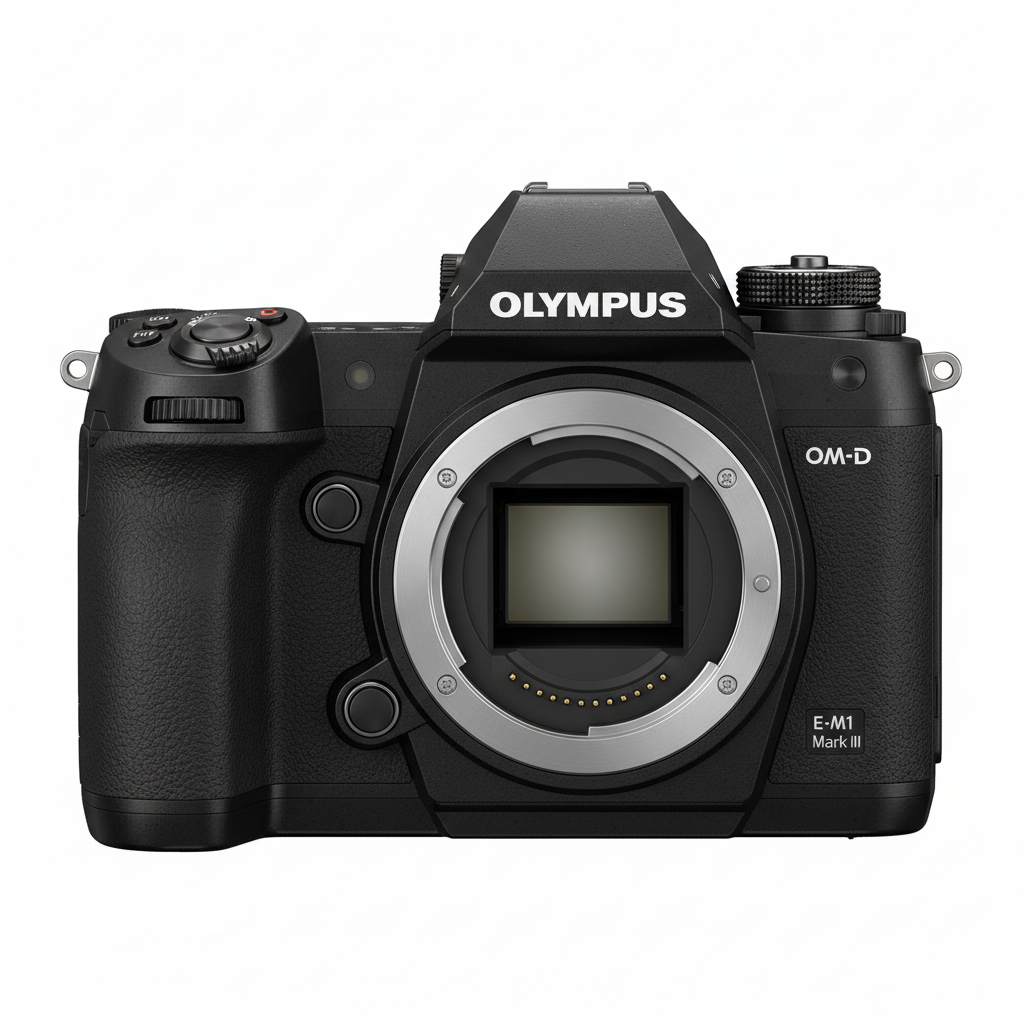
Olympus OM-D E-M1 Mark III
Professional speed and mobility in one package
Key Features
Camera Capabilities
Click the Links Below for Details
The Most Important Buttons & Dials — Olympus OM-D E-M1 Mark III
| Control / Button / Dial | Status | Note |
|---|---|---|
| Shutter-release Button | ✓ Present | |
| Mode Dial | ✓ Present | |
| +/- EV (Exposure Compensation) Button | ✓ Present | |
| Dedicated ISO Button | ✓ Present | |
| Dedicated Aperture Dial / Ring | ~ Limited | Via command dials |
| Dedicated Shutter Speed Dial | ~ Limited | Via command dials |
| AF-ON Button | ✓ Present | |
| Main Command Dial | ✓ Present | |
| Sub-Command Dial | ✓ Present | |
| Function (Fn) Buttons | ✓ Present | |
| Joystick / Multi-selector | ✓ Present | |
| AF-assist / Self-timer Lamp | ✓ Present | |
| Monitor Mode Button | ✓ Present | |
| Video Record Button | ✓ Present | |
| Drive Mode Control | ✓ Present |
How-to Use Olympus OM-D E-M1 Mark III
Welcome to the How-to section of the camera. In this Light & Composition University website, each page for a camera has a how-to section and a section for learning. Simply because the buttons and the controls of each camera is located in different places that not only varies for brands but in each model. How-to section help you operate your camera, however, if you are interested to learn photography, not only you need to know how your camera works, but also you must know what you can change and why you do that to get better photo. Click the “Learn” or scroll down.
Olympus OM-D E-M1 Mark III Exposure Indicators
| Optimal exposure | Underexposed by 1/3 EV | Overexposed by over 2 EV |
|---|---|---|
|
− . 0 . +
|
− . 0 . +
|
− . 0 . +
|||||||►
|
The key to the photography is light, and it’s the exposure indicators, where you see how much light your camera sensor sees. These indicators both in monitor and viewfinder show whether the photograph would be under or over-exposed at the current setting. The amount of under or overexposure is shown in increments of 1/3 EV.
Learn & Master Photography with Olympus OM-D E-M1 Mark III
For over a decade, we have been teaching photography following a university standard. No one does it better than us. We have a selection of courses, diplomas, graduate and post-graduate programs, as well as some of our best-selling university press publications, to guide you in the best possible way for your camera. Enroll in the fundamentals and then move to the genres you want to master.
Technical Specification
| Sensor | 20.4MP Live MOS Micro Four Thirds |
| Resolution | 5184 x 3888 |
| ISO Range | 64-25600 |
| Autofocus | 121-point Phase Detection |
| Shutter Speed | 1/8000 to 60 sec |
| Burst Rate | 60 fps |
| Video | 4K 30p |
| Stabilization | 7.5 stops IBIS |
| Viewfinder | 2.36m-dot OLED |
| LCD | 3.0-inch Vari-angle Touchscreen |
| Memory Card | Dual SD (UHS-II) |
| Connectivity | Wi-Fi, Bluetooth, USB-C, HDMI |
| Battery Life | 420 shots |
| Weight | 580g |
| Dimensions | 134.1 x 90.9 x 68.9 mm |