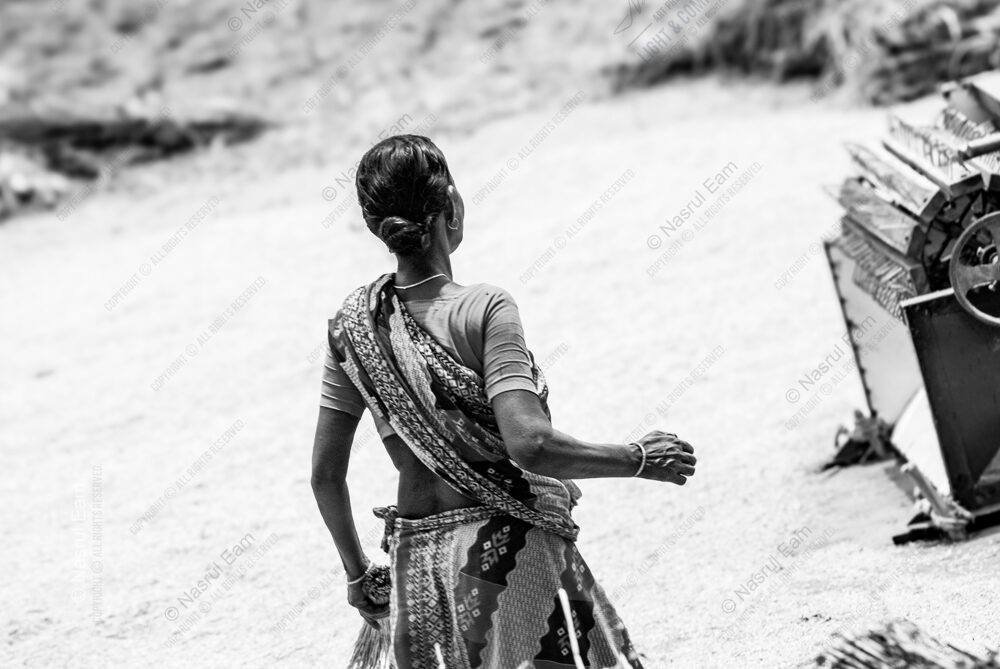
Gathering Dry Straw Before the High Mound
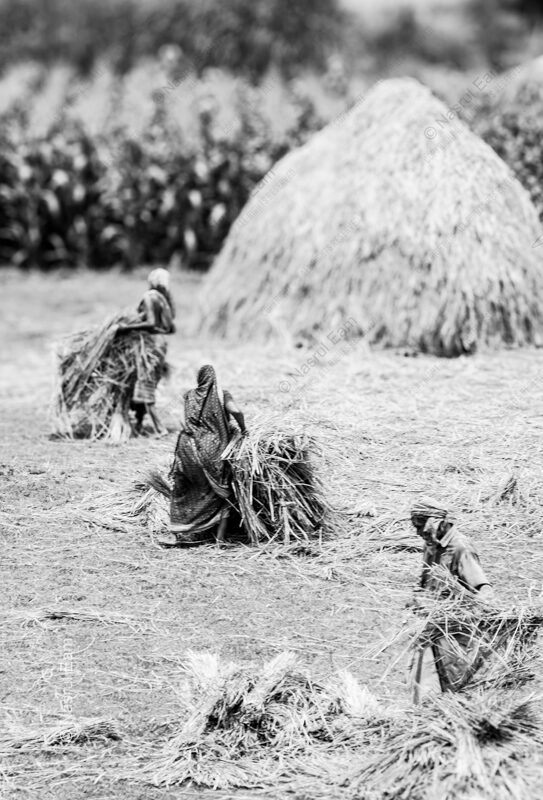
The vertical composition establishes a rhythmic spatial progression across a heavily textured agrarian terrain. In the lower right, a bent figure carries a voluminous bundle of stalks, directing the viewer’s eye diagonally upward toward a central worker clad in a patterned saree. Further back to the left, a third figure carries another load, completing a dynamic triangular choreography across the landscape. The right upper quadrant is anchored by a towering conical haystack, whose organic form balances the open, dust-strewn field below. Softly rendered vegetation in the distant background creates an enclosing horizontal boundary.
Brilliant daylight illuminates the scene with crisp clarity, catching the coarse strands of cut straw and highlighting their complex fibrous textures against the dark, sun-baked earth. The monochromatic scale spans from bright highlights on the sunlit haystack to dense, velvety tones folded within the worker’s patterned garment. Selective depth of field ensures that foreground straw details appear sharply tactile, while the foliage behind dissolves into a soft, shimmering bokeh. This contrast between crisp line and painterly diffusion elevates the everyday labor into a graphic study of material texture and light.
Captured by fine art photographer Nasrul Eam during May 2008, this scene unfolds within the rich agricultural landscapes stretching between Manikganj and Rajbari in Bangladesh. Traveling through these fertile floodplain regions, Eam observed the timeless agrarian rhythms that define life along the river basin. Rather than documenting simple labor, his lens records the organic relationship between human endeavor and the land, framing a quiet moment of communal effort during the seasonal harvest.
Through this composition, Eam explores his ongoing philosophical inquiry into human connectivity and environmental harmony. The figures, defined not by distinct portraiture but by gesture and physical engagement with the crops, embody a collective relationship rooted in long-standing tradition. By rendering the image in rich black and white, Eam strips away temporal distractions, transforming a fleeting moment of field work into a poetic reflection on human sustenance. The interplay between human form and natural harvest speaks to an elemental bond with the earth.
Impeccably suited for museum exhibition or premier private collections, this artwork stands as a quintessential exemplar of contemporary fine art documentary photography. Its sophisticated spatial geometry and masterly tonal range ensure an enduring visual presence. Rendered on archival fine art paper, the print offers museum-grade longevity and exquisite tactile detail, making it a cornerstone acquisition for discerning collectors of fine monochrome photography.
About the Photographer
Nasrul Eam is a visionary art and documentary photographer whose work has deeply influenced the photography world since 2008. With over 60 publications to his name, including notable works like “The Quintessence of Photography: Understanding Composition” and “Masterclass in Portrait Photography: Echoes of Emotion”, he explores the intricacies of human emotion and visual storytelling. As the chief judge for Light & Composition University’s prestigious photography award for the past 14 years, Nasrul’s discerning eye and expertise have shaped the future of countless photographers. His role as Dean of the Department of Art and Photography further reflects his dedication to nurturing new talent. Nasrul’s photography, particularly through projects like “The Happy Children of the Third World,” captures the essence of his subjects with profound depth, inspiring collectors and photographers alike. His evocative images transcend time, culture, and genre, and have become highly sought after in the art world for their emotional depth and unique storytelling, making them a valuable addition to any high-end collection. His work continues to inspire and elevate the art of photography globally, solidifying his reputation as one of the foremost photographers of his generation.