Two Figures Beside the Water’s Edge
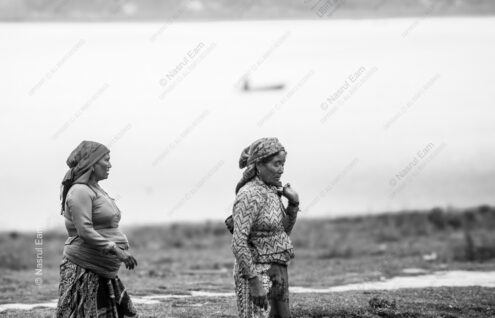
This striking black and white photograph presents a compelling study of two women in profile, positioned against a vast, softly rendered expanse of water and sky. The composition is anchored by the figures, whose distinct postures and attire create a subtle spatial tension. The woman on the left, with a more robust build, walks with a determined stride, her gaze directed forward. Her counterpart on the right stands with a more introspective air, her hand near her face, suggesting a moment of reflection or weariness. The framing emphasizes their isolation within the expansive landscape, with the horizon line creating a clear division between the terrestrial and the aquatic. The foreground is textured with rough ground, providing a grounding contrast to the ethereal backdrop, and the negative space of the water and sky amplifies the sense of quietude and contemplation.
The lighting in the image is diffuse and atmospheric, characteristic of overcast conditions or early morning/late evening light. This soft illumination minimizes harsh shadows, allowing for a rich spectrum of tonal gradations, from the luminous highlights on the water’s surface to the deep, velvety blacks in the women’s clothing and hair coverings. The black and white rendering accentuates the textures of their garments, the contours of their faces, and the subtle variations in the landscape. The overall tonality contributes to the timeless quality of the image, aligning perfectly with the collection’s emphasis on form, shadow, and emotional depth. The photographic technique employed, likely a moderate aperture to ensure sharpness on the subjects while softening the background, enhances the visual narrative and draws the viewer’s attention to the human element.
Captured by Nasrul Eam in May 2009, this image transports us to the serene yet evocative setting of Pokhara. The broad, tranquil body of water suggests the presence of Phewa Lake or a similar expansive reservoir, a signature feature of the Pokhara Valley. The women, likely locals going about their daily lives, are rendered with a profound respect for their environment and their personal journeys. The photograph serves as a window into a specific time and place, hinting at the rhythms of life in this picturesque Nepalese region, where nature and human existence are inextricably linked.
Nasrul Eam’s artistic vision, as evidenced in this work, consistently delves into the human condition, exploring themes of emotion, dignity, and the quiet narratives that unfold in everyday life. His mastery of composition and light allows him to imbue his subjects with a palpable sense of presence and inner life. This photograph resonates with a deep emotional quality, inviting viewers to ponder the stories held within these women’s expressions and postures. It speaks to the universal experience of navigating one’s path, whether through physical landscapes or the internal terrain of thought and feeling, demonstrating Eam’s profound ability to capture moments of quiet significance.
This limited-edition archival print represents a significant acquisition for any discerning collector. Its timeless aesthetic, masterful execution, and evocative subject matter ensure its enduring appeal and value. The print’s archival quality guarantees its longevity, making it a museum-grade piece that will continue to enrich collections for generations. The photograph’s ability to transcend cultural boundaries and speak to universal human experiences solidifies its status as a cornerstone artwork, offering both aesthetic pleasure and profound contemplative depth.
About the Photographer
Nasrul Eam is a visionary art and documentary photographer whose work has deeply influenced the photography world since 2008. With over 60 publications to his name, including notable works like “The Quintessence of Photography: Understanding Composition” and “Masterclass in Portrait Photography: Echoes of Emotion”, he explores the intricacies of human emotion and visual storytelling. As the chief judge for Light & Composition University’s prestigious photography award for the past 14 years, Nasrul’s discerning eye and expertise have shaped the future of countless photographers. His role as Dean of the Department of Art and Photography further reflects his dedication to nurturing new talent. Nasrul’s photography, particularly through projects like “The Happy Children of the Third World,” captures the essence of his subjects with profound depth, inspiring collectors and photographers alike. His evocative images transcend time, culture, and genre, and have become highly sought after in the art world for their emotional depth and unique storytelling, making them a valuable addition to any high-end collection. His work continues to inspire and elevate the art of photography globally, solidifying his reputation as one of the foremost photographers of his generation.