Expedition Overview
Paris has been photographed more than any other city on earth — which means the standard images are not just available but over-reproduced to the point of invisibility, and the interesting photography now happens in the arrondissements between the monuments. The Canal Saint-Martin's cast-iron footbridges and plane-tree banks are at their most optically clear at 6am before the first café opens; the covered passages of the 2nd and 9th arrondissements receive a quality of glass-vaulted afternoon light that has no equivalent in the city's open streets; and Belleville's Rue de Ménilmontant climbs through a quarter where the immigrant markets run from dawn and the signage has not been curated for tourism.
Kirsten Bruning approaches Paris without the elevated Arc de Triomphe viewpoint and the Eiffel Tower framing that constitute most of the city's photographic export. The expedition works at street level in the arrondissements the guidebooks treat as transition zones — reading the specific quality of Paris light not as a backdrop for monuments but as the defining characteristic of street life in a city where the relationship between stone, water, and sky changes every hour.
Expedition Itinerary
Day 1: Canal Saint-Martin — The City Before It Wakes
The Canal Saint-Martin runs 4.5km between the Bastille basin and the Villette, lined with 19th-century cast-iron footbridges and flanked by plane trees that produce dappled shade from mid-morning. Pre-dawn positioning at the Rue Grange-aux-Belles bridge catches the canal surface as a mirror — the bridge arches reflected in still water before the first barge movement disturbs it. By 7am the light has entered the canal corridor from the east: warm, directional, lasting until 9am before it levels and the surface goes flat. The covered passages (Galerie Vivienne, Passage Brady) are best photographed in the early afternoon when the glass vaults are fully lit from above.
The Goal of the Day: Urban canal photography in pre-dawn mirror conditions; glass-vaulted passage light and the covered-market interior.
Day 2: Le Marais & Belleville — Two Centuries in One Day
The Marais is Paris's best-preserved 17th-century residential quarter: the hôtels particuliers on Rue des Francs-Bourgeois pre-date Haussmann's boulevards by 200 years and their scale is intimate enough for close architectural photography at street level. From the Marais we move east to Belleville, where the hill's immigrant quarter runs street markets from 7am — the Rue de Belleville itself, the North African produce market on the connecting streets, the Vietnamese bakeries on the lower slope. The light here is open to the east and direct in the morning: a different quality from the enclosed Marais lanes entirely.
The Goal of the Day: Pre-Haussmann urban architecture and contemporary market street documentary photography; two contrasting Paris scales in sequence.
Day 3: Seine Quays — The Bouquiniste Hour and Low-Angle Light
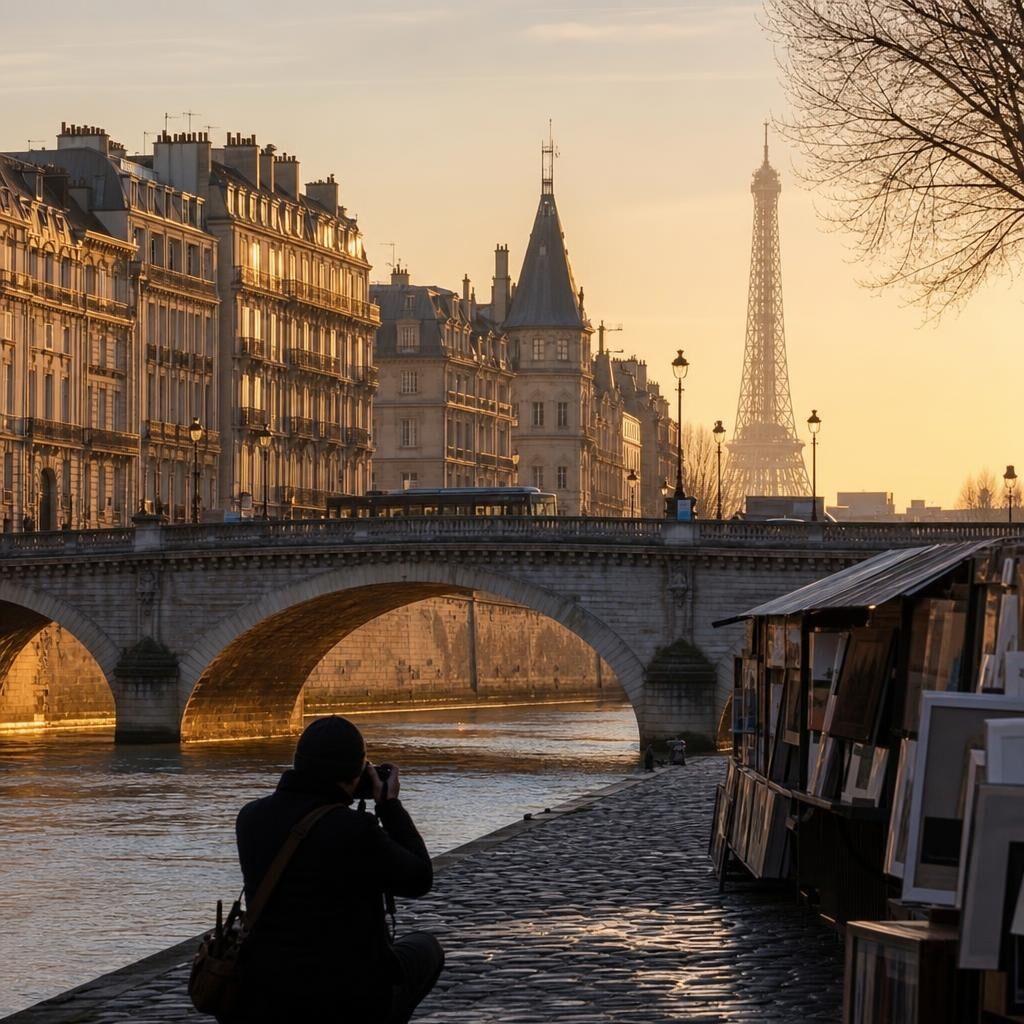
The Seine's bouquiniste stalls open at 9am but the photographic conditions are best at 7:30, when the morning light crosses the river at a low angle and hits the Île de la Cité's stone embankment directly. The Left Bank quays below Saint-Germain catch the reflection off the water from below — the buildings glow from the underside in a quality of light available nowhere else in the city. The quays are on two levels: the upper road and the lower riverside walkway 4 metres below, and the angles from water level are different in every direction. Late afternoon: Saint-Germain itself, where the light narrows between the buildings after 4pm and the café terraces are backlit from the west.
The Goal of the Day: River quay photography in low-angle reflected morning light; café terrace and boulevard photography in backlit late afternoon.
Book Your Expedition
Note: Final price may vary based on specific expedition details and customizations.
Expedition Leaders
Kirsten Bruning is a distinguished L&C Faculty Expedition Leader and Art Marketing Specialist based in the vibrant city of Cologne, Germany. Since joining Light & Composition University in 2019, Kirsten has dedicated her expertise to guiding aspiring photographers and promoting the art of visual storytelling. Her photographic work is characterized by a profound appreciation for the subtle beauty found in nature and a unique ability to capture the emotional narratives embedded within everyday moments. Her approach encourages participants to look beyond the obvious, fostering a deeper connection with their surroundings and their craft.
Kirsten's journey into photography began at an early age, sparked by her father's introduction to the timeless art of analogue photography. This foundational experience instilled in her a meticulous eye and a deep respect for the photographic process, influences that are evident in her diverse range of specialties. She masterfully navigates various genres, including Street, Architecture, Portrait, Landscape, Nature, Long Exposure, Travel, and Documentary photography. Whether she's exploring urban environments or serene natural landscapes, Kirsten consistently seeks to uncover and highlight the often-overlooked details that tell a compelling story.
As an experienced Expedition Leader, Kirsten leads immersive photographic journeys across a rich tapestry of European locations, including Germany, Belgium, the Netherlands, Luxembourg, and France. Her expeditions are more than just photo walks; they are carefully curated experiences designed to inspire creativity, enhance technical skills, and provide participants with unforgettable cultural and visual encounters. Through her warm guidance and extensive knowledge, Kirsten empowers photographers of all levels to refine their vision and capture the world with authenticity and artistic flair, embodying the spirit of discovery and artistic expression.
Travel Information
Local Logistics
Utilize Paris's efficient Metro system for inter-district travel, purchasing a multi-day pass for convenience. Plan walking routes within each district, as many photographic opportunities are best discovered on foot. Ensure your camera batteries are fully charged and carry spare power banks, as long days of shooting will deplete them quickly.
Health and Safety
Wear comfortable, supportive walking shoes, as you will cover significant distances daily across various terrains. Stay hydrated by carrying a water bottle and be mindful of your personal belongings, especially in crowded tourist areas and on public transport. In case of emergency, the general European emergency number is 112.
Cultural Guidelines for Photographers
Always be respectful of local residents and their privacy; it is polite to ask permission before taking close-up photos of individuals. When photographing inside public buildings or museums like parts of the Louvre, be aware of "no flash" policies and designated photography zones. Avoid obstructing pathways or views for others, especially at popular scenic spots along the Seine Riverbanks or within Luxembourg Gardens.
What to Bring
Photography EquipmentCamera body and spare batteryLenses for Street, Portrait, Architecture photographyMemory cards and portable hard driveTripod for long exposure shotsCamera bag with weather protectionClothingComfortable walking shoesLayered clothing for variable weatherCompact rain jacketPersonal ItemsValid ID or passportTravel insurance documentsCash and payment cards