Expedition Overview
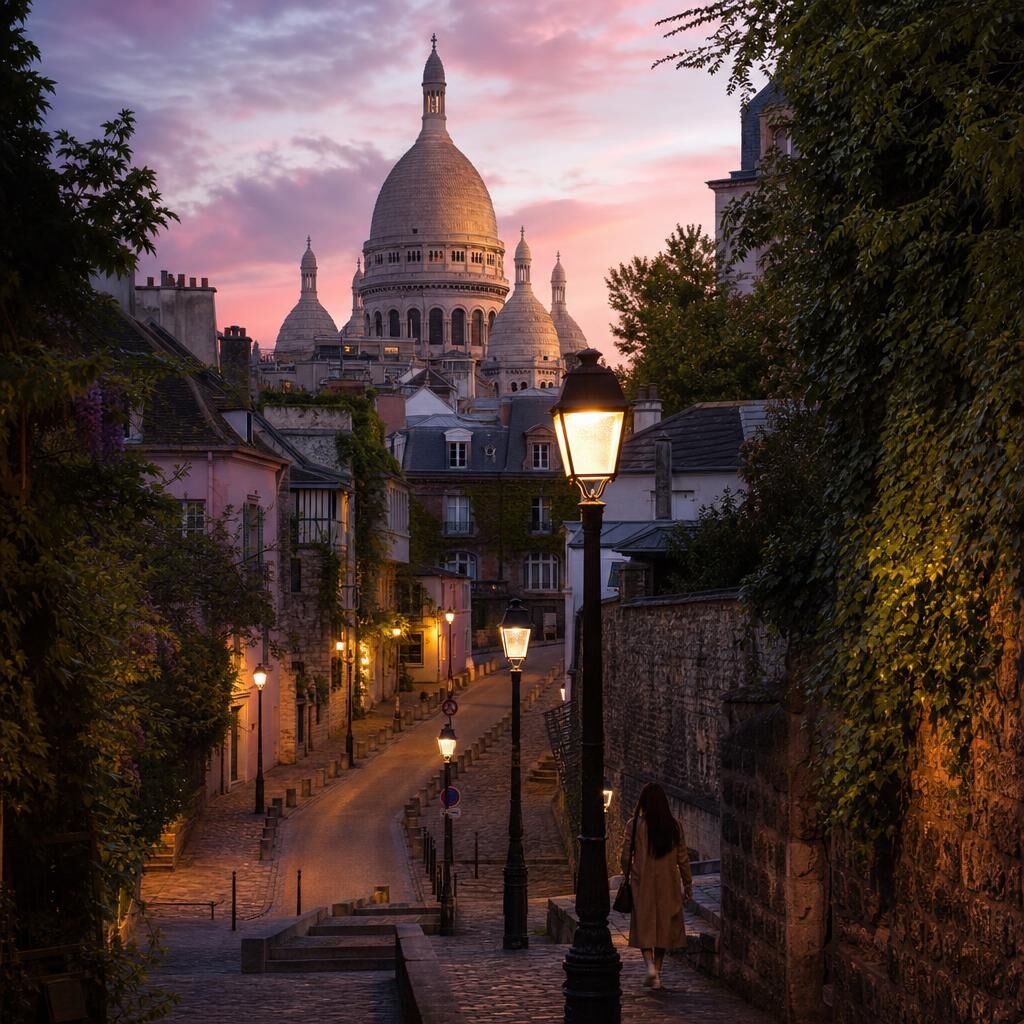
Montmartre is a hill — physically a steep limestone butte rising 130 metres above the Paris basin — and its photographic character follows directly from that geological fact. Light enters the staircase streets from specific angles at specific hours; views of the city appear and disappear between rooflines as you climb or descend; and the streets at the summit run at different orientations from the streets below, producing light conditions unavailable on the flat city. Rue Lepic's market operates from 7am and the vendors — the same families for generations — have their backs to the Paris skyline and their faces toward the hill: portraits that are specifically Montmartre in a way that no elevated city viewpoint can produce.
Kirsten Bruning approaches Montmartre without the instinct to photograph from the Sacré-Cœur steps with the city as backdrop — the single position that generates the majority of the butte's photographic output. The expedition reads the hill as a working neighbourhood first and a viewpoint second: the morning market, the stairway light, the small lanes that have not been walked with a camera as the primary object.
Expedition Itinerary
Day 1: Rue Lepic Market — The Hill's Working Morning
The Rue Lepic market begins at 7am with the vegetable and fish vendors' arrival and is at full capacity by 8:30am — the 90-minute window before the tourist buses reach the Sacré-Cœur summit. The street runs downhill to the northwest, meaning the morning light enters from behind the photographer and illuminates the stallholders' faces directly: an ideal portrait condition sustained for the full market hour. From the market we work the connecting lanes — Rue des Abbesses, the small place at the top of the steps, the staircase streets where the light falls in bars across cobblestones at angles that flat Paris cannot produce.
The Goal of the Day: Market street portraiture in directional morning light; documentary photography of a working Parisian hill neighbourhood before tourist occupation.
Day 2: Sacré-Cœur Summit — Paris as a Horizon
Pre-dawn arrival at the Sacré-Cœur terrace positions us before the light has reached the basilica — the white travertine still in shadow while Paris 130 metres below begins to emerge from the dark. The city extends 20km to the south and east; on clear mornings the first light catches the glass towers of La Défense and the Eiffel Tower's steel simultaneously while the closer streets are still grey. Place du Tertre, directly behind the basilica, is empty before 9am — the portrait artists and tourist caricaturists set up between 9:30 and 10; we work the space in the 45 minutes before their arrival changes its character entirely.
The Goal of the Day: City panorama photography from elevation at dawn; empty public space in the window before tourist occupation changes its photographic character.
Book Your Expedition
Note: Final price may vary based on specific expedition details and customizations.
Expedition Leaders
Kirsten Bruning is a distinguished L&C Faculty Expedition Leader and Art Marketing Specialist based in the vibrant city of Cologne, Germany. Since joining Light & Composition University in 2019, Kirsten has dedicated her expertise to guiding aspiring photographers and promoting the art of visual storytelling. Her photographic work is characterized by a profound appreciation for the subtle beauty found in nature and a unique ability to capture the emotional narratives embedded within everyday moments. Her approach encourages participants to look beyond the obvious, fostering a deeper connection with their surroundings and their craft.
Kirsten's journey into photography began at an early age, sparked by her father's introduction to the timeless art of analogue photography. This foundational experience instilled in her a meticulous eye and a deep respect for the photographic process, influences that are evident in her diverse range of specialties. She masterfully navigates various genres, including Street, Architecture, Portrait, Landscape, Nature, Long Exposure, Travel, and Documentary photography. Whether she's exploring urban environments or serene natural landscapes, Kirsten consistently seeks to uncover and highlight the often-overlooked details that tell a compelling story.
As an experienced Expedition Leader, Kirsten leads immersive photographic journeys across a rich tapestry of European locations, including Germany, Belgium, the Netherlands, Luxembourg, and France. Her expeditions are more than just photo walks; they are carefully curated experiences designed to inspire creativity, enhance technical skills, and provide participants with unforgettable cultural and visual encounters. Through her warm guidance and extensive knowledge, Kirsten empowers photographers of all levels to refine their vision and capture the world with authenticity and artistic flair, embodying the spirit of discovery and artistic expression.
Travel Information
Local Logistics
Montmartre is best explored on foot, but consider using the Funicular for an easy ascent to Sacré-Cœur to conserve energy. The Metro provides convenient access to the base of the hill, with stations like Anvers or Abbesses serving as ideal starting points for your exploration. Plan your photography sessions for early mornings or late afternoons to capture softer light and minimize crowds, especially at popular spots like Place du Tertre.
Health and Safety
Be vigilant against pickpockets, particularly in crowded areas around Sacré-Cœur and Place du Tertre; always keep your valuables secure and out of sight. Wear comfortable walking shoes and dress in layers, as the hilly terrain requires extensive walking and weather conditions can change quickly. Staying hydrated is important throughout your expedition, and in an emergency, dial 112 for European emergency services.
Cultural Guidelines for Photographers
When photographing artists at Place du Tertre, always ask for their permission first, and it is courteous to offer a small gratuity if you take a portrait. Inside Sacré-Cœur Basilica, photography is generally prohibited; please respect these rules to maintain the sacred and contemplative atmosphere. Be discreet and mindful when photographing residential streets like Rue Lepic, avoiding disruption to daily life and respecting the privacy of residents.
What to Bring
Here's a packing list tailored for a 2-day easy photography expedition to Montmartre, focusing on street and portrait photography in a Western European context.---Montmartre Photography Expedition Packing List (2-Day)1. Photography Equipment- Camera Body: One primary mirrorless or DSLR camera body.- Lenses (Choose 1-2 for versatility and specific focus):- Versatile Zoom: e.g., 24-70mm f/2.8 or 24-105mm f/4 (great for street and environmental portraits).- Fast Prime for Street/Portrait: e.g., 35mm f/1.4 or f/1.8 (classic street, environmental portrait) OR 50mm f/1.4 or f/1.8 (excellent for portraits, good for street).- Portrait Prime (Optional): e.g., 85mm f/1.4 or f/1.8 (if dedicated to tight portraits with beautiful bokeh).- Spare Batteries: At least 2-3 fully charged batteries (Montmartre involves lots of walking and photo ops).- Memory Cards: 2-3 high-capacity SD cards (or CFexpress/XQD depending on camera), formatted and ready.- Camera Bag: Comfortable and secure camera backpack or messenger bag (with rain cover). Choose one that doesn't scream "expensive camera inside."- Lens Cleaning Kit: Lens pen, microfiber cloth, small blower brush